The Enchanted Horse Arabian Myth Meaning & Symbolism
A tale of a magical mechanical horse that carries a prince to a distant kingdom, testing his courage, wisdom, and heart in a journey of wonder and destiny.
The Tale of The Enchanted Horse Arabian
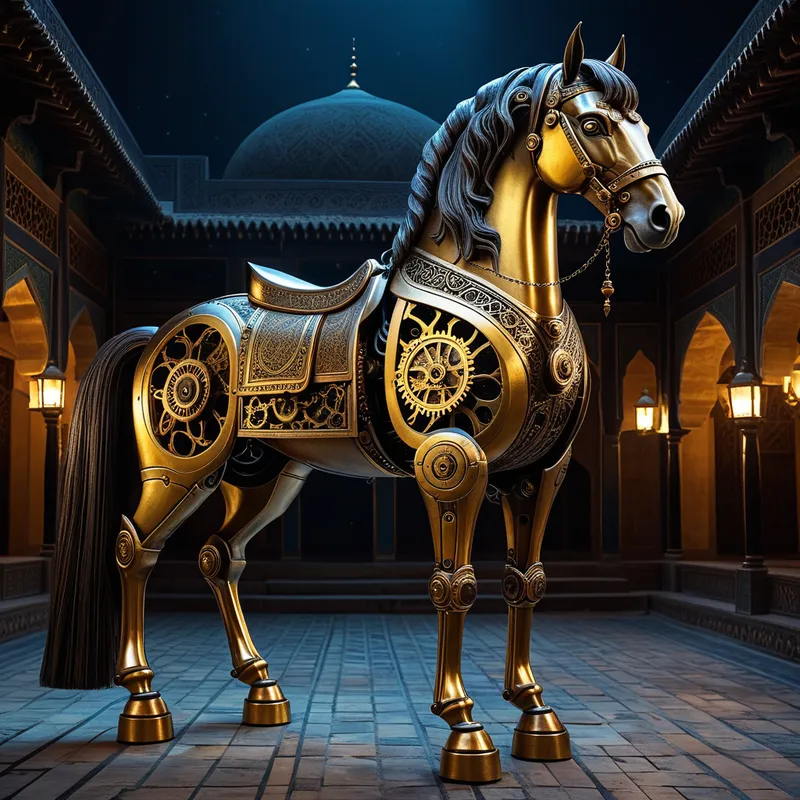
Listen, and let the sands of time part. In the court of a great Shah, where the air was thick with the scent of rosewater and ambition, a day of marvels arrived. A sage from a distant land, his eyes holding the glint of far-off stars, presented a wonder that stole the breath from every onlooker. It was a horse. But no ordinary steed of flesh and blood. This was a creature of polished ebony and ivory, inlaid with jewels that caught the fire of a thousand lamps. It was a statue, yet it lived. It was a machine, yet it possessed a spirit. A single, cunningly concealed peg behind its ear was the secret to its flight.
The Shah’s son, Prince Kamar al-Akmar, whose heart was as restless as the desert wind, looked upon the enchanted horse and saw not a curiosity, but a destiny. While the court debated its value in gold and land, the prince’s soul heard a different call—the silent song of the horizon. With a boldness born of youthful fire, he mounted the creature. His fingers found the peg. He turned it.
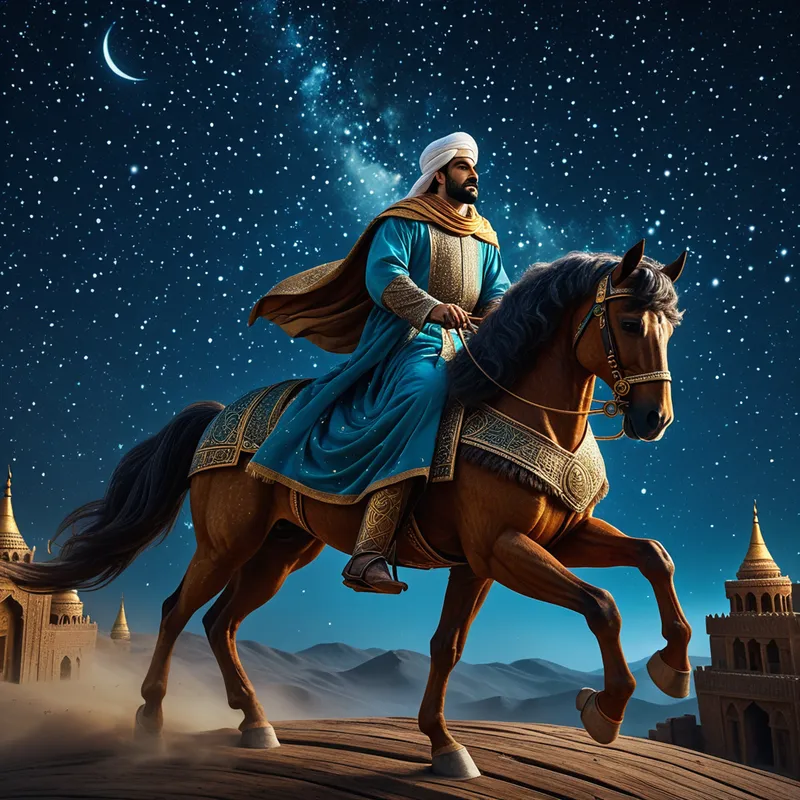
The world fell away. The palace gardens, the murmuring fountains, the shocked faces of the court—all dissolved into a rushing blur. The horse ascended, not with the beat of wings, but with a silent, impossible grace, piercing the veil of the night sky. Stars became his companions; the moon, a guiding lantern. He was a speck between heaven and earth, a rider on the back of a dream, carried by a will not entirely his own. Fear was swallowed by awe, and awe by a profound, exhilarating loneliness. He was utterly free, and utterly lost.
The descent came as dawn painted the world in hues of rose and amber. He found himself in a garden of such splendor it seemed a piece of paradise misplaced. Marble pavilions stood beside pools of liquid silver, and the air was heavy with the perfume of night-blooming jasmine. And there, sleeping on a bed of silken cushions, was a princess of such beauty that the sun itself seemed to pause in reverence. Her name was Shams al-Nahar, and in her silent, sleeping form, Kamar al-Akmar’s journey of exploration became a journey of the heart. He woke her not with a touch, but with a poem whispered on the morning breeze, a declaration from a traveler who had crossed the sky to find her.
But paradise is guarded. The discovery, the furious king, the threat of execution—the adventure turned perilous. The enchanted horse, his only means of return, stood idle. His escape was not a mere flight; it was a rescue, a daring snatching of fate itself. With the princess clinging to him, he once more turned the peg, and the mechanical heart of the horse thrummed to life. They ascended, two souls bound by wonder and terror, leaving a kingdom in uproar far below. The return was triumphant, yet incomplete. For the sage, the creator of the wonder, sought his due, and through trickery and dark magic, stole the princess away, casting Kamar al-Akmar into a despair deeper than any sky he had crossed.
The final journey was not one of discovery, but of reclamation. It was a quest through the mundane world, fueled by grief and forged by love, to track the shadow of the sage to a distant, fortified city. Here, the prince had no magical horse. He had only his wits, his courage, and the burning memory of a love won in a celestial garden. Disguised as a healer, he penetrated the heart of the enemy’s stronghold, not with force, but with cunning. He found his princess, not sleeping, but imprisoned in a waking nightmare. Their final escape was a silent, desperate sprint back to the world of the possible, back to the waiting, inert form of the enchanted horse. One last turn of the peg, and the miracle repeated itself, this time carrying them home for good—not as boy and prize, but as man and woman, rulers of their own destiny, the wonder now a vessel for their shared life, its magic integrated into the tapestry of their reign.
Cultural Origins & Context
This tale, often known as “[The Ebony Horse](/myths/the-ebony-horse “Myth from Arabian culture.”/),” is one of the lesser-told yet profoundly resonant stories from the vast ocean of the One Thousand and One Nights. Unlike the more widely known cycles of Sinbad or Aladdin, this story carries a distinct flavor of Persianate wonder, likely entering the Arabic corpus through cultural exchange along the Silk Road. It is a story of the court, reflecting the Abbasid era’s fascination with science, mechanics (‘ilm al-hiyal), and the wondrous automata reported by travelers from Byzantium and beyond. The enchanted horse is a literary cousin to the flying carpet and the brass horseman of other tales, embodying the human desire to transcend earthly limits through ingenuity.
Told in the intimate, suspenseful context of Scheherazade’s nightly narrations, the story served multiple functions. It was pure entertainment, a “wonder-tale” designed to captivate a king and stay an execution. On a deeper level, it was a mirror for the aristocracy, exploring themes of royal curiosity versus responsibility, the value of wisdom over mere wealth, and the proper use of power and wonder. The sage is not a benevolent murshid but a possessive trickster, warning that knowledge without ethics is a danger. The story passed from teller to listener in coffee houses and royal chambers, a shared dream of technological marvel and romantic destiny that stretched from Baghdad to Cairo, its details shifting like desert sands but its core architecture remaining steadfast.
Symbolic Architecture
The enchanted horse is the central [hieroglyph](/symbols/hieroglyph “Symbol: Ancient Egyptian writing system using pictorial symbols, representing sacred knowledge, communication with the divine, and the power of language to shape reality.”/) of the [soul](/symbols/soul “Symbol: The soul represents the essence of a person, encompassing their spirit, identity, and connection to the universe.”/). It is not a living animal but a crafted [artifact](/symbols/artifact “Symbol: An object from the past carrying historical, cultural, or personal significance, often representing legacy, memory, or hidden knowledge.”/), representing the synthesized [vehicle](/symbols/vehicle “Symbol: Vehicles in dreams often symbolize the direction in life and the control one has over their journey, reflecting personal agency and decision-making.”/) of [consciousness](/symbols/consciousness “Symbol: Consciousness represents the state of awareness and perception, encompassing thoughts, feelings, and experiences.”/)—the integrated psyche that can carry the ego beyond its known boundaries.
The mechanical horse is the body of intention made manifest, a vessel forged from the raw materials of will and curiosity, waiting for the conscious hand to activate its latent potential.
The [prince](/symbols/prince “Symbol: A prince symbolizes nobility, leadership, and aspiration, often representing potential or personal authority.”/)’s [journey](/symbols/journey “Symbol: A journey in dreams typically signifies adventure, growth, or a significant life transition.”/) is the classic monomyth. The initial, joyous [flight](/symbols/flight “Symbol: Flight symbolizes freedom, escape, and the pursuit of one’s aspirations, reflecting a desire to transcend limitations.”/) represents the [inflation](/symbols/inflation “Symbol: A dream symbol representing feelings of diminishing value, loss of control, or expansion beyond sustainable limits in one’s life or psyche.”/) of the ego—the intoxicating, often reckless first foray into the unconscious or the [realm](/symbols/realm “Symbol: The symbol of ‘Realm’ often signifies the boundaries of one’s consciousness, experiences, or emotional states, suggesting aspects of reality that are either explored or ignored.”/) of possibility. The garden and the [princess](/symbols/princess “Symbol: The symbol of a princess embodies themes of power, privilege, and feminine grace, often entailing a journey of self-discovery.”/) symbolize the [anima](/symbols/anima “Symbol: The feminine archetype within the male unconscious, representing soul, creativity, and connection to the inner world.”/), the soul-[image](/symbols/image “Symbol: An image represents perception, memories, and the visual narratives we create in our minds.”/) that the conscious mind must encounter and relate to for wholeness. Her abduction by the sage represents the [shadow](/symbols/shadow “Symbol: The ‘shadow’ embodies the unconscious, repressed aspects of the self and often represents fears or hidden emotions.”/)’s claim on this newfound [connection](/symbols/connection “Symbol: Connection symbolizes relationships, communication, and bonds among individuals.”/)—the old patterns, the possessive intellect, or unintegrated [trauma](/symbols/trauma “Symbol: A deeply distressing or disturbing experience that overwhelms the psyche, often manifesting in dreams as unresolved emotional wounds or psychological injury.”/) that threatens to steal away the hard-won [relationship](/symbols/relationship “Symbol: A representation of connections we have with others in our lives, often reflecting our emotional state.”/) with the deeper self. The final, grounded [quest](/symbols/quest “Symbol: A quest symbolizes a journey or search for purpose, fulfillment, or knowledge, often representing life’s challenges and adventures.”/) to reclaim her is the true work of individuation: patience, [strategy](/symbols/strategy “Symbol: A plan of action designed to achieve a long-term or overall aim, often involving competition, resource management, and foresight.”/), and the [application](/symbols/application “Symbol: An application symbolizes engagement, integration of knowledge, or the pursuit of goals, often representing self-improvement and personal development.”/) of conscious skill in the real world.
The Dreamer’s Resonance
When this myth stirs in the modern collective unconscious, it often manifests in dreams of miraculous vehicles—cars that fly, bicycles that ascend mountains, or elevators that travel to unknown floors. The dreamer feels the exhilaration of the initial ascent, a somatic thrill of liberation from gravity and constraint. This often correlates with a waking-life moment of breakthrough, a new idea, or the start of a relationship that feels fated.
The subsequent feeling of being lost in the vastness, or the sudden, perilous descent into an unknown but beautiful garden, signals the ego’s confrontation with the scale of the unconscious. The dream may then shift to themes of loss, theft, or being pursued by a cunning, older figure (the sage as shadow). This is the psyche’s dramatization of a feared regression, the anxiety that a new psychological gain—a creative project, a deepening love, a spiritual insight—will be co-opted by old complexes of fear, addiction, or intellectual arrogance. The somatic residue is often a feeling of frantic searching or a clenched determination upon waking.
Alchemical Translation
The myth models the full solve et coagula—dissolve and coagulate—of the psyche. The prince’s comfortable identity in his father’s court (the prima materia) is dissolved by the flight on the horse. He is stripped of status, location, and certainty, reduced to a pure experiencing entity in the void.
The garden is the albedo, the whitening: the encounter with the soul’s purity and beauty that provides direction and meaning after the dissolution of the old self.
The abduction is the nigredo, the blackening—the necessary despair, the confrontation with the shadow (the sage) that claims ownership of the soul-image. This despair is not an end, but the ferment that makes transformation possible. The prince’s disguised journey as a healer is the citrinitas, the yellowing: the application of acquired wisdom and humble service in the mundane world. He must heal others (integrate his understanding into reality) to reach his goal.
The final, triumphant return flight with the reclaimed princess is the rubedo, the reddening: the sacred marriage (coniunctio) of the conscious mind and the anima, now permanently integrated. The enchanted horse is no longer a toy for solitary exploration but the stable, reliable vehicle for a shared, conscious life. For the modern individual, this translates to the process of taking an initial spark of inspiration, enduring the inevitable crisis of doubt and shadow-work, applying disciplined skill in the real world, and ultimately creating a life structure—a relationship, a career, a creative practice—that embodies the original wonder in a durable, earthly form.
Associated Symbols
Explore related symbols from the CaleaDream lexicon:
- Horse — The primary vessel of the journey, representing the integrated psyche, personal power, and the instinctual energy harnessed by consciousness for transcendence.
- Journey — The core narrative structure of the myth, symbolizing the lifecycle of psychological development, from departure from the known through trials to a transformed return.
- Sky — The realm of the initial flight, representing limitless possibility, the domain of spirit, thought, and the often-inflating first encounter with the unconscious.
- Key — The small peg that activates the horse, symbolizing the crucial insight, decision, or small action that unlocks vast inner potential and sets destiny in motion.
- Garden — The anima realm, a walled paradise of soulful beauty and connection that represents the integrated feeling function and the discovery of deep relational value.
- Shadow — Embodied by the possessive sage, representing the unconscious complex that seeks to own, control, and sabotage the individual’s connection to their soul-image.
- Dragon — The fortified city and the guarding king, symbolizing the final, formidable obstacle of the internalized status quo or deep-seated fear that must be outwitted, not merely fought.
- Love — The force that transmutes adventure into destiny, moving the prince from a seeker of wonders to a protector and reclaimer, completing the journey from ego to Self.
- Crown — The earned sovereignty at the tale’s end, representing the integrated Self that rules the inner kingdom with wisdom, having mastered both the magical and the mundane.
- Dream — The entire narrative operates as a dream-logic parable for the soul’s journey, with the enchanted horse itself being a manifest dream of technological and spiritual aspiration.