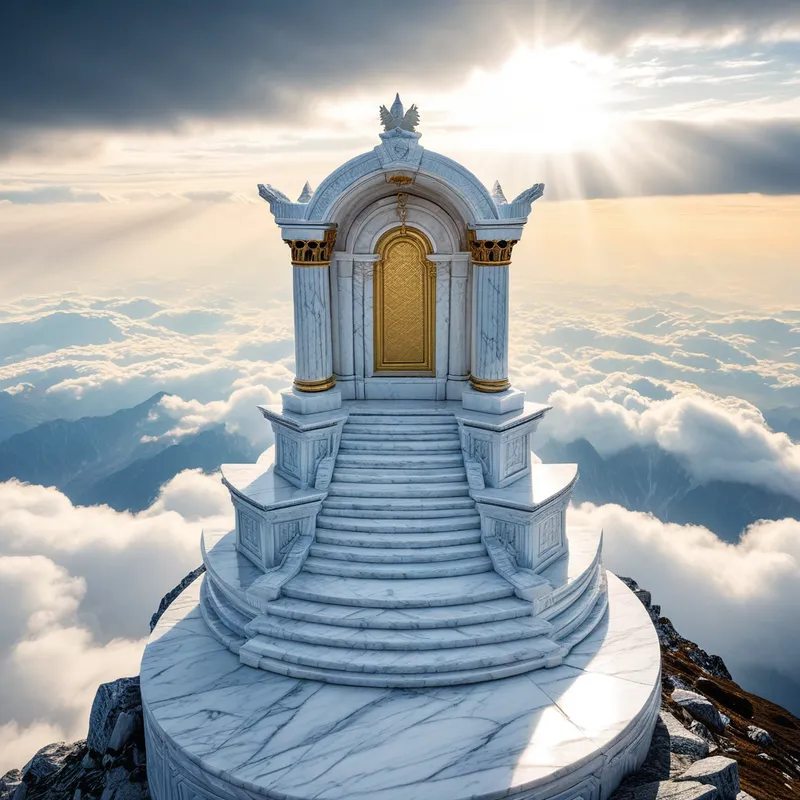
The Empty Throne of Olympus Myth Meaning & Symbolism
A prophecy foretells a vacant throne on Olympus, plunging the cosmos into chaos as gods and mortals confront the terrifying vacuum of absolute authority.
The Tale of The Empty Throne of Olympus
Hear now a tale not of triumph, but of a terrible silence. A story whispered by the Moirai at the loom of the cosmos, a thread of chilling prophecy woven into the very fabric of divine rule.
Upon the sun-drenched peak of Mount Olympus, where the air tasted of ambrosia and thunder, there stood the heart of the world: the Hall of Thrones. Here sat the Dodekatheon, bathed in a light that was neither day nor night, but the glow of eternal sovereignty. At its head was the Khrónos of Zeus, a masterpiece of polished oak and ivory, inlaid with lightning-bolt sapphires. From it, order flowed like a great river to the lands below.
But one fate-turning dawn, the river ceased. The hall was filled with the usual assembly—Hera’s gaze was sharp, Poseidon’s trident gleamed, Athena stood in thoughtful silence. Yet a coldness crept upon them, a stillness that hushed even the rustle of divine robes. All eyes were drawn to the center. The throne of Zeus was empty.
Not merely unoccupied. It was vacant. A yawning absence that seemed to swallow the light around it. The sapphires were dull, the oak looked like dead wood. The palpable authority that had anchored reality for an age was gone, vanished without a roar of thunder or a decree. A profound quiet, heavier than any sound, settled over the gods. In that silence, the first crack appeared in the firmament.
Chaos, the old enemy, stirred from its slumber at the world’s edge. Without the central will of the Ruler, the delicate tensions that held the cosmos began to fray. The seasons on earth stuttered, spring blooming in one valley while winter’s frost clung to the next. The tides, once obedient to the moon’s pull, sloshed erratically upon the shores. Mortals felt it first as a deep unease, a sense that the axis of the world had slipped. Prayers rose to Olympus, but they echoed in the hall, unanswered, falling like stones into the void before the empty seat.
Among the gods, ambition and terror warred. Who would dare to claim it? Ares saw a chance for conquest, but his hand hesitated before the sheer magnitude of the vacancy. Apollo, for all his foresight, found his oracles mute on this matter. Hestia kept her flame burning low, a small, steady point of warmth against the growing cold. The throne was not just a seat; it was the fulcrum of destiny. To sit upon it unprepared was not to rule, but to be consumed by the void it now represented.
The cosmos hung in balance, in the terrible, pregnant pause between one order and the next. The Empty Throne waited, a question carved in ivory and gold, and all of creation held its breath for an answer.
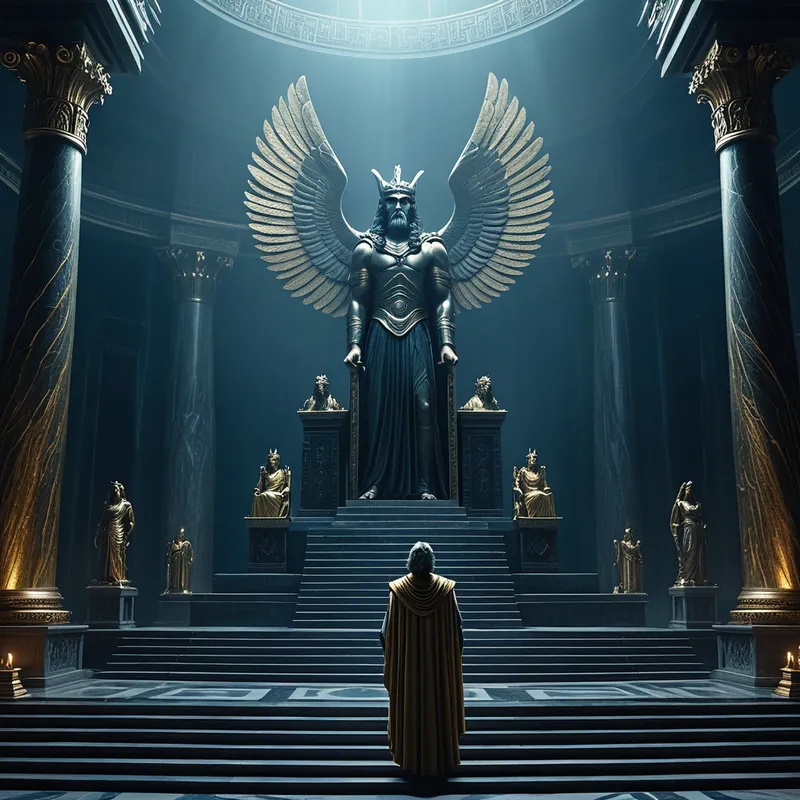
Cultural Origins & Context
The motif of the Empty Throne, while not the centerpiece of a single surviving epic, is a powerful undercurrent in Greek religious and philosophical thought. It emerges from the deep-seated anxiety about cosmic and political order (kosmos) versus chaos (khaos). In the Theogony, the succession of divine rulers—Ouranos to Kronos to Zeus—establishes a pattern of violent overthrow. The stability of Zeus’s reign was not a given; it was a hard-won peace that required eternal vigilance.
This myth likely circulated in philosophical circles, in tragedies, and in the secret rites of mystery cults. It served as a theological thought experiment: what if the principle of order itself was absent? It functioned as a warning to the Greek polis (city-state) about the perils of a leadership vacuum—stasis (civil strife) was their greatest political fear. The story asked the society to contemplate the foundations of its own authority, both divine and human, and to recognize that power is not merely a possession, but a function that, if left unfilled, invites the primal void to return.
Symbolic Architecture
The Empty Throne is the ultimate symbol of the vacated center. It represents the abdication, failure, or transformation of the ruling principle that organizes a psyche, a society, or a cosmos.
The throne is not empty because it lacks a king; the king is absent because the throne has revealed its true nature: a vessel for a function, not a person.
Psychologically, it corresponds to the collapse of the dominant conscious attitude—the ego’s ruling complex that gives life its structure and direction. This could be a career identity, a political ideology, a religious faith, or a patriarchal authority figure. The “emptiness” is not peaceful; it is an active, terrifying vacuum that threatens to pull all subsidiary structures (the other “gods” or inner complexes) into disarray and conflict. The Khaos that stirs is the undifferentiated unconscious, rising up when the directing consciousness is gone.
The Dreamer’s Resonance
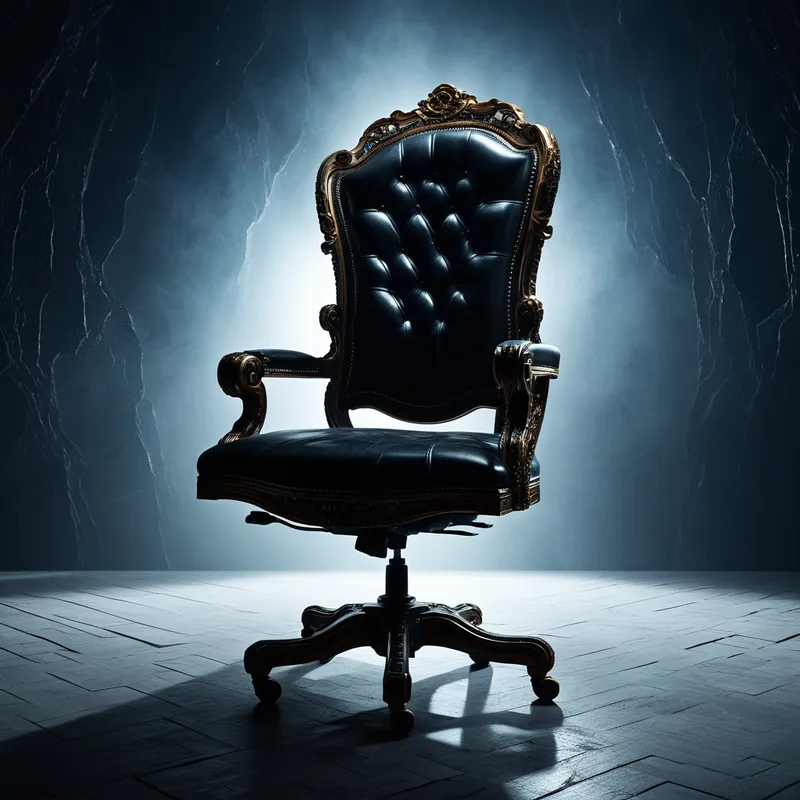
When this myth patterns a modern dream, the dreamer is in a profound state of psychic transition. They may dream of an empty CEO’s chair, a vacant pulpit, a missing parent at the head of the table, or a derelict control room.
Somnatically, this often accompanies feelings of groundlessness, vertigo, or a chilling quiet at the core of one’s being. Psychologically, it marks the de-integration of the ruling archetype—often the Ruler or the Senex (the Old Wise King). The dreamer is experiencing the “cosmic chaos” within: old values feel hollow, life structures seem arbitrary, and a terrifying but potent freedom emerges. The dream is not about finding a new king to idolize, but about enduring the liminal void where the old rule has ended and the new has not yet taken form.
Alchemical Translation
The alchemical process mirrored here is solutio—the dissolution of the reigning form into the prima materia, the chaotic first matter. The throne, the symbol of fixed and crystallized power, must be emptied for transformation to occur.
The individuation journey requires the ego to stand before its own empty throne—to relinquish its claim to absolute sovereignty and acknowledge the larger, Self-ordained order of the psyche.
The modern individual’s “triumph” is not in seizing the throne, but in holding the tension of its emptiness. This is the incubation period where one must resist the urge to hastily install a new, untested identity (the false king) or to flee into chaos. One must converse with the disarrayed “gods”—the inner talents, drives, and complexes now vying for influence. Through this council, a new, more conscious ordering principle can slowly coalesce from within, not as a tyrannical Zeus, but as an integrative, symbolic center—the Self. The throne may be filled again, but the ruler will have been irrevocably changed by the knowledge of the void that underpins all authority. The emptiness becomes the source of its legitimacy, a reminder that true power serves a function greater than itself.
Associated Symbols
Explore related symbols from the CaleaDream lexicon: