The Eleusinian Mysteries of an Myth Meaning & Symbolism
A universal myth of descent and return, where the loss of the sacred initiates a soul's journey through the underworld to achieve a transformative reunion.
The Tale of The Eleusinian Mysteries of an
Hear now the tale that is whispered not in one tongue, but in the silent language of the turning earth and the grieving heart. It begins in the realm of an, where the world was sustained by her presence. The air was thick with the scent of ripe grain, and light fell from her hands like warm honey, nourishing all things. Her daughter, the spirit of the tender shoot and the blossoming flower, danced through fields of endless summer, her laughter the sound of spring rain.
But the cosmos turns on a axis of necessity. From the deep places, from the realm of silent stone and final rest, came a rumbling. Not a god of evil, but a sovereign of a different order—the Lord of the Rooted Realms. He witnessed the daughter’s radiant joy, a light so profound it illuminated even the edges of his dominion. In an act that was neither theft nor cruelty, but a profound and terrible necessity of balance, the earth cracked open. A chariot of obsidian and smoke rose, and in a moment that stretched into an eternity, the daughter was gathered into the depths. The fissure sealed, leaving only a stunned silence and a single, fallen narcissus blossom turning to dust.
The light of the world dimmed. an felt the severing in her very soul. Casting off her radiance like a discarded veil, she wrapped herself in a cloak of mortal sorrow. For nine days and nine nights, she wandered the now-gray world, a stranger in a land she once sustained. No nectar touched her lips, no comfort found her. She asked the sun, who had seen all; she questioned the silent moon. None could guide her. Her grief was a plough that tore up the fields, and where her tears fell, the soil salted itself. Life itself began to wither, holding its breath.
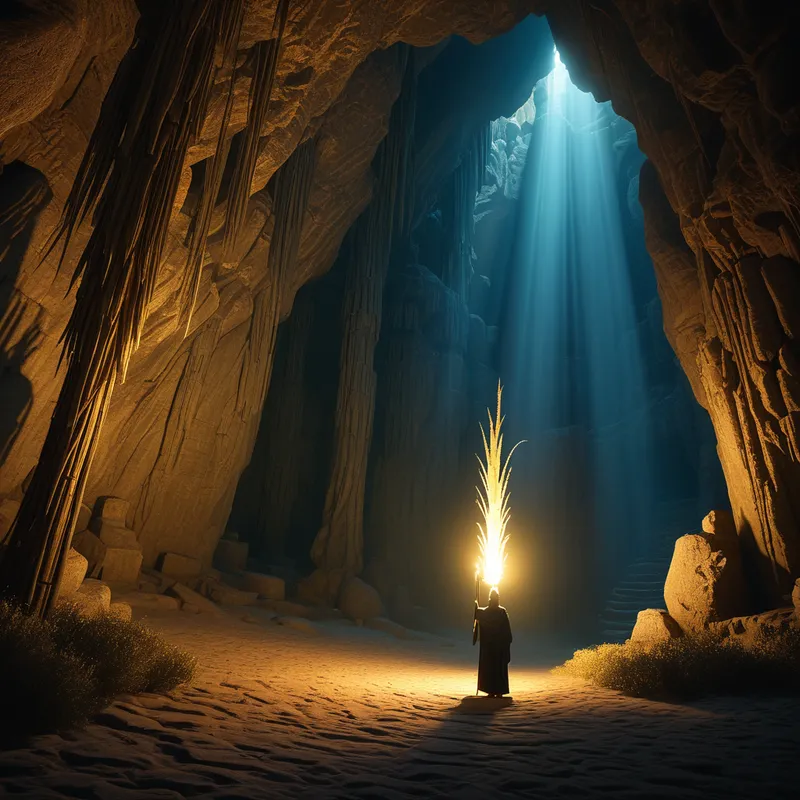
Driven by a love that defies all realms, an came to the very threshold of life—a great, yawning cavern that breathed cold air, the gateway to the Rooted Realms. Without hesitation, she stepped into the darkness. The path wound down through galleries of forgetting, across rivers of sighing shades. Here, the glory of the grain meant nothing. Here, only essence remained. After a journey that stripped her of every title, she stood in the throne room of shadows, before the Lord of the Depths. She was no longer the bountiful goddess, but a mother, raw and elemental.
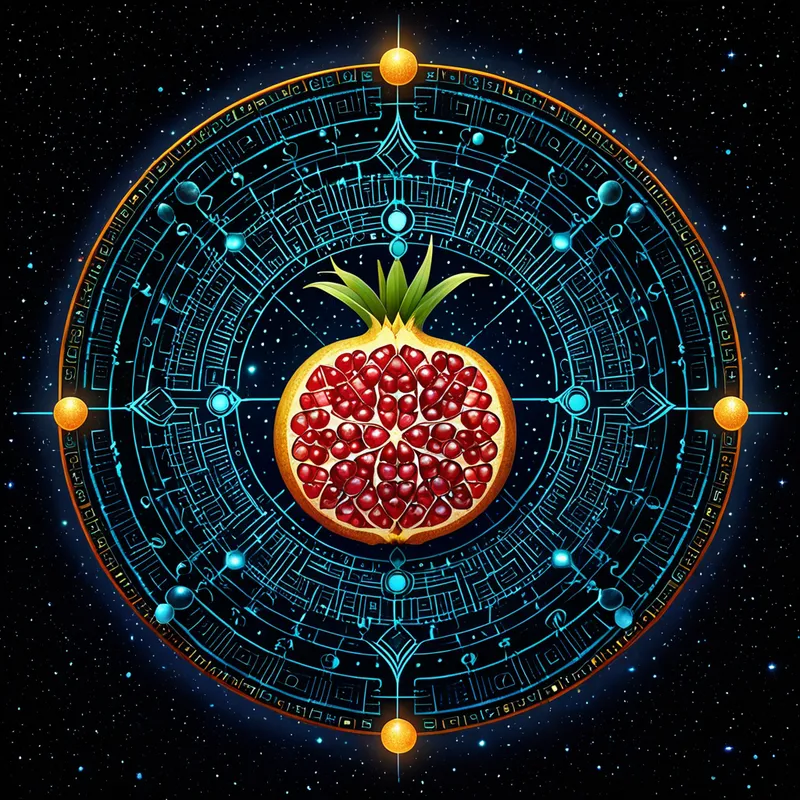
She beheld her daughter, not a prisoner in chains, but a queen seated beside a sovereign, her light now a subdued, profound glow that illuminated the beauty of the deep—the glitter of crystals, the slow flow of subterranean waters, the peace of final rest. A reunion, bittersweet and flooded with tears, ensued. Yet, ascent was not simple. The Lord of the Depths offered a single, fateful pomegranate seed. In accepting it, the daughter bound herself to the cycle of depths and heights, to the law of return. A covenant was struck: for part of the turning year, she would reign below, and for part, she would walk above.
And so, an returned to the world, not as she left it, but transformed. Her joy was no longer naive, but earned, deep as the roots of an ancient oak. Where she walked, life erupted not in careless abundance, but in a conscious, celebratory riot. She established the Mysteries at a place of power—Eleusis. There, in torch-lit secrecy, she taught a truth not with words, but with direct experience: that the descent into the deepest loss is not an end, but the necessary passage for a more holy, more complete return. The seed must fall into the dark earth to split its husk and rise again. This is the mystery whispered by the grain, sung by the seasons, and written in the silent script of the human soul.
Cultural Origins & Context
The myth of The Eleusinian Mysteries of an transcends any single historical culture, residing instead in the "Global/Universal" stratum of human experience. It is the ur-narrative of agrarian and existential consciousness, emerging independently wherever humans observed the annual death and rebirth of vegetation and correlated it with the mysteries of their own existence: loss, grief, and the hope of renewal. While its most famous codification is in the Greek myth of Demeter and Persephone, its pattern is etched in the cycles of Inanna's descent in Sumer, the journey of Izanami in Japan, and the hibernation myths of countless oral traditions.
It was passed down not merely as a story, but as a dromenon—a "thing done." In its ideal form, it was the core of initiatory rites, like those at historical Eleusis. These were not public festivals but secret, personal inductions into a direct encounter with the sacred. The tellers were hierophants—"those who show the sacred." Their function was societal and psychological: to provide a container for the universal human experiences of profound loss and the search for meaning, thereby preventing individual despair from unraveling the communal fabric. The myth and its rites acted as a cultural immune system, transforming the poison of meaningless suffering into the medicine of sacred understanding.
Symbolic Architecture
At its heart, this myth maps the psyche's journey through a necessary fragmentation. an represents the conscious, nurturing, daylight aspect of the Self—the ego's world of order, growth, and relationship. Her daughter symbolizes the youthful, innocent, and attached libido—that which is cherished and feels inseparable from the light.
The abduction is not a catastrophe, but a summons from the soul. The cherished value must be taken into the underworld of the unconscious to be transformed.
The Lord of the Rooted Realms is the archetypal Shadow and the spirit of depth. He is not evil, but the holder of all that is repressed, forgotten, and potential. His realm is the unconscious itself. an's descent is the ego's courageous, grief-driven plunge into its own depths, where its former identities and certainties are stripped away. The pomegranate seed is the symbol of irreversible psychological change—a commitment to the cyclical nature of life. Once tasted, one can never again live in permanent, untroubled light; one must accept the rhythm of engagement with the depths.
The final establishment of the Mysteries represents the creation of a new, resilient psychic structure—a transcendent function—that can hold the tension of opposites: joy and sorrow, life and death, above and below.
The Dreamer's Resonance
When this myth stirs in modern dreams, it signals a profound initiation underway in the dreamer's psyche. One may dream of a cherished home collapsing, a luminous child wandering into a forest and not returning, or finding oneself in a vast, institutional basement (the modern underworld) searching for something vital that has been "filed away."
Somatically, this can feel like a heavy depression, a "dark night of the soul," where the world loses its color and taste—a direct echo of an's fasting. Psychologically, it is the process of an old, outworn identity or a naïve complex (the "innocent daughter") being dissolved by the unconscious. The ego feels orphaned, bereft of its former nourishment and guidance. The dreamer is in the "nine nights" of wandering, where conscious effort feels futile. The psyche is forcing a necessary descent to break the ego's identification with only the light, preparing it for a more grounded, substantial, and compassionate form of consciousness.
Alchemical Translation
The alchemical opus mirrored in this myth is the nigredo. The radiant, golden state of initial unity (the mother and daughter in the field) is shattered, leading to the descent into the prima materia of the underworld. This is the indispensable first stage of individuation: the confrontation with the shadow and the death of infantile hopes.
The purpose of the journey is not to recover what was lost, but to return with what was found in the loss.
an's journey models the ego's task: to actively engage with the grief, to follow the pain into the depths without spiritual bypass, and to witness what the unconscious has claimed. The reunion in the underworld is the coniunctio—the meeting of the conscious attitude with its lost, transformed counterpart. The daughter who returns is not the same; she is now Queen of the Depths, integrating the value of darkness, rest, and interiority.
For the modern individual, this translates to the transformative power of fully experiencing a major life rupture—a career loss, the end of a relationship, a spiritual crisis—not as a failure, but as an involuntary initiation. The "Eleusis" one establishes upon return is a new, more authentic way of living that honors the full cycle. One learns to consciously withdraw (the winter of the soul) for introspection and to consciously engage (the summer of the soul) in creation. The mystery revealed is that our deepest wounds are the very fissures through which the numinous, the meaning that sustains all seasons, enters the world.
Associated Symbols
Explore related symbols from the CaleaDream lexicon: