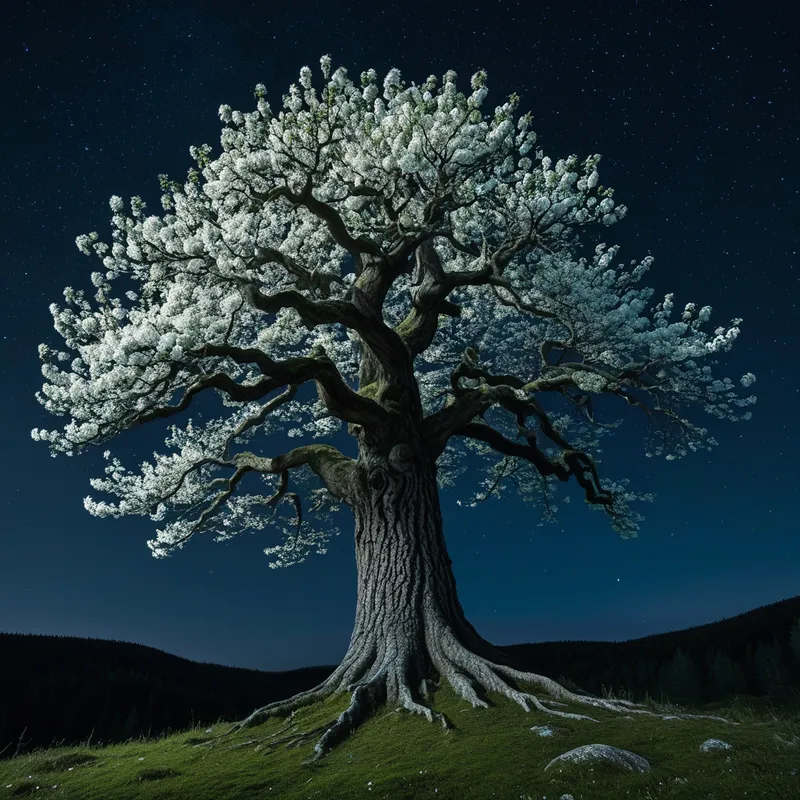
The Elder Tree / Hyldemoer Myth Meaning & Symbolism
A sacred elder tree houses the wrathful Hyldemoer. To cut its wood without permission invites her curse, a lesson in reverence for the deep feminine.
The Tale of The Elder Tree / Hyldemoer
Listen, and let the hearth-fire grow low. In the time when the boundary between root and rock, breath and breeze, was thin as a spider’s silk, there stood the Elder. Not merely a tree, but a threshold. Its leaves whispered with the voices of the recently departed, its blossoms smelled of summer milk and forgotten lanes, and its dark berries held the blood of the earth itself.
Within its heartwood dwelt the Hyldemoer. She was not a goddess of lofty halls, but a spirit of the hedge, the border, the in-between. She was the memory in the land, the keeper of small, vital things: the safe passage of a child’s fever, the blessing of a cow’s milk, the final comfort for a soul leaving its body. To her, every elder tree was a pillar of her hall, a limb of her own vast, sleeping body.
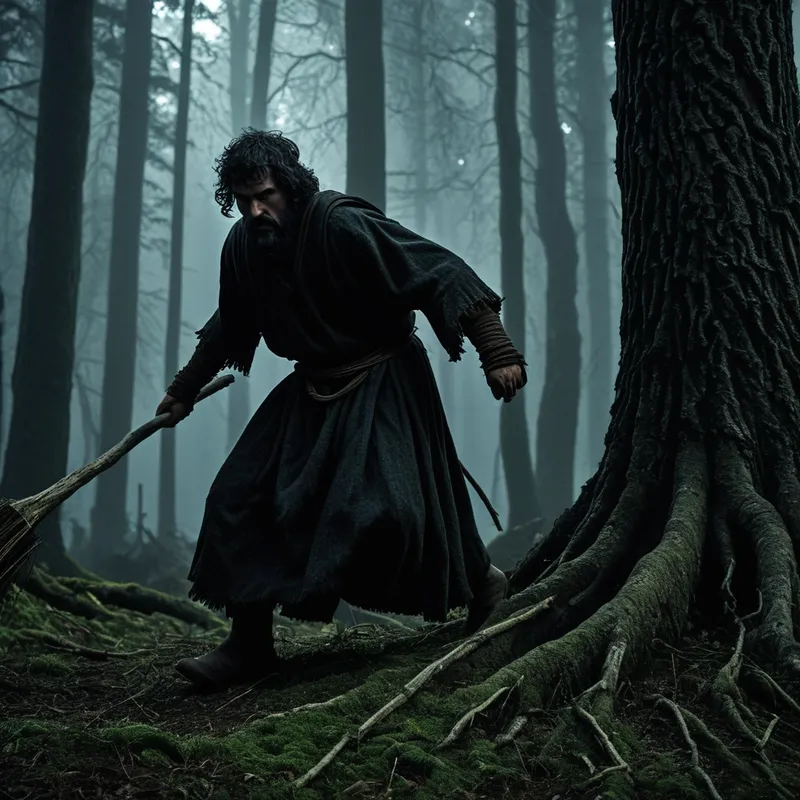
Now, there came a man—a woodcutter, or perhaps a farmer needing a cradle for his new-born. He saw the elder’s straight, pithy branches and thought them easy taking. The air grew still as he raised his axe. The birds fell silent. The very insects ceased their humming. He did not feel the gaze from within the bark, the ancient patience watching his ignorance. The blade bit into the green wood. A sigh, not of wind but of profound sorrow, moved through the clearing.
He took his lumber home, his hands smelling of the tree’s bitter sap. That night, as he worked the wood, a splinter pierced his thumb. A small thing. But by morning, the wound was angry and hot, swelling with a poison that pulsed like a second heart. Fever dreams took him. In them, a woman of bark and shadow stood at the foot of his bed, her eyes deep pools of woodland gloom. “You took from my body without asking,” her voice was the creak of a thousand branches. “Now you will know its essence.”
His family grew desperate. The local wise-woman, her face a map of old knowing, came and saw the elder-wood cradle half-made on his bench. Her breath caught. “You have offended the Elder Mother,” she whispered, a true fear in her eyes. The only cure was not a poultice, but a plea.
At dusk, they returned to the wounded tree. The wise-woman placed a bowl of fresh milk, thick with cream, at its roots. She spoke words older than the village, words of apology and respect, acknowledging the spirit within. She offered gratitude for the wood, promising its use for a sacred purpose—the cradle for new life. They waited in the deepening violet dark.
A softness returned to the air. The fever in the man broke like a wave upon a shore. The swelling receded, leaving only the memory of pain and a profound, humbling lesson etched upon his soul. The Hyldemoer had been appeased, her law upheld: nothing from the elder is taken, only received as a gift.
Cultural Origins & Context
This myth, woven from threads found across Northern Europe, belongs not to the grand epics of Odin or Thor, but to the domestic and folkloric stratum. It is a huskarl tale, a story of the hearth and the hedge, passed down by grandmothers, midwives, and farmers. In Denmark and Britain, particularly, the elder was surrounded by a dense thicket of taboo and practice. It was considered deeply unlucky to burn elder wood, to fashion household tools from it without ceremony, or to cut it without first whispering a request to the Hyldemoer.
Its societal function was profoundly pedagogical and ecological. It encoded a law of reciprocal relationship with the natural world. The elder was a pharmacy—its flowers for cordials, its bark for ointments, its berries for dyes and wines. The myth ensured this resource was not exploited but treated as a sacred covenant. The tree was a living bridge to the Álfheimr and the ancestral dead, making its misuse a spiritual transgression with immediate, physical consequences. It taught that the world is ensouled, and that survival depends on etiquette with the invisible.
Symbolic Architecture
The Elder Mother is the archetype of the Genius Loci, the spirit of a specific place. She represents the localized, immanent divine—the intelligence of an ecosystem. She is not a distant sky god but the very consciousness of the landscape.
The sacred is not only above us; it is immediately around us, sleeping in the wood, watching from the leaf. To violate its rest is to poison oneself.
The tree itself is a perfect symbol of liminality. It stands at the border of properties, between the cultivated field and the wild wood. Its flowers are used for life (medicines) and its wood associated with death (often found in graves). It is a gateway. The man who cuts it represents the emerging human consciousness that sees the world as inert matter, a resource to be extracted. His punishment—a poisoning from a mere splinter—is the symbolic backlash of the repressed psychic and natural world. The infection is the ignored spirit returning, demanding recognition.
The offering of milk is crucial. It is not a grand sacrifice but a domestic, nourishing gift, symbolizing a return to a relationship of sustenance and care. It translates the transaction from one of theft to one of exchange, restoring the broken reciprocity.
The Dreamer’s Resonance
When this myth stirs in the modern psyche, it often manifests in dreams of violation and consequent ailment. One may dream of cutting down a beloved tree in a childhood garden only to find one’s hands turning to wood. Or of moving into a new house and aggressively remodeling it, only to have the walls bleed sap and the floors sprout roots that cause a persistent, unexplained illness.
Somatically, this can mirror feelings of chronic inflammation, autoimmune responses, or mysterious fatigue that resists medical diagnosis. Psychologically, it signals that the dreamer is “cutting elder wood”—exploiting some deep, foundational part of their own psyche or life without permission. This could be ignoring intuition (the inner wise-woman), overworking a creative gift until it becomes toxic, or severing ties to family or personal history with contempt rather than conscious ceremony. The Hyldemoer’s wrath is the psyche’s immune response, a sickness meant to halt the profane action and force a ritual of apology to the Self.

Alchemical Translation
The alchemical process modeled here is one of reverentia—the foundational stage often skipped in the rush for transformation. Before the nigredo (blackening) or albedo (whitening), there must be a humble approach to the primal materia.
The modern individual seeks growth, healing, or creation—the “cradle” for a new life phase. In enthusiasm, they may hack at the raw materials of their soul: their past traumas, their innate talents, their deep emotions. They treat these as lumber to be milled for their own project. This is the woodcutter’s error. The Hyldemoer is the Self’s deep, instinctual, and ecological layer that will not be treated as inert resource.
Individuation begins not with conquest, but with petition. The first work is to approach the inner elder grove, to leave an offering of attention, and to ask: “May I work with you?”
The resulting “fever” is the necessary crisis. It is the dark night where the ego’s project falls apart, poisoned by its own arrogance. The cure is the ritual of apology—the active, symbolic act of making amends to the injured inner spirit. This is the wise-woman’s role, the mediating function of consciousness that knows the old protocols. It involves stopping, returning to the point of violation (the repressed memory, the neglected talent, the scorned relationship), and offering the “milk” of genuine respect, time, and care.
The transmutation is subtle but profound. The wood is not returned to the tree; the cradle can still be built. But it is built with blessing, and thus becomes a vessel for true life, not a monument to theft. The individual learns to live in a reciprocating psyche, where every act of taking from the inner depths is balanced by an act of devotional giving. They become, themselves, a living elder tree—a sanctuary at the border between worlds, offering shelter, healing, and a stern, loving law to all who approach.
Associated Symbols
Explore related symbols from the CaleaDream lexicon: