The Earth Myth Meaning & Symbolism
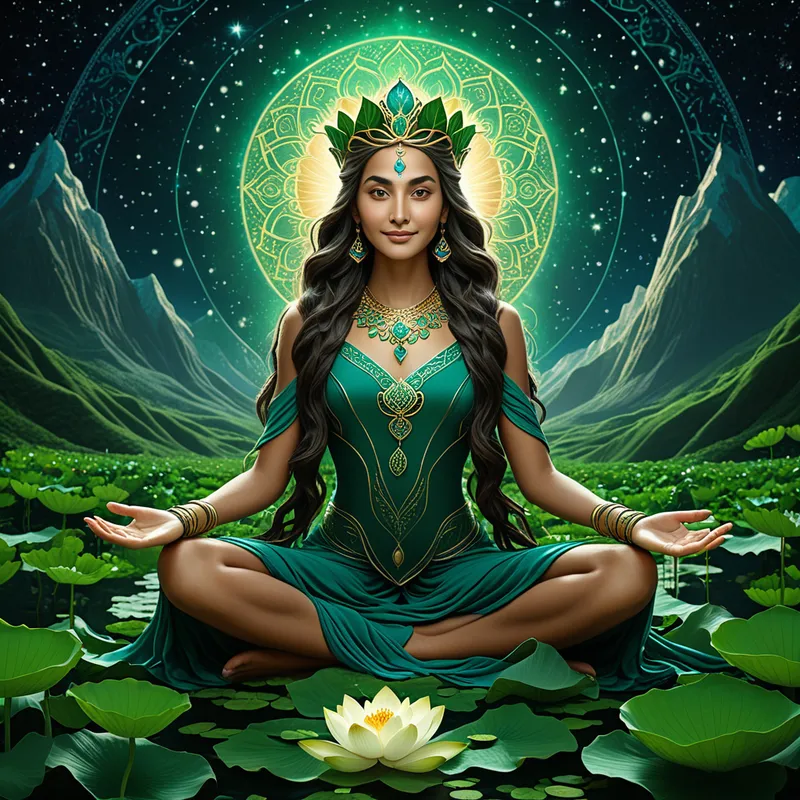
The Earth is not a passive rock, but the goddess Prithvi, who endures the weight of creation to sustain all life, embodying sacred resilience.
The Tale of The Earth
Listen. Before time was measured, there was only the One, the boundless ocean of potential, Brahman. From its desire for expression, the worlds were dreamed. But these worlds were formless, light and heavy, fire and [water](/myths/water “Myth from Chinese culture.”/), all churning without a home. They needed a foundation, a vessel to hold the burgeoning dream of life.
And so, from the essence of sustenance itself, she was born. Not as rock and soil, but as consciousness—[Prithvi](/myths/prithvi “Myth from Hindu culture.”/), the Vast One. She was stability amidst the cosmic dance, patience in the face of eternal flux. The divine architect, [Vishnu](/myths/vishnu “Myth from Hindu culture.”/), approached her. “Great Mother,” his voice was the sound of galaxies spinning, “the dream of creation is ready to manifest. But it is heavy with possibility, with the souls of all that will be. It needs a ground to stand upon, a womb to be nurtured within. Will you bear this weight?”
Prithvi did not hesitate. Her consent was the first law of nature: [the law](/myths/the-law “Myth from Biblical culture.”/) of support. She spread herself, a boundless, fertile plain, and received the seed of all worlds. Mountains rose as her bones, rivers flowed as her lifeblood, forests grew as her garment. For eons, she held it all—the devas in their celestial cities, the asuras in their subterranean realms, and the countless, unnamed creatures in between. She bore the weight of their wars, their triumphs, and their follies without complaint, her silence the bedrock of existence.
But balance is a fragile [thing](/myths/thing “Myth from Norse culture.”/). A demon of arrogance, Hiranyaksha, sought to unravel creation itself. With a power born of terrible [tapas](/myths/tapas “Myth from Hindu culture.”/) (austerities), he seized Prithvi, the very foundation of reality, and dragged her from her station. He plunged her into the depths of the primordial waters, the Garbhodaka, where chaos reigns. The worlds trembled, unmoored. Life gasped, rootless.
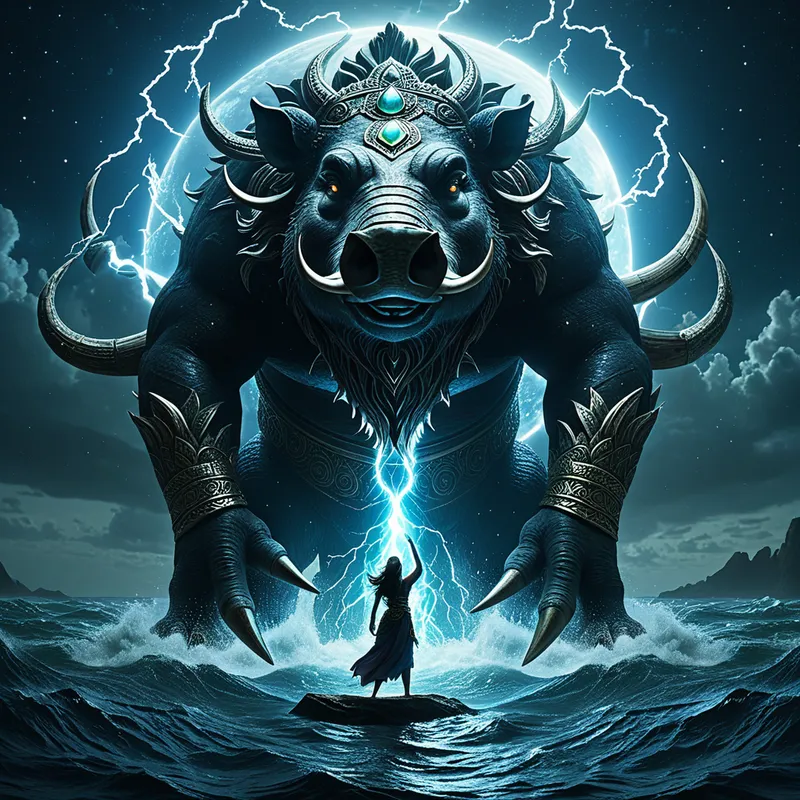
In that moment of cosmic crisis, the promise of preservation was activated. From a pore on Vishnu’s skin emerged a form of awesome, terrible beauty: the [Varaha](/myths/varaha “Myth from Hindu culture.”/), the Cosmic Boar. He was not a beast of the earth, but the earth’s own fierce protector incarnate. With a roar that shook the foundations of space, he dove into the abyssal waters. The struggle was titanic, a vortex of dark water and divine fury. Finally, [Varaha](/myths/varaha “Myth from Hindu culture.”/) found Prithvi, submerged and dimmed, clinging to her essence. Gently, with tusks that could lift universes, he raised her from the deep. He placed her back upon the waters, not as a sunken treasure, but as a crowned queen, restored to her sovereign place. He steadied her with his presence, and the axis of [the world](/myths/the-world “Myth from Tarot culture.”/) was set right once more. The Earth had been rescued, but more so, her sacred role had been reaffirmed through a divine covenant of protection and sacrifice.
Cultural Origins & Context
The myth of Prithvi is not a single story but a resonant theme woven into the very fabric of Vedic and Puranic literature. Her earliest personification appears in the Rigveda, often paired with Dyaus (Sky) in a primordial union that births all life. This duality—Earth and Sky—established a fundamental cosmological framework.
The story was kept alive not in dusty tomes alone, but in the living breath of tradition. It was recited by priests during rituals for fertility and stability, sung by farmers sowing seeds into her body, and enacted in temple sculptures and festival dramas. Societally, the myth functioned as a profound ecological and ethical charter. It encoded the understanding that the Earth is not a resource to be exploited, but a conscious, divine entity (devi) to be revered. The tale of her rescue by Varaha, particularly popular in the Vishnu Purana, served to reinforce the concept of dharma—the cosmic order that must be preserved against forces of chaos (adharma). It taught that the stability of society and [the self](/myths/the-self “Myth from Jungian culture.”/) is directly mirrored in the stability of the sacred ground beneath our feet.
Symbolic Architecture
At its core, the myth of Prithvi is a master [symbol](/symbols/symbol “Symbol: A symbol can represent an idea, concept, or belief, serving as a powerful tool for communication and understanding.”/) of the principle of containment. She represents the psychic [vessel](/symbols/vessel “Symbol: A container or structure that holds, transports, or protects something essential, representing the self, emotions, or life journey.”/), [the ego](/myths/the-ego “Myth from Jungian culture.”/)-[structure](/symbols/structure “Symbol: Structure in dreams often symbolizes stability, organization, and the framework of one’s life, reflecting how one perceives their environment and personal life.”/), necessary to hold the immense, often chaotic, contents of the unconscious (the primordial waters) and give them form.
The Earth does not create the seed, but she provides the necessary resistance for it to break open and reach toward the sky.
Prithvi is the archetypal Magna Mater, but with a crucial, often overlooked [dimension](/symbols/dimension “Symbol: Represents the fundamental structure of reality, consciousness, or existence beyond ordinary perception.”/): her endurance. She is not merely a nurturing [mother](/symbols/mother “Symbol: The symbol of ‘Mother’ represents nurturing, protection, and the foundational aspect of one’s emotional being, often associated with comfort and unconditional love.”/); she is a bearing mother. The [weight](/symbols/weight “Symbol: Weight symbolizes burdens, responsibilities, and emotional loads one carries in life.”/) she carries symbolizes the burdens of [consciousness](/symbols/consciousness “Symbol: Consciousness represents the state of awareness and perception, encompassing thoughts, feelings, and experiences.”/): [responsibility](/symbols/responsibility “Symbol: Responsibility in dreams often signifies the weight of duties and the expectations placed upon the dreamer.”/), [history](/symbols/history “Symbol: History in dreams often represents the dreamer’s past experiences, lessons learned, or unresolved issues that continue to influence their present.”/), [trauma](/symbols/trauma “Symbol: A deeply distressing or disturbing experience that overwhelms the psyche, often manifesting in dreams as unresolved emotional wounds or psychological injury.”/), and the sheer complexity of existence. The [demon](/symbols/demon “Symbol: Demons often symbolize inner fears, repressed emotions, or negative aspects of oneself that the dreamer is struggling to confront.”/) Hiranyaksha represents the [shadow](/symbols/shadow “Symbol: The ‘shadow’ embodies the unconscious, repressed aspects of the self and often represents fears or hidden emotions.”/) force of [inflation](/symbols/inflation “Symbol: A dream symbol representing feelings of diminishing value, loss of control, or expansion beyond sustainable limits in one’s life or psyche.”/)—the ego that, swollen with power (tapas), seeks to sever our [connection](/symbols/connection “Symbol: Connection symbolizes relationships, communication, and bonds among individuals.”/) to the grounding, limiting, but ultimately sustaining [reality](/symbols/reality “Symbol: Reality signifies the state of existence and perception, often reflecting one’s understanding of truth and life experiences.”/). To plunge the [Earth](/symbols/earth “Symbol: The symbol of Earth often represents grounding, stability, and the physical realm, embodying a connection to nature and the innate support it provides.”/) into the waters is to risk a psychotic [breakdown](/symbols/breakdown “Symbol: A sudden failure or collapse of a system, structure, or mental state, often signaling a need for fundamental change or repair.”/), where all structure dissolves back into the undifferentiated unconscious.
Varaha’s [rescue](/symbols/rescue “Symbol: The symbol of rescue embodies themes of salvation, support, and liberation from distressing circumstances.”/) is not an external [event](/symbols/event “Symbol: An event within dreams often signifies significant life changes, transitions, or emotional milestones.”/) but an internal function of the Self. Varaha is the instinctual, earthy, yet divine [aspect](/symbols/aspect “Symbol: A distinct feature, quality, or perspective of something, often representing a partial view of a larger whole.”/) of the [psyche](/myths/psyche “Myth from Greek culture.”/) that recognizes the value of form and [foundation](/symbols/foundation “Symbol: A foundation symbolizes the underlying support systems, values, and beliefs that shape one’s life, serving as the bedrock for growth and development.”/). He is the powerful, embodied will to preserve [the vessel](/myths/the-vessel “Myth from Alchemical culture.”/) of consciousness when it is threatened with annihilation.
The Dreamer’s Resonance
When this myth stirs in the modern dreamer, it often manifests as profound somatic and architectural imagery. You may dream of your house—the symbol of the psyche—foundation cracking, sinking into mud, or being flooded from below. You may dream of carrying a tremendous, unbearable weight on your shoulders, or of your own body turning to stone or earth.
These are not dreams of despair, but dreams of initiation into the archetype of the caregiver on a cosmic scale. The psyche is signaling that the personal “earth”—your capacity to hold, to endure, to provide a stable ground for your own life—is under duress. You may be bearing a weight of responsibility (familial, professional, karmic) that feels it will crush you, or you may feel your foundational beliefs and identity being “dragged into the deep” by a chaotic life event or a surge of unresolved emotion (the demonic force). The dream is the psyche’s way of making the burden conscious, of having you feel the sacred weight Prithvi carries eternally.

Alchemical Translation
The alchemical process modeled here is the transmutation of burden into foundation. The modern individuation journey is not about escaping weight, but about learning to bear the right weight, consciously and sacredly.
[The first stage](/myths/the-first-stage “Myth from Alchemical culture.”/) is Recognizing the Plunge: acknowledging when we are overwhelmed, when our foundational stability is compromised. The demon Hiranyaksha must be seen—perhaps as workaholism, a toxic relationship, or an inflated self-image that disconnects us from our bodily, earthly reality.
The second is the Descent of the Protector: This is the activation of an inner Varaha. It is not about fighting the chaos with more chaos, but about calling upon a fierce, grounded, protective instinct. In practice, this may look like setting a firm boundary (the tusks that lift), returning to the body through somatic practice (the dive into the waters), or fiercely committing to a simple, stabilizing routine.
The goal is not to be saved from the weight, but to become the sacred ground that can bear it.
The final translation is Becoming the Sovereign Ground. Prithvi, once rescued, is not passive. She is reinstated as queen. The alchemical work is to consciously accept our role as the vessel of our own experience. Our wounds, our history, our responsibilities—these are not just burdens; they are the very topography of our soul, the unique landscape we are meant to steward. We are asked to move from feeling crushed by our lives to foundational for our lives. In doing so, we perform the ultimate act of care—not just for ourselves, but for the entire fragile world of psyche and relationships that depends on our stability. We become, in our own small sphere, the Earth that endures.
Associated Symbols
Explore related symbols from the CaleaDream lexicon: