The Dreamtime Myth Meaning & Symbolism
The foundational epoch when ancestral beings shaped the world, establishing all life, law, and landscape in an eternal, living present.
The Tale of The Dreamtime
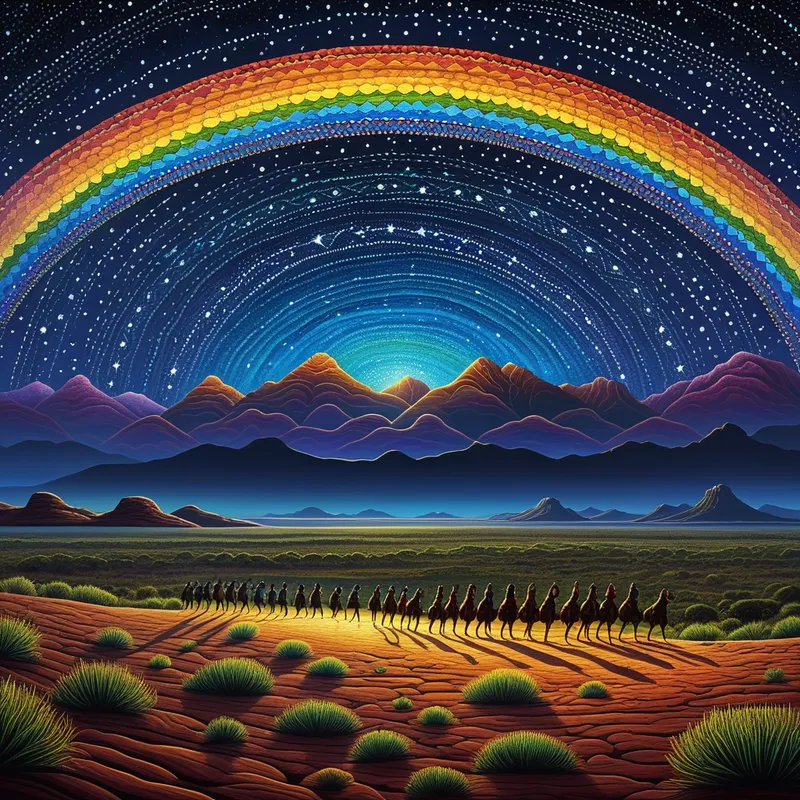
In the beginning, there was no beginning. There was only the flat, silent, and featureless. A vast plain slept under a starless sky, a world of potential, dark and deep. Then, from within [the earth](/myths/the-earth “Myth from Hindu culture.”/) itself and from beyond [the sky](/myths/the-sky “Myth from Persian culture.”/), the Ancestors stirred. They were not gods as others know them, but the first embodiments of all things: the [Rainbow Serpent](/myths/rainbow-serpent “Myth from Australian Aboriginal culture.”/), the Emu Man, the Honey Ant Women, the Kangaroo Ancestor. They awoke into [the world](/myths/the-world “Myth from Tarot culture.”/) that was also themselves.
And they began to Dream.
Their dreaming was not sleep; it was a fierce, creative waking. The Rainbow Serpent uncoiled, her massive body carving winding paths through the soft earth. Where she moved, [water](/myths/water “Myth from Chinese culture.”/) followed, filling the grooves to become mighty rivers and waterholes. She pushed up mountains with her back and left valleys in her wake. The First Men and Women walked, singing. Their songs did not describe the world—they were the world. Each note dropped from their lips became a rock, a tree, a cluster of spinifex. A melody for the honey grevillea, a rhythm for the cracking of stone under the sun.
They hunted, loved, fought, and journeyed. In their epic travels, every action was indelible. A spear thrown in anger became a ridge of jagged stone. A place where lovers met became a cluster of sweet-fruited trees. Where a great Ancestor grew weary and lay down to rest, their body softened into the contours of the land, becoming a mountain range or a coastal bay. Their essence remained, a living presence within the form.
Their work was the laying down of [The Law](/myths/the-law “Myth from Biblical culture.”/). This was not a list of rules, but the fundamental patterns of relationship: between people, between clans, between humans and animals, between all living things and the land itself. The Rainbow Serpent decreed the cycles of water and drought. The Emu Man established the seasons for ceremony. The Honey Ant Women taught the ways of finding sustenance and sharing it.
Finally, their great work complete, the Ancestors withdrew. Some sank back into the earth. Others ascended into the sky, becoming the brilliant stars of the Southern Cross or the dark spaces between them. They did not die. They returned to a state of potency, leaving behind the physical testament of their journeys—the entire Australian continent—and the vibrational blueprint of their Law, woven into the very fabric of place. The Dreamtime did not end. It merely changed state, becoming simultaneous with the present, a layer of reality just beneath the surface of things, waiting to be sung back into being.
Cultural Origins & Context
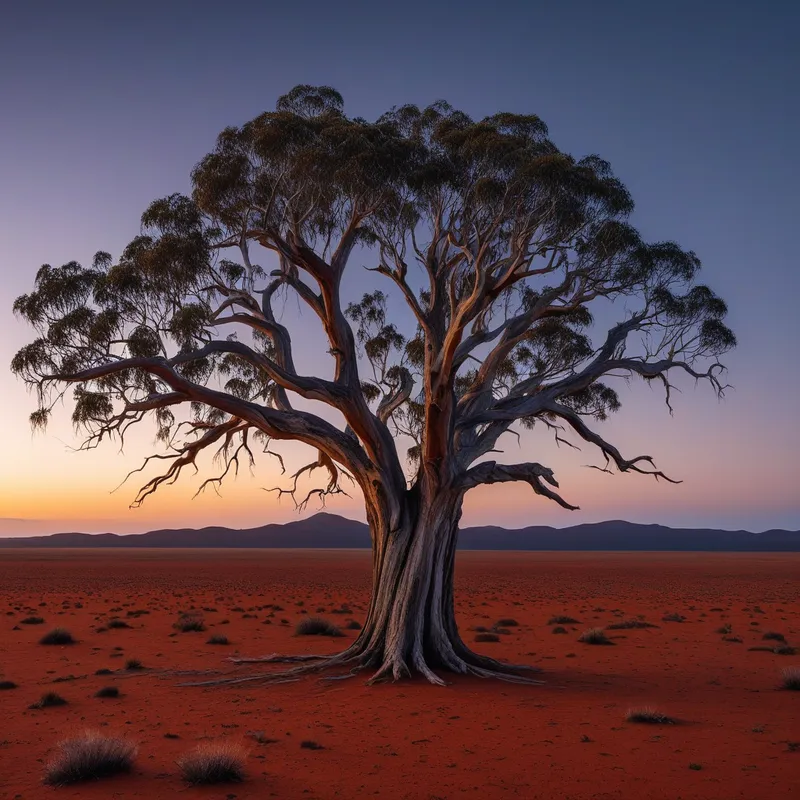
This is not a single myth, but the foundational metaphysical framework for over 250 distinct Aboriginal Australian language groups, each with their own specific Ancestors, [songlines](/myths/songlines “Myth from Aboriginal culture.”/), and stories tied to their Country. The knowledge of the Dreamtime—more accurately translated as Tjukurrpa (Pitjantjatjara) or Alcheringa (Arrernte)—is the ultimate authority, the constitution of existence.
It was and is passed down not through written texts, but through an intricate, living tapestry of oral narrative, song, ceremony, dance, and art. Elders are the custodians of this knowledge, teaching the next generation the specific songlines that map their Country, detailing the adventures of the Ancestors who formed it. This transmission is not mere history; it is a ritual act of co-creation, maintaining the world. To sing the country is to participate in the ongoing Dreamtime, to keep the Law alive, and to ensure the fertility of the land and the people. Its societal function is total: it is cosmology, law, geography, morality, and identity, inextricably fused.
Symbolic Architecture
The Dreamtime presents a radical symbolic [architecture](/symbols/architecture “Symbol: Architecture in dreams often signifies structure, stability, and the framing of personal identity or life’s journey.”/) where time is not [linear](/symbols/linear “Symbol: Represents order, predictability, and a direct, step-by-step progression. It symbolizes a clear path from cause to effect.”/) but spherical, where the past is not behind us but within the present [landscape](/symbols/landscape “Symbol: Landscapes in dreams are powerful symbols representing the dreamer’s emotional state, personal journey, and the broader context of life situations.”/).
The world is not a dead artifact of creation, but a living body of memory. Every hill is a thought, every river a sentence, in the ongoing story of being.
The Ancestors symbolize the archetypal forces of [nature](/symbols/nature “Symbol: Nature symbolizes growth, connectivity, and the primal forces of existence.”/) and [consciousness](/symbols/consciousness “Symbol: Consciousness represents the state of awareness and perception, encompassing thoughts, feelings, and experiences.”/) before they become fragmented. They are the unified state where “[human](/symbols/human “Symbol: The symbol of a human represents individuality, complexity of emotions, and social relationships.”/),” “animal,” “landscape,” and “instinct” are one. Their [differentiation](/symbols/differentiation “Symbol: The process of distinguishing or separating parts of the self, emotions, or identity from a whole, often marking a developmental or psychological milestone.”/) and journeys represent the process of the world coming into its manifold forms from a state of unity. The [Rainbow Serpent](/symbols/rainbow-serpent “Symbol: A powerful creator deity in Australian Aboriginal mythology, representing fertility, water, and the life cycle.”/), often the first [actor](/symbols/actor “Symbol: An actor represents roles, transformation, and the performance of identity in dreams.”/), embodies the primal, chaotic, and fertile [energy](/symbols/energy “Symbol: Energy symbolizes vitality, motivation, and the drive that fuels actions and ambitions.”/) of [life](/symbols/life “Symbol: The symbol of ‘Life’ represents a journey of growth, interconnectedness, and existential meaning, encompassing both the joys and challenges that define human experience.”/) itself—shaping, sometimes destructive, always creative.
The central [symbol](/symbols/symbol “Symbol: A symbol can represent an idea, concept, or belief, serving as a powerful tool for communication and understanding.”/) is the songline. It is a [path](/symbols/path “Symbol: The ‘path’ symbolizes a journey, choices, and the direction one’s life is taking, often representing individual growth and exploration.”/) across land and a [melody](/symbols/melody “Symbol: A melody symbolizes emotion, memory, and communication, often representing the subconscious expressing itself through sound.”/) through time. Psychologically, it represents the individuation [journey](/symbols/journey “Symbol: A journey in dreams typically signifies adventure, growth, or a significant life transition.”/)—the unique, pre-ordained [pattern](/symbols/pattern “Symbol: A ‘Pattern’ in dreams often signifies the underlying structure of experiences and thoughts, representing both order and the repetitiveness of life’s situations.”/) of a life. To be “on song” is to be in alignment with one’s deepest nature and [purpose](/symbols/purpose “Symbol: Purpose signifies direction, meaning, and intention in life, often reflecting personal ambitions and core values.”/), following the internalized map of the Ancestors. To lose the song is to become spiritually lost, disconnected from meaning and [source](/symbols/source “Symbol: The origin point of something, often representing beginnings, nourishment, or the fundamental cause behind phenomena.”/).
The Dreamer’s Resonance
When this myth stirs in the modern [psyche](/myths/psyche “Myth from Greek culture.”/), it often manifests in dreams of profound connection to landscape. One may dream of a specific, unknown yet deeply familiar place—a canyon, a desert, a waterhole—that feels like “home” in a primordial sense. There is a somatic feeling of the dreamer’s body matching the landscape, its contours feeling like their own bones.
Other dreams may involve hearing a potent, wordless song or a rhythmic vibration that seems to structure the dream environment, causing features to rise and fall. This is the psyche touching the Dreamtime layer, experiencing the world as sung into being. Conversely, dreams of a featureless, flat, and silent plain may reflect a state of disconnection from one’s inner songline, a loss of creative or spiritual potency. The psychological process is one of seeking orientation—not just in physical space, but in the deeper geography of the soul, longing to find the track left by one’s own inner Ancestor.
Alchemical Translation
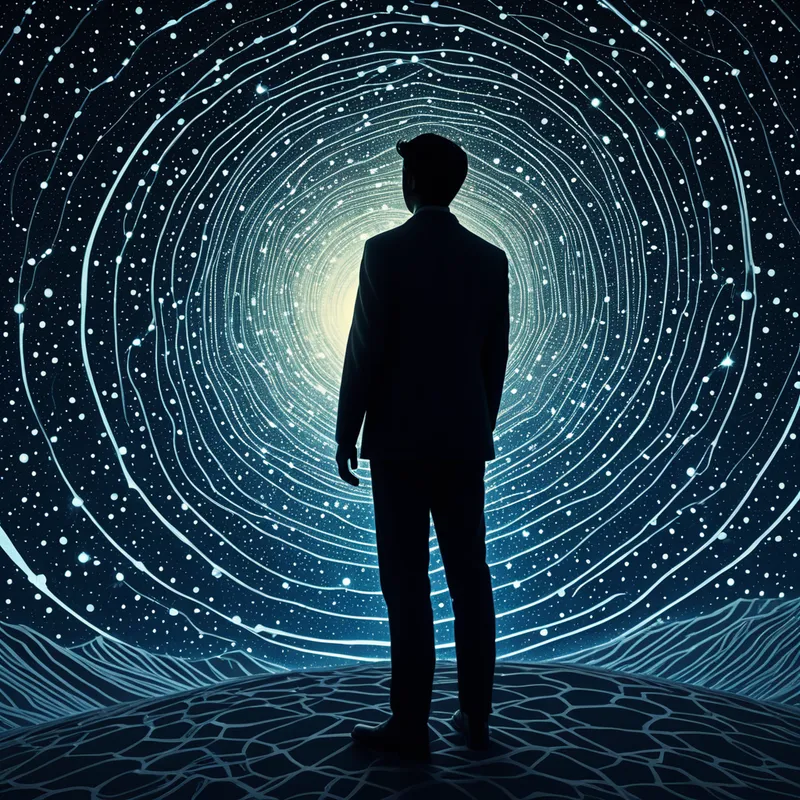
For the modern individual, the alchemy of the Dreamtime is the transmutation of a fragmented, historical life into an eternal, synchronous, and purposeful one. It models individuation as a process of remembering and re-singing.
Individuation is not about becoming someone new, but about remembering the ancient song of your own being and having the courage to sing it into the present world.
[The first stage](/myths/the-first-stage “Myth from Alchemical culture.”/) is the recognition of the “featureless plain”—the felt sense of a life not yet authentically one’s own, governed by external laws. The “stirring of the Ancestors” is the awakening of archetypal potentials from within the unconscious: the creative force, the nurturer, [the hunter](/myths/the-hunter “Myth from African culture.”/), the guide. Their “journey” is the often-messy process of living these potentials out, allowing one’s actions, choices, and experiences to shape the internal and external landscape permanently. Every true choice becomes a mountain; every endured suffering, a carved waterhole that holds depth.
The establishment of The Law translates to the development of an internal ethic, a personal constitution derived from one’s deepest nature, not from external imposition. Finally, the “withdrawal” of the Ancestors is not a loss, but their integration. They become the enduring features of the personality—the innate talents, the core values, the resilient spirit—that remain as a lasting foundation. One achieves a state where the creative epoch (Dreamtime) is not a past event, but the continuous, living present of a life in alignment. You become both [the Ancestor](/myths/the-ancestor “Myth from Global culture.”/) of your own existence and the living Country where your spirit resides.
Associated Symbols
Explore related symbols from the CaleaDream lexicon: