The Dragon's Path Myth Meaning & Symbolism
A myth of a mortal's perilous journey to master the celestial dragon's power, embodying the ultimate quest for inner authority and cosmic harmony.
The Tale of The Dragon’s Path
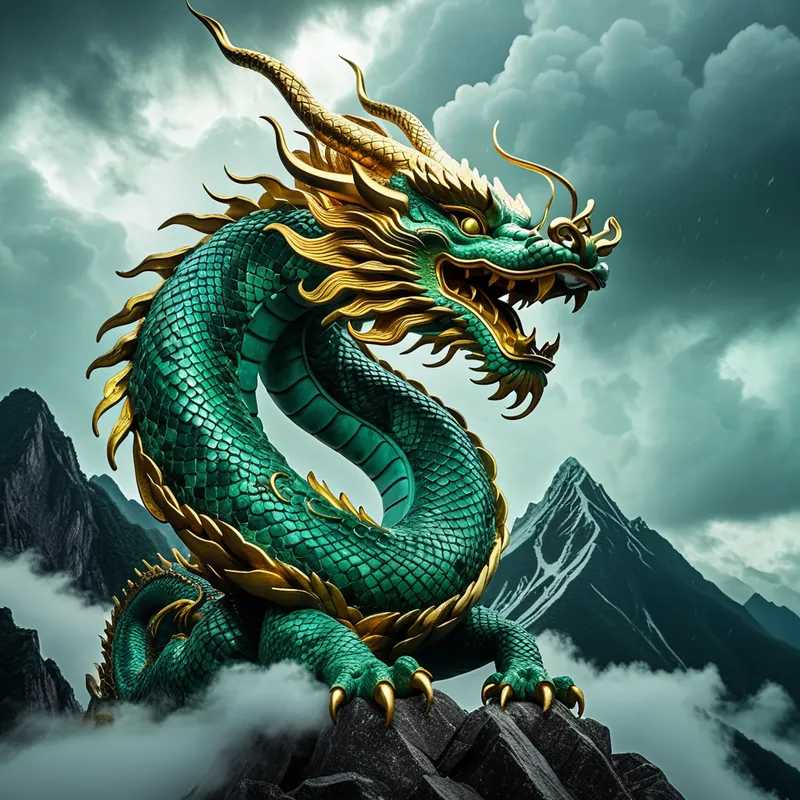
Listen, and let the mists of time part. In an age when the world was raw and the heavens closer, there lived a land cradled by sacred peaks. Yet, the harmony of Tian and Earth was fractured. The great Qinglong, the Azure Dragon of the East, whose breath was the spring wind and whose scales held the pattern of the rains, had fallen into a slumber of deep melancholy. Its celestial path across the sky grew faint, and with it, the seasons faltered. Rivers ran low, crops withered under a listless sun, and a silence, thick as mountain fog, settled over the people.
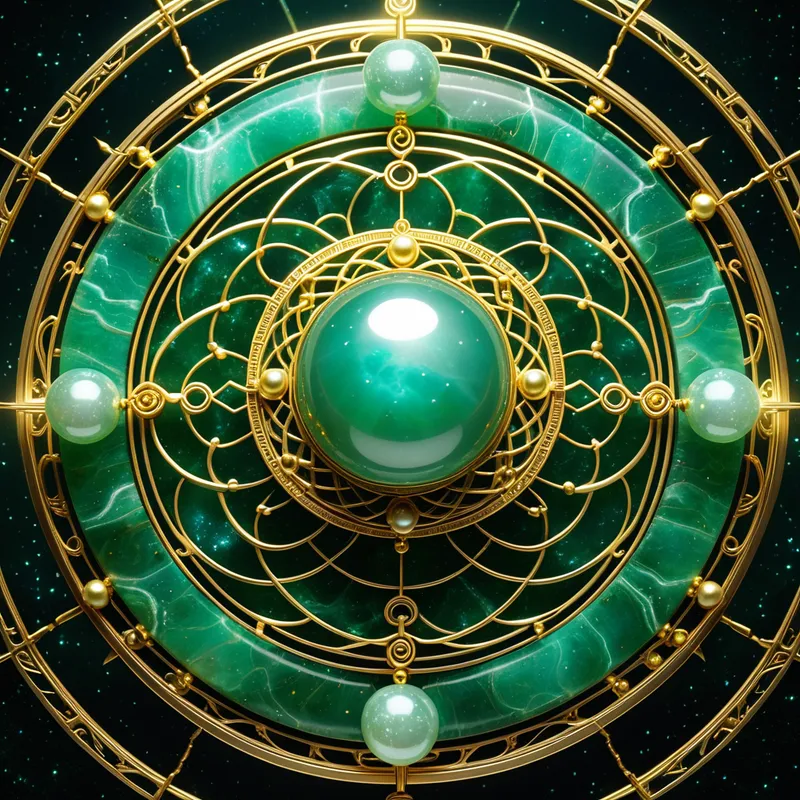
From a humble village at the foot of the Kunlun range came a youth named Lián. He was not a prince nor a warrior, but one who listened—to the whisper of the bamboo, the complaint of the dry earth, the fearful murmurs of the elders. In his heart, a conviction grew: the dragon’s path must be awakened, not by force, but by remembrance. The old songs spoke of the Longzhu, the Dragon Pearl, a fragment of primordial hundun given form, which held the rhythm of the dragon’s celestial journey. It was lost, hidden where the earth met the vault of heaven.
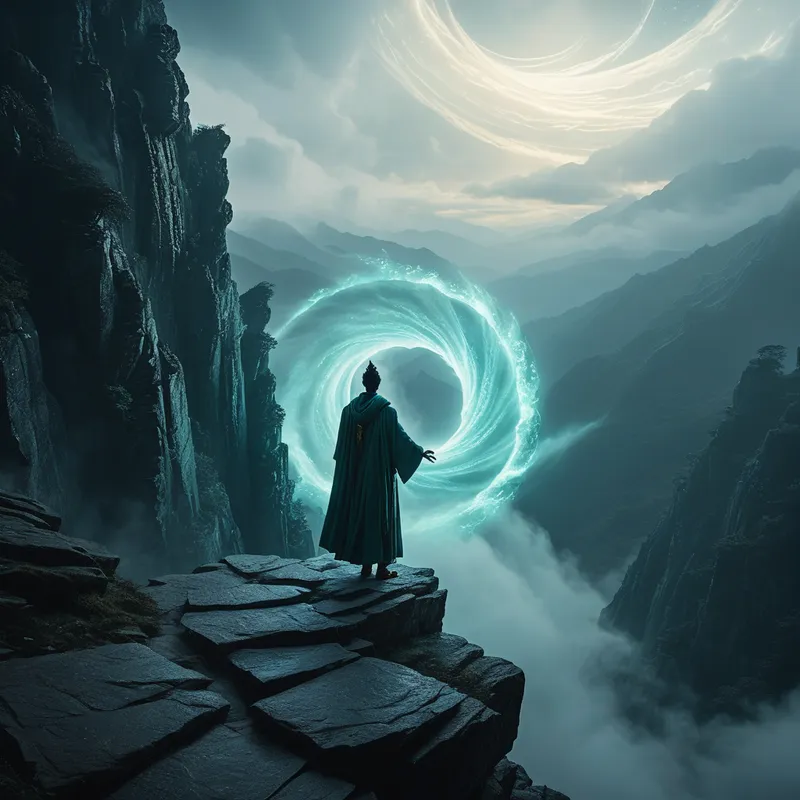
His journey was the path itself. He climbed where the air grew thin and stars brushed the stone. He traversed the Valley of Echoing Winds, where every doubt he whispered roared back at him. He crossed the Bridge of a Single Hair, a span of luminous thread over an abyss of swirling clouds, where balance was not of the body but of the spirit. He faced the Guardian of the Peaks, a stone qilin that tested his intent not with claw, but with a silent gaze that laid his soul bare. Lián carried no weapon, only an empty jade bowl, a vessel for a gift not yet received.
At the summit, where time bled into eternity, he found not a treasure trove, but a vast, silent pool—a mirror to the sky. The great Qinglong lay coiled around the mountain’s crown, its immense form seemingly made of jade and storm, its eyes closed. The Longzhu was there, but it was not a jewel to grasp. It was the perfect, still reflection of the full moon in the center of the pool, unattainable, a part of the water itself.
Lián did not reach to take. He knelt. And with the empty bowl, he gently scooped from the pool, cradling the moon’s reflection—the Longzhu—within it. As he lifted this offering of captured moonlight, a single drop fell from the bowl’s rim. It struck the pool’s surface. The ripple spread, touching the dragon’s form.
The Qinglong stirred. Its eye opened, not with fury, but with a recognition as deep as the bedrock. It saw its own path, its purpose, reflected in the bowl held by the mortal. It saw the connection—the dragon needed the earth to walk upon, and the earth needed the dragon to bring the heavens down. In that silent exchange, the path was remembered. The dragon ascended, not away, but into its ordained circuit, its movement now a vibrant call. The first drop of rain fell, then a second, then a cascade that was not just water, but the very music of renewal. Lián descended, the path behind him now verdant and alive, the dragon’s course a vibrant scar of light across the sky.
Cultural Origins & Context
The motifs of “The Dragon’s Path” are woven from the deepest threads of Chinese spiritual and cosmological thought, rather than being a single, codified myth from one text. It is a narrative tapestry that draws from the ancient veneration of the dragon as a shen, a divine being of transformation and celestial authority, central to concepts of kingship and the Tianming. The dragon’s association with water, weather, and the life-giving forces of nature made it a pivotal figure in agrarian society’s relationship with the cosmos.
This story pattern echoes in Daoist allegories of quests for harmony with the Dao, and in folk traditions where heroes interact with dragon kings of the seas and rivers. It was passed down not merely as entertainment, but as a pedagogical and societal model. Storytellers, daoshi, and village elders would recount such tales to illustrate the proper relationship between humanity and the natural/divine order. Its function was to teach reverence, articulate the ideal of the virtuous ruler or sage who aligns with cosmic forces (the dragon), and affirm that true power comes from integration and respectful dialogue with the greater whole, not domination.
Symbolic Architecture
At its heart, this myth is a profound map of psycho-spiritual integration. The Dragon represents the vast, often unconscious, primal power of the psyche—the instinctual forces, the creative qi, the archetypal Self that dwarfs the conscious ego. Its dormant state symbolizes a life out of sync with one’s deepest nature, leading to inner and outer barrenness.
The hero’s journey is not to slay the dragon, but to learn its language; not to conquer the unconscious, but to be recognized by it.
Lián, the mortal, embodies the conscious ego or the seeking individual soul. His empty jade bowl is the prepared, receptive mind and heart, the vessel of humility and intention. The perilous mountain path is the arduous process of introspection, confronting inner voids (the abyss) and guardians of the threshold (the qilin, representing internalized values or super-ego). The Longzhu as a reflection signifies that the treasure—wholeness, wisdom, authentic power—is not an external object to be seized, but a realization that emerges from the reflective depths of one’s own being. The act of offering the reflection back to the dragon is the critical moment of recognition: the ego consciously presenting the integrated Self to itself, initiating a sacred circuit of energy.
The Dreamer’s Resonance
When this myth stirs in the modern dreamer, it often signals a profound call to inner authority and a re-negotiation with one’s own latent power. Dreaming of a dormant or distant dragon may reflect a deep sense of creative or vital energy being blocked, a life force asleep. The dreamer might feel “dry,” uninspired, or powerless against life’s currents.
Dreams of climbing an impossible path, or seeking a luminous object in high, remote places, mirror the somatic tension of the individuation process—the feeling of striving toward a wholeness that feels just out of reach. The encounter with the dragon in the dream is pivotal. Is it fearsome or benevolent? The dream-ego’s reaction—to fight, flee, or, as in the myth, to offer a gesture of connection—reveals the dreamer’s current relationship with their own unconscious power. A successful “awakening” of the dragon in a dream can be followed by somatic sensations of release, flowing energy, or profound calm, marking a psychological integration that nourishes the entire psyche.

Alchemical Translation
The alchemy of “The Dragon’s Path” is a model for psychic transmutation where the base metal of a fragmented self (the barren land) is turned into the gold of an integrated personality (the harmonious, rain-fed realm). The process follows the classic stages: nigredo, the blackening, represented by the drought and the dragon’s melancholy—a state of depression, confusion, or felt meaninglessness that initiates the quest.
The peak of the mountain is not a place of conquest, but of communion; the goal is not to possess the pearl, but to become a vessel through which its light can flow.
The arduous journey is the albedo, the whitening, the purification through trials that burn away the ego’s impurities of arrogance and fear. The final encounter at the summit is the rubedo, the reddening, the sacred marriage (hehun). Here, the conscious (Lián) and the unconscious (the Qinglong) meet not in conflict, but in mutual recognition. The offering of the reflected Longzhu is the act of synthesis. For the modern individual, this translates to the moment when one’s life’s work, art, or simply one’s authentic way of being becomes the “vessel” that carries and expresses the deep, often hidden, pattern of the Self. The awakened dragon’s path across the sky is the new, vibrant order of a life lived in alignment—where one’s personal journey becomes a celestial circuit, contributing to the harmony of one’s inner and outer worlds. The power is no longer sought; it is embodied, and in its wake, it brings the nourishing rain of creativity, purpose, and vitality.
Associated Symbols
Explore related symbols from the CaleaDream lexicon: