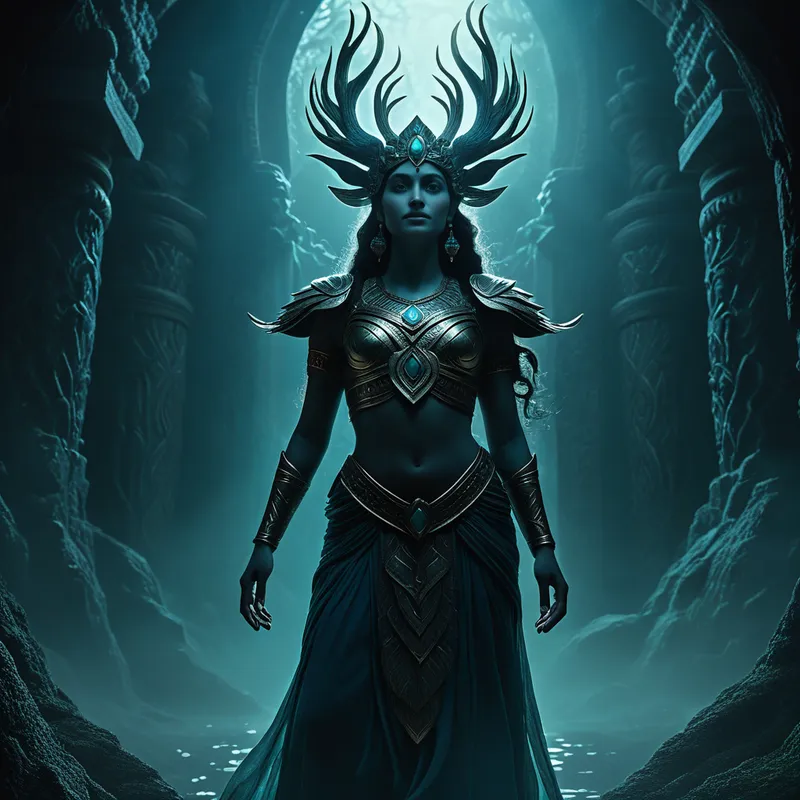
The Dragon Kings of Mongolia
Ancient Mongolian myths tell of powerful Dragon Kings who ruled the waters and mountains, embodying both creation and chaos in the vast steppes.
The Tale of The Dragon Kings of Mongolia
The story does not begin with a roar, but with a silence so deep it could drink [the sky](/myths/the-sky “Myth from Persian culture.”/). In the time before time, when [the world](/myths/the-world “Myth from Tarot culture.”/) was a canvas of wind and grass, the great Tengri breathed life into the bones of [the earth](/myths/the-earth “Myth from Hindu culture.”/). From the deepest fractures in the rock, where [water](/myths/water “Myth from Chinese culture.”/) whispered secrets to stone, they emerged: the Luu or Luu Ud, [the Dragon Kings](/myths/the-dragon-kings “Myth from Chinese culture.”/). They were not the fire-breathers of western tales, but beings of a more ancient, elemental pact. Their bodies were the sinuous curves of rivers, their scales the glitter of ice on a mountain peak, their voices the thunder that rolled across the endless steppe.
Each [Dragon](/myths/dragon “Myth from Chinese culture.”/) King claimed a dominion. One coiled within the sacred headwaters of the Onon River, his dreams dictating the fertility of the land. Another slumbered in the frozen heart of the Altai Mountains, his breath the blizzard, his heartbeat the slow grind of glaciers. They were the rulers of the gazriin ezen, the “masters of the place,” the animating spirits of the land itself. To the nomadic peoples, they were both benefactor and tyrant. A Dragon King could bless a valley with gentle rains and lush pastures, ensuring the survival of herds and families. His favor meant life.
Yet, his wrath was the very fabric of catastrophe. A displeased Dragon King would withdraw into his watery or mountainous abode, and the rivers would run thin, betraying their beds. The springs would vanish, leaving the earth parched and cracked like old leather. Or, in a tempest of rage, he would unleash torrents that swallowed yurts and swept away horses, or shake the earth until the mountains themselves trembled. The people knew they lived by the grace of a capricious power. They made offerings at ovoos ([cairns](/myths/cairns “Myth from Celtic culture.”/)) erected at high passes and river sources—tying blue silk scarves, leaving libations of milk or airag (fermented mare’s milk), whispering prayers for protection and favor. The relationship was one of profound, uneasy reciprocity. [The Dragon](/myths/the-dragon “Myth from Chinese culture.”/) King held the power of life and [death](/myths/death “Myth from Tarot culture.”/), and humanity existed in the tense, respectful space between his creation and his [chaos](/myths/chaos “Myth from Greek culture.”/).
Cultural Origins & Context
The myth of the [Dragon Kings](/myths/dragon-kings “Myth from Chinese culture.”/) is woven into the very fabric of the Mongolian worldview, a synthesis of ancient Tengrism and later Buddhist influences that traveled along the [Silk Road](/myths/silk-road “Myth from Chinese culture.”/). In the Tengrist cosmos, every feature of the landscape is alive with spirit (ezen). A mountain is not merely a mountain; it is a conscious, powerful entity. A lake is a living eye. The [Dragon Kings](/myths/dragon-kings “Myth from Chinese culture.”/) are the most majestic and potent expressions of this animistic reality, the archetypal rulers of these natural domains.
Their integration into Mongolian Buddhist cosmology, particularly after the 16th [century](/myths/century “Myth from Biblical culture.”/), saw them transformed into nāgas, serpentine deities who became protectors of the [Dharma](/myths/dharma “Myth from Hindu culture.”/). Yet, they never lost their primal, chthonic character. They dwelled in the watery, subterranean world of nāgalok, a realm of immense wealth and psychic power, often associated with the unconscious and the foundational energies of the earth. This dual identity—as both indigenous spirit-lord and Buddhist protector—reflects the Mongolian genius for syncretism. The Dragon King is a bridge between the wild, untamed soul of the steppe and the structured order of spiritual doctrine. He represents the raw, sovereign power of nature that must be acknowledged and honored, even within a framework of philosophical order.
Symbolic Architecture
The [Dragon](/symbols/dragon “Symbol: Dragons are potent symbols of power, wisdom, and transformation, often embodying the duality of creation and destruction.”/) [King](/symbols/king “Symbol: A symbol of ultimate authority, leadership, and societal order, often representing the dreamer’s inner power or external control figures.”/) is a master [symbol](/symbols/symbol “Symbol: A symbol can represent an idea, concept, or belief, serving as a powerful tool for communication and understanding.”/) of ambivalent sovereignty. He is the ultimate Ruler, but his [kingdom](/symbols/kingdom “Symbol: A kingdom symbolizes authority, belonging, and a sense of identity within a larger context or community.”/) is the unconscious, instinctual world of [Nature](/symbols/nature “Symbol: Nature symbolizes growth, connectivity, and the primal forces of existence.”/) itself. He does not rule by decree from a distant [throne](/symbols/throne “Symbol: A seat of authority, power, and sovereignty, representing leadership, divine right, or social hierarchy.”/), but by being the territory. His power is immanent, not transcendent.
He is the embodiment of the world’s libido, its raw, creative, and often terrifying life force. To encounter him is to encounter the non-human psyche of the land, a consciousness that is vast, ancient, and utterly indifferent to human concerns except as they relate to the balance of his domain.
His serpentine, aquatic form symbolizes the fluid, cyclical, and deeply mysterious processes of [life](/symbols/life “Symbol: The symbol of ‘Life’ represents a journey of growth, interconnectedness, and existential meaning, encompassing both the joys and challenges that define human experience.”/). He is the [blood](/symbols/blood “Symbol: Blood often symbolizes life force, vitality, and deep emotional connections, but it can also evoke themes of sacrifice, trauma, and mortality.”/) of the [earth](/symbols/earth “Symbol: The symbol of Earth often represents grounding, stability, and the physical realm, embodying a connection to nature and the innate support it provides.”/)—the groundwater, the [river](/symbols/river “Symbol: A river often symbolizes the flow of emotions, the passage of time, and life’s journey, reflecting transitions and movement in one’s life.”/)’s flow, the sap in the trees. His association with storms and earthquakes reveals the other side of this [life](/symbols/life “Symbol: The symbol of ‘Life’ represents a journey of growth, interconnectedness, and existential meaning, encompassing both the joys and challenges that define human experience.”/) force: its [capacity](/symbols/capacity “Symbol: A measure of one’s potential, limits, or ability to contain, process, or achieve something, often reflecting self-assessment or external demands.”/) for explosive, chaotic transformation. He is creation and destruction in one coiled form, the necessary [tension](/symbols/tension “Symbol: A state of mental or emotional strain, often manifesting physically as tightness, pressure, or unease, signaling unresolved conflict or anticipation.”/) that keeps the world from stagnation. The offerings made to him are not bribes, but acts of symbolic exchange—a recognition that [human](/symbols/human “Symbol: The symbol of a human represents individuality, complexity of emotions, and social relationships.”/) [life](/symbols/life “Symbol: The symbol of ‘Life’ represents a journey of growth, interconnectedness, and existential meaning, encompassing both the joys and challenges that define human experience.”/) is sustained by forces that must be psychically fed and acknowledged, lest they turn hungry and destructive.
The Dreamer’s Resonance
To dream of the Dragon King is to feel the stirring of a profound, autonomous power complex within the [psyche](/myths/psyche “Myth from Greek culture.”/). He is the personification of what Carl Jung might call the “mana personality,” an archetypal force of immense influence that can either empower or overwhelm the conscious ego.
In the individual, the Dragon King may manifest as a towering, innate talent or a driving, instinctual passion—a creative force that feels like it comes from a deep, ancient well within. It can be the compelling voice of an artist, the strategic genius of a leader, or the profound intuition of a healer. However, if this inner Dragon King is ignored, disrespected, or repressed, he becomes the source of inner chaos. His withheld waters become creative drought, depression, or a feeling of lifelessness. His storms become uncontainable rage, impulsive acts, or psychosomatic illnesses that shake the foundations of one’s life.
The myth teaches that this inner ruler cannot be controlled, only related to. It requires the “offering” of our attention, our respect, and a portion of our conscious energy. The psychological task is not to slay the dragon, but to learn its language, to honor its domain, and to negotiate a sustainable relationship with this ultimate source of personal power and vitality.
Alchemical Translation
The alchemical process mirrored in the myth is that of negotiation with [the prima materia](/myths/the-prima-materia “Myth from Alchemical culture.”/)—the chaotic, foundational substance of the soul. The Dragon King is the [prima materia](/myths/prima-materia “Myth from Alchemical culture.”/) of the Mongolian landscape and, by extension, the human psyche: the undifferentiated, potent, and dangerous raw material of being.
The ritual offerings at the ovoo are the alchemical operation. The conscious ego (the herder) approaches the edge of the unconscious (the sacred mountain pass, the river source). The offering of milk, a symbol of nourishment and the sustaining feminine, or a blue scarf, representing the sky (Tengri) and spiritual connection, is an act of sacrifice. It is a small piece of conscious order given willingly to the chaotic, powerful unconscious.
This sacred exchange aims not for domination, but for conjunction. The goal is a temporary, sacred treaty between the human and the elemental, the conscious and the unconscious. When successful, it results in the “blessing”: the rains come, creativity flows, inner balance is restored. The Dragon King’s power is not taken; it is participated with. The alchemical gold here is not immortality, but right relationship—the enduring capacity to live in a world of powerful, animate forces without being destroyed by them, and to draw sustenance from their depths without demanding submission.
Associated Symbols
Explore related symbols from the CaleaDream lexicon:
- Dragon — The archetypal symbol of immense, primordial power, often guarding great treasure or wisdom, representing the untamed forces of nature and the unconscious.
- Water — The element of the unconscious, emotion, intuition, and the flow of life; the primary domain of the Dragon Kings, symbolizing both sustenance and potential flood.
- Mountain — A symbol of enduring strength, spiritual ascent, and the meeting point between heaven and earth; the throne and body of the terrestrial Dragon Kings.
- Power — The fundamental energy of influence and sovereignty, embodied absolutely by the Dragon King, who is less a wielder of power and more its natural manifestation.
- Nature — The vast, animate, and sovereign system of life and elemental force of which the Dragon King is the ruling personification.
- Conflict — The essential tension between chaos and order, creation and destruction, that the Dragon King embodies and mediates within his domain.
- River — The flowing, life-giving manifestation of the Dragon King’s power, representing destiny, time, and the nourishing yet potentially dangerous path of life.
- Thunder — The terrifying voice of the sky, often associated with the Dragon King’s wrath or pronouncements, symbolizing sudden awakening, divine power, and disruptive change.
- Stone — The enduring, foundational element of the earth, often stacked into ovoos as ritual offerings to the Dragon Kings, representing permanence, [altar](/myths/altar “Myth from Christian culture.”/), and the bones of the world.
- Ritual — The prescribed act of exchange and communication with the sacred, as seen in the offerings to the Dragon Kings, necessary for maintaining balance between humanity and the powerful unseen.
- Shadow — The hidden, potent, and often feared aspect of the psyche or the world, which the Dragon King can represent in his chaotic, destructive, and underworldly aspects.
- Journey — The nomadic necessity and spiritual path across the Dragon King’s domain, requiring his permission and blessing, symbolizing the soul’s passage through the territories of the unconscious.