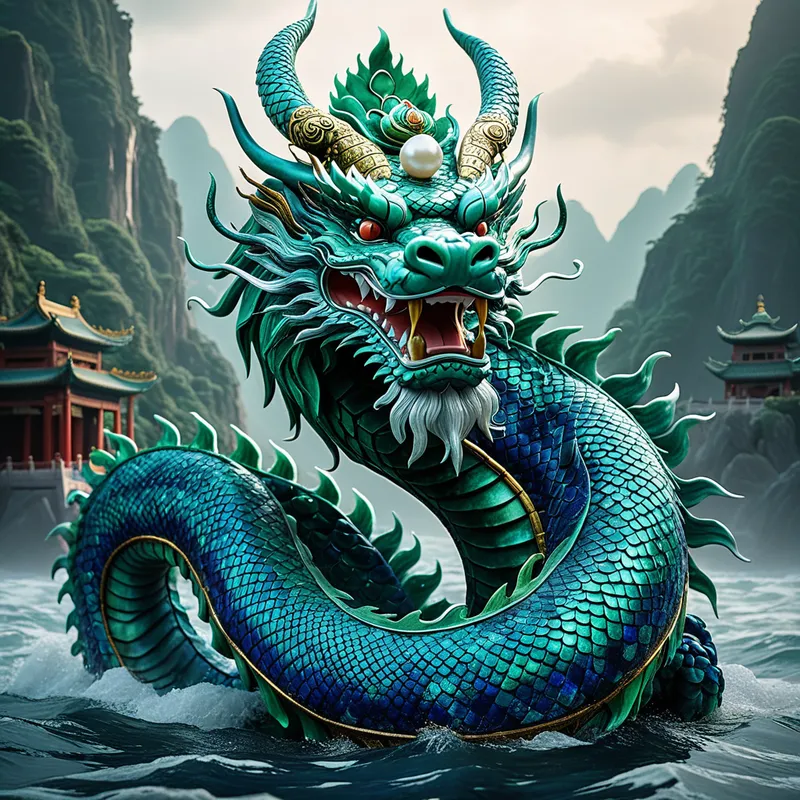
The Dragon Kings Myth Meaning & Symbolism
The myth of the Dragon Kings, rulers of the waters, embodies the psyche's struggle to master primal chaos and bring life-giving order to the inner world.
The Tale of The Dragon Kings
Listen, and hear the tale that flows from the four corners of the world, carried on the monsoon wind and whispered by the river’s current. In the time before time was measured, when the world was raw and the heavens close, the waters were not tame. They were a roiling, formless chaos, answering to no law but their own wild heart. Floods would swallow the land without warning; droughts would crack the earth to bone-dust. Humanity lived in the shadow of this caprice, their prayers lost in the thunder.
But in the deepest trenches of the Four Seas, and in the hidden veins of the great rivers and lakes, there existed a sovereignty born of this very chaos. They were the Long Wang. Ao Guang, the eldest, held court in the glittering coral palaces of the East Sea. His brothers, Ao Qin, Ao Shun, and Ao Run, ruled the South, North, and West Seas respectively. They were not mere beasts, but divine monarchs, dragons who could shift shape into majestic, bearded men clad in robes of liquid silk and crowns that held the light of the deep.
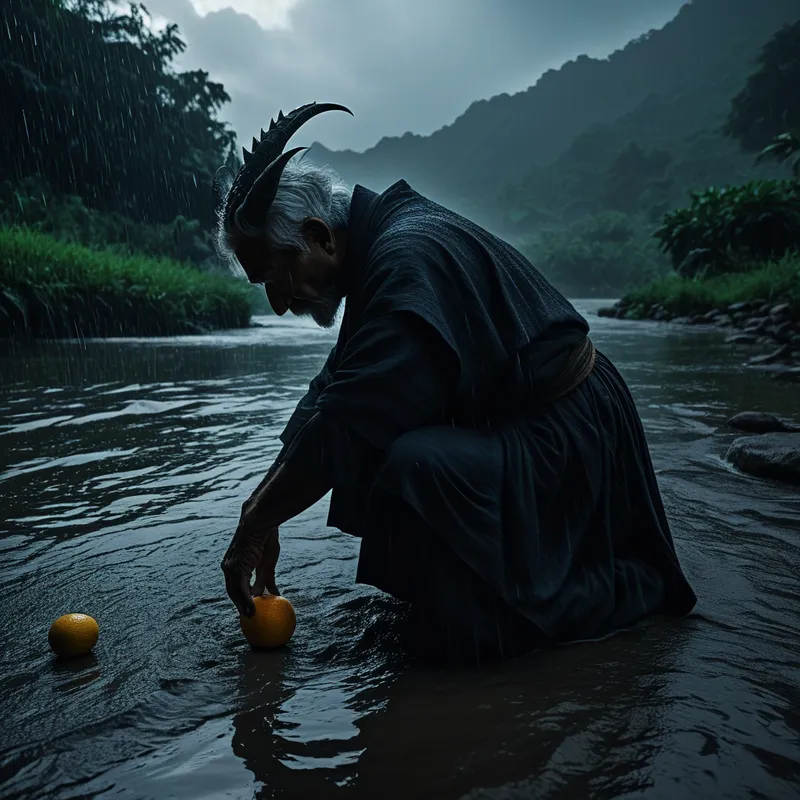
Their dominion was absolute. With a flick of a claw, they could summon typhoons; with a sigh, they could call forth the nourishing spring rains. The people knew this. When the rains failed, processions would wind their way to the water’s edge. Offerings of jade, silk, and the finest rice wine would be cast into the depths with pleas etched on faces lined with fear. Sometimes, the Dragon King would listen. The sky would darken, and a gentle, life-giving rain would fall. But other times… other times, the silence from the deep was a heavier burden than any storm. It was the silence of a king indifferent to his subjects’ suffering, a reminder that the power of life and death rested in a realm utterly alien to the world of men.
The tales tell of their tempers. A fisherman who netted a sacred carp, kin to the Dragon King’s court, might find his boat encircled by sudden, violent whirlpools. A foolish prince who polluted a river with arrogance could awaken to find his kingdom’s wells running with salt. The Dragon Kings were guardians, but their justice was elemental, swift, and often terrifying. They were the untamed psyche of the world itself—capable of glorious creation and utter destruction, bound by their own inscrutable codes. To navigate their world was to navigate the fundamental, unpredictable power of nature, a force that demanded respect, ritual, and a profound understanding of balance.
Cultural Origins & Context
The myth of the Long Wang is not a single story from one text, but a living tapestry woven from ancient animism, Daoist cosmology, and later Buddhist influences. Its roots sink deep into China’s agrarian soul, where the management of water was—and is—the literal difference between life and death, prosperity and famine. These deities emerged from the human need to personify, and thus negotiate with, the uncontrollable elements.
They were chronicled in classics like the Journey to the West, where the Monkey King Sun Wukong famously “borrows” the magical, tide-controlling pillar from Ao Guang’s treasury. They appear in folktales told by village elders and in operas performed during festivals praying for rain. Their function was multifaceted: they were theological explanations for weather patterns, ethical frameworks emphasizing ecological respect, and narrative tools for exploring the relationship between the human community and the sovereign, often distant, powers that governed their fate. To honor the Dragon King was to perform the rituals of balance, to acknowledge humanity’s place within a larger, sentient cosmos.
Symbolic Architecture
Psychologically, the Dragon Kings represent the sovereign power of the unconscious, specifically its emotional and instinctual currents. Water is the universal symbol of the unconscious—deep, life-giving, mysterious, and potentially overwhelming. The Dragon Kings are the personified rulers of this realm.
The Dragon King does not command the water; he is the water’s will incarnate. To encounter him is to encounter the raw, untamed authority of your own deepest nature.
Their fourfold division mirrors the totality of the psyche: the East (spring, birth), South (summer, growth), North (winter, repose), and West (autumn, harvest). Each king governs a different “sea” of inner experience—from the creative surges of inspiration (East) to the cold depths of forgotten memories (North). Their shifting forms, from dragon to human, signify the transformative nature of these energies as they cross the threshold into consciousness. Their famed treasures—like the tide-controlling pillar—are symbols of the ego’s potential tools, which must be “borrowed” or integrated from the unconscious with great cunning and respect, lest they unleash chaos.
The Dreamer’s Resonance
When the figure of a Dragon King surfaces in a modern dream, it rarely appears as a literal mythic beast. Instead, it manifests as the experience of confronting a powerful, autonomous, and often intimidating authority within one’s own psyche. This could be a dream of a vast, intimidating CEO who controls the “floodgates” of resources (emotions, creativity, vitality), or a mysterious, older figure living in the basement of one’s dream house who controls the plumbing and electrical systems—the fundamental flows of psychic energy.
The somatic feeling is key: a sense of awe, of being subject to a force much larger than oneself. There may be anxiety about making an “offering” or plea—expressing a repressed need or emotion—and fearing a catastrophic “flood” of feeling in return. Alternatively, dreaming of successfully negotiating with this figure, or receiving a gift of water (a pearl, a cup), points to a nascent dialogue with the deep self, a granting of permission for life-giving emotional energy to flow into conscious life.
Alchemical Translation
The individuation process modeled by the Dragon King myth is not one of slaying the dragon, but of learning its language and earning its respect. The dragon is not a monster to be killed, but a sovereign to be acknowledged. The modern ego, often identifying as the sole ruler of its internal kingdom, must journey to the “Eastern Sea”—the depths of its own unconscious—and present itself not as a conqueror, but as a petitioner and, ultimately, a partner.
The alchemical goal is not to drain the sea, but to learn the art of sailing upon it, to build canals that direct its fertile silt to the fields of conscious life.
This requires the “rituals” of introspection, active imagination, and respect for the irrational. The ego must offer its rigid plans (the jade and silk) to the deeper, older wisdom. The struggle is to hold the tension between the need for conscious order and the awesome, chaotic power of the instinctual self. The triumph is the “peaceful reign”—a state of inner balance where the rains of inspiration fall when needed, the floods of rage or grief are managed, and the droughts of depression are alleviated. The individual becomes, in a sense, the co-regent of their own inner waters, embodying the Long Wang’s sovereignty in a conscious, integrated form. The pearl of great price they hold is the integrated self, luminous with the power of reconciled opposites.
Associated Symbols
Explore related symbols from the CaleaDream lexicon: