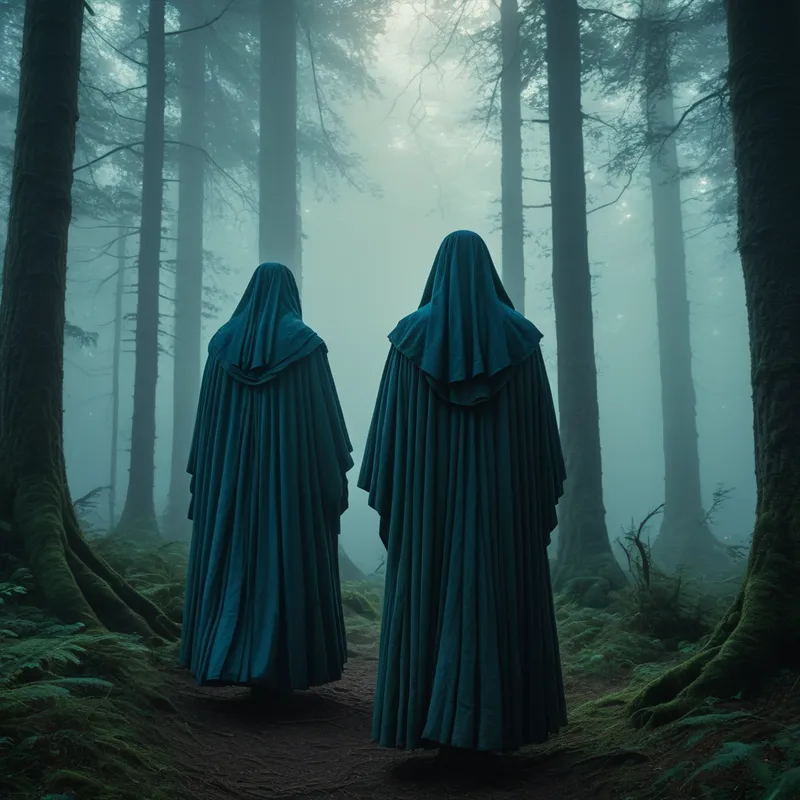
The Doppelgänger Myth Meaning & Symbolism
A universal myth of the double, a spectral mirror-self whose appearance is a profound omen, forcing a confrontation with the hidden and unlived parts of the soul.
The Tale of The Doppelgänger
Listen, and listen well. This is not a story of a distant land or a forgotten god. This is a story that walks beside you, that breathes your breath. It begins in the quiet moments, in the corner of your eye.
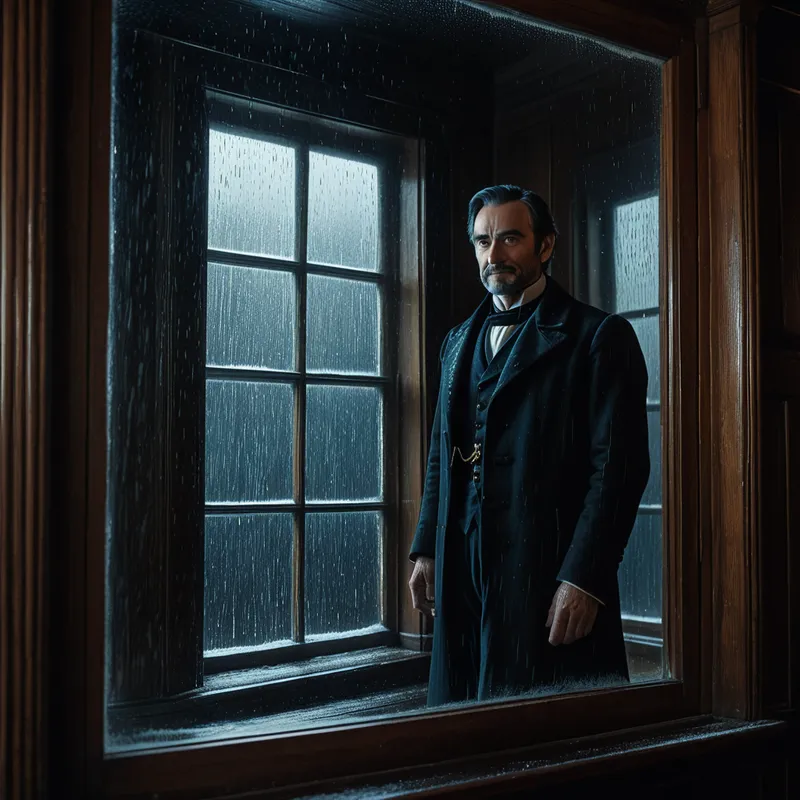
There was a man—a scholar, a minister, a poet; the face changes, but the soul is the same. He was a man of substance, of reputation, who walked the solid cobblestones of his life with measured steps. One evening, as the gas lamps hissed to life, painting the fog a sickly orange, he saw himself. Not in a mirror, but walking toward him on the empty street. It was his own face, his own gait, his own coat, but worn with a subtle, alien weariness. Their eyes met. In that glance was a recognition deeper than memory, a cold familiarity that bypassed the heart and seized the spine. His double passed by without a word, leaving behind only the scent of ozone and a silence that swallowed the city’s sounds.
From that moment, [the world](/myths/the-world “Myth from Tarot culture.”/) became a hall of mirrors. He would glimpse the figure across a crowded room, standing where he knew he was not. He would find his favorite chair still warm, the imprint of a body just departed. His own handwriting began to appear on documents he had not yet touched. The solidity of his life, the certainty of I am here, began to dissolve. His friends grew quiet, their glances furtive. They had seen it too. The whispers began: to see one’s Doppelgänger is an omen. For the one who is seen, it is a harbinger of grave illness. For the one who sees it… it is a [herald](/myths/herald “Myth from Greek culture.”/) of their own imminent death.
The climax came not in a storm, but in a terrible stillness. Attending a solemn function, surrounded by the murmur of polite society, he felt a tap on his shoulder. He turned. There he stood, his double, not spectral but solid, real as the floor beneath them. The double’s eyes held not malice, but a profound and infinite sorrow—the sorrow of a life unlived, of paths untaken. It spoke a single sentence, the man’s own voice echoing from a great distance: “The hour is come.” The gathered crowd gasped, not at the double, but at the man himself. For in that instant, he became as pale as marble, his strength leaving him as if siphoned away. He did not die there on the spot. He returned home, a shell, and took to his bed. Within the week, he was gone. Some say his last words were a whispered conversation with the empty chair beside him.
Cultural Origins & Context
The myth of the double is not owned by a single culture; it is a universal haunting. Its most famous naming comes from German Romanticism—Doppelgänger—but its essence is far older. In ancient Egyptian belief, the ka was a tangible duplicate of the person, a guardian spirit that required sustenance even after death. Norse folklore spoke of the vardøger, a spectral double that performed one’s actions shortly before one arrived. In many West African and diasporic traditions, the concept of [the shadow](/myths/the-shadow “Myth from Jungian culture.”/)-self carries immense spiritual weight, a companion soul with its own will.
This story was not told around campfires of heroes, but whispered in parlors and written in the private journals of the Romantic and Gothic eras. Authors like E.T.A. Hoffmann, Jean Paul, and later Dostoevsky gave it literary form. It was a myth for the emerging modern individual, for a world where identity was becoming a question rather than a given. Its societal function was as a narrative container for profound anxieties: the fear of losing one’s soul, the terror of a predetermined fate, and the unsettling suspicion that [the self](/myths/the-self “Myth from Jungian culture.”/) might not be singular, stable, or entirely one’s own.
Symbolic Architecture
At its core, the [Doppelgänger](/symbols/doppelgnger “Symbol: The Doppelgänger represents a duality or a mirror self, often prompting contemplation about identity, choices, and the nature of self.”/) is the ultimate [symbol](/symbols/symbol “Symbol: A symbol can represent an idea, concept, or belief, serving as a powerful tool for communication and understanding.”/) of the [shadow](/symbols/shadow “Symbol: The ‘shadow’ embodies the unconscious, repressed aspects of the self and often represents fears or hidden emotions.”/). It is not merely an evil twin, but the sum total of everything we have disowned, repressed, or failed to become. It holds our unlived [life](/symbols/life “Symbol: The symbol of ‘Life’ represents a journey of growth, interconnectedness, and existential meaning, encompassing both the joys and challenges that define human experience.”/).
The Doppelgänger does not come to destroy you, but to complete you. Its appearance is the psyche’s most desperate attempt to be made whole.
The [omen](/symbols/omen “Symbol: A sign or event believed to foretell the future, often seen as a warning or promise from the universe.”/) of [death](/symbols/death “Symbol: Symbolizes transformation, endings, and new beginnings; often associated with fear of the unknown.”/) is thus not merely physical, but psychological. It signifies the impending death of the current, inauthentic [persona](/symbols/persona “Symbol: The social mask or outward identity one presents to the world, often concealing the true self.”/)—the constructed “I” that walks the cobblestones oblivious to its deeper [nature](/symbols/nature “Symbol: Nature symbolizes growth, connectivity, and the primal forces of existence.”/). The confrontation is fatal to [the ego](/myths/the-ego “Myth from Jungian culture.”/)’s illusion of control and [singularity](/symbols/singularity “Symbol: A point of infinite density and potential, often representing a moment of profound transformation, unity, or the convergence of all possibilities.”/). The double represents [fate](/symbols/fate “Symbol: Fate represents the belief in predetermined outcomes, suggesting that some aspects of life are beyond human control.”/) itself, the inescapable trajectory of one’s own buried truths returning to claim their due. It is the externalized embodiment of self-alienation, showing us what happens when we refuse to acknowledge the parts of ourselves that seem foreign, frightening, or forbidden.

The Dreamer’s Resonance
When the Doppelgänger pattern emerges in modern dreams, it signals a critical moment of individuation. To dream of meeting your double is to dream of meeting your own potential, both glorious and terrifying.
The somatic experience is often one of chilling recognition, a freeze response coupled with intense fascination. Psychologically, the dreamer is undergoing a process of self-confrontation. The double may act out repressed desires, speak uncomfortable truths, or simply observe with knowing eyes. This is the [psyche](/myths/psyche “Myth from Greek culture.”/) staging an intervention. Common scenarios—being chased by the double, fighting it, or merging with it—map directly onto the ego’s struggle with integrating the shadow. The dream is a safe(ish) space where the ultimate question can be posed: “Who are you?” The answer, whispered back from [the mirror](/myths/the-mirror “Myth from Various culture.”/), is always some version of: “I am what you have forgotten. I am what you could be.”
Alchemical Translation
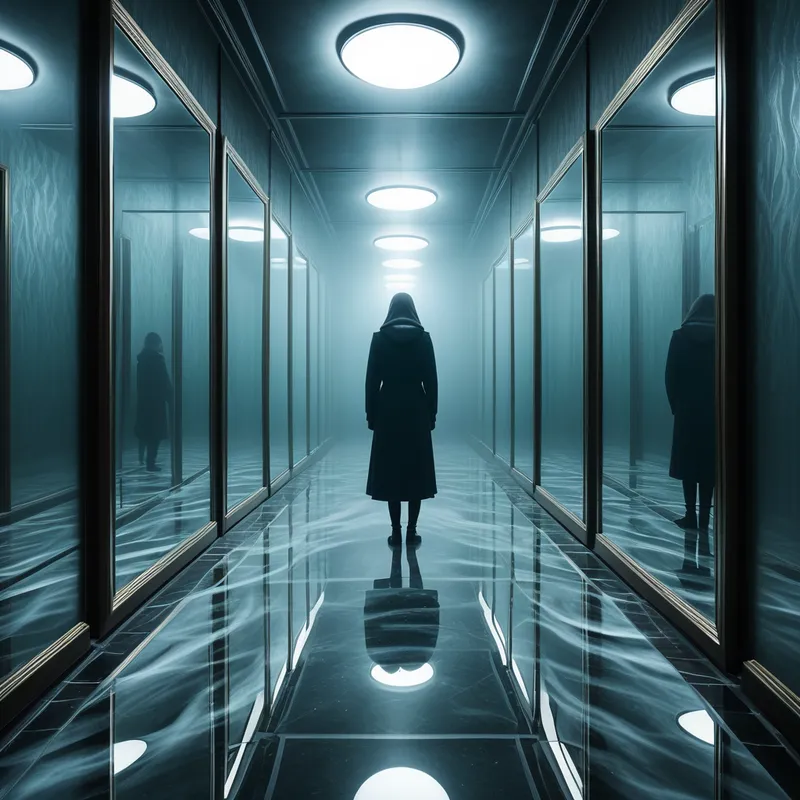
The myth of the Doppelgänger models the alchemical stage of [nigredo](/myths/nigredo “Myth from Alchemical culture.”/)—the blackening, the descent into the darkness of the unconscious. The initial sighting is the shocking revelation of the shadow. The ensuing haunting is the shadow-work, where repressed contents flood into conscious life, threatening to dismantle the old identity.
The triumph is not in defeating the double, but in realizing you are not its enemy, but its estranged kin. The goal is not to kill the shadow, but to marry it.
The “death” foretold by the omen is the necessary death of the ego’s naive sovereignty. The alchemical translation is one of transmutation through recognition. When the individual can turn, face the double, and say, “You are also me,” without fleeing into madness or denial, the process shifts. The spectral omen transforms into an inner companion. The energy once bound in fear and repression is liberated. The individual who integrates this encounter does not become two people, but one far more complex, authentic, and whole person. They have looked into the mirror of fate and seen not an end, but the beginning of their true, unfragmented story. The Doppelgänger, once a harbinger of doom, becomes the silent witness to a life finally being lived in full.
Associated Symbols
Explore related symbols from the CaleaDream lexicon: