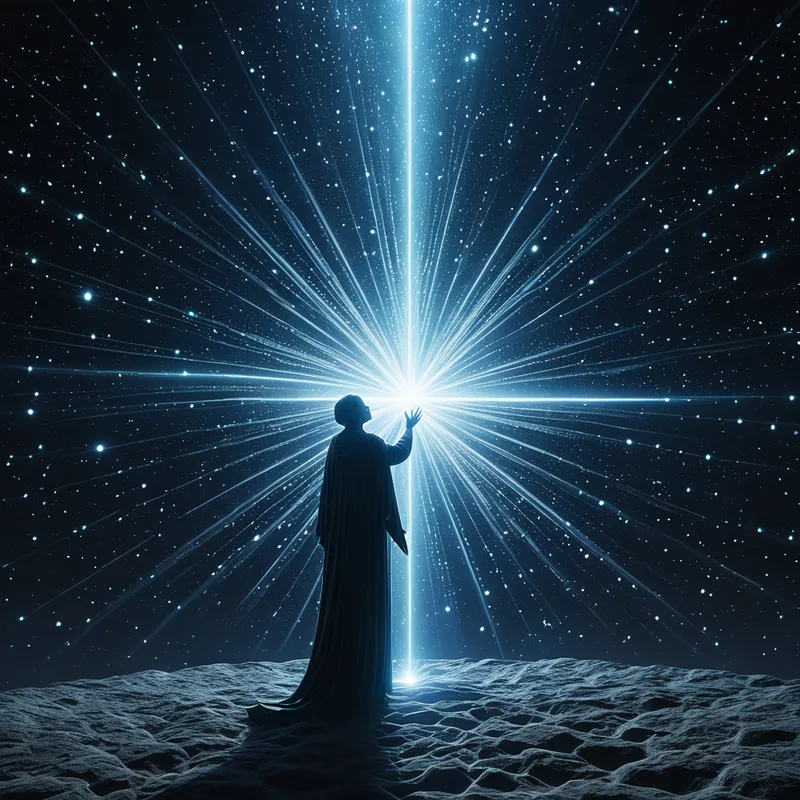
The Divine Spark in Matter Myth Meaning & Symbolism
A tale of luminous spirit, imprisoned in a world of shadow, whose remembrance ignites the perilous journey of awakening and return.
The Tale of The Divine Spark in Matter
Listen, and I will tell you of a world born from a scream of anguish.
In the beginning, before time was measured, there was the Pleroma—a realm of pure, boundless light, silence, and fullness. Here, the Aeons dwelt in harmonious pairs, a great chain of being emanating from the unfathomable, nameless One. Their existence was a song of perfect knowing, a dance of thought and grace. But in the outermost reaches of this fullness, a youngest Aeon, moved by a longing too deep for words, acted alone. Without her harmonious counterpart, she reached—not in malice, but in a passion of wonder—for a direct knowledge of the One that could not be contained.
This overreaching, this passionate thought, gave birth in isolation. From her longing and her grief, a form coagulated in the void: chaotic, blind, and howling. This was [Yaldabaoth](/myths/yaldabaoth “Myth from Gnostic culture.”/), the Archon, whose face was a lion’s snarl and whose body was a serpent’s coil. Ignorant of the Pleroma above, believing himself the only god, he fashioned a prison in his own image: a cosmos of matter, shadow, and law. He and his Archons spun the heavens like a vast, intricate cage, and sculpted the earth from forgetfulness. They fashioned Adam of red clay, a statue of mud, and it lay inert upon the ground.
But from the heights, the true Aeons looked down in pity. Into this lump of earth, they secretly sent a breath stolen from the light of the Pleroma. A Pneuma, a fragment of the original fire, was breathed into the nostrils of the clay man. Adam gasped, and his eyes opened—not with the dull sight of the beasts, but with a terrible, aching memory of a home he had never seen. This is the secret: humanity is asleep, but within each slumbers a captive star.
The Archons, enraged by this light in their creation, sealed the prison tighter. They forged the cycle of birth and death, the veil of the heavens, the intoxication of the senses, and [the angel of forgetfulness](/myths/the-angel-of-forgetfulness “Myth from Jewish culture.”/) who stands at the gate of each new life. They made the world beautiful and cruel to make us love our chains.
Yet the spark remembers. In the deepest night of the soul, it stirs. It is the stranger’s voice that whispers, “You are not of this place.” It is the grief for a lost kingdom whose name you never learned. It is the insatiable hunger that bread cannot fill. This is the call. And the one who hears it begins the long, solitary journey—not across mountains, but through the labyrinth of their own conditioned mind, past the seductive guards of passion and fear, to gather the scattered light, remember their true name, and find the hidden Pneuma within the flesh, waiting to go home.
Cultural Origins & Context
This is not a myth for the marketplace or the temple of the state god. It is a secret history, whispered in the dim light of gathering places in Alexandria, Rome, and the deserts of Egypt during the first few centuries CE. The carriers of this story were the diverse groups scholars later label “Gnostic” (from gnosis, meaning direct, experiential knowledge). They were often intellectual and spiritual dissidents operating within—and against—the prevailing religious currents of Hellenistic Judaism and early Christianity.
Their texts, like the Apocryphon of John or the Gospel of Thomas, were often hidden, discovered in codices buried in jars, like the Nag Hammadi library. The myth was not told to explain natural phenomena or enforce social order, but to provide a radical map for individual liberation. It functioned as a diagnosis of the human condition (we are divine beings in exile) and a prescription for cure (awakening through gnosis). The teller was often a teacher, a guide who had themselves tasted the awakening, leading the listener inward. In a world experienced as oppressive and alienating, under Roman rule or orthodox dogmatism, this myth provided a profound framework for making sense of suffering and locating ultimate authority not in external priests or scriptures, but within the self’s deepest core.
Symbolic Architecture
The myth presents a complete symbolic cosmology of the psyche. The [Pleroma](/symbols/pleroma “Symbol: In Gnostic cosmology, the Pleroma is the divine fullness or totality of spiritual powers, representing the realm of perfection beyond the material world.”/) represents the unconscious wholeness of the Self, the state of undifferentiated potential before ego-[consciousness](/symbols/consciousness “Symbol: Consciousness represents the state of awareness and perception, encompassing thoughts, feelings, and experiences.”/). The youngest Aeon (often Sophia) symbolizes the psyche’s necessary [movement](/symbols/movement “Symbol: Movement symbolizes change, progress, and the dynamics of personal growth, reflecting an individual’s desire or need to transform their circumstances.”/) toward [consciousness](/symbols/consciousness “Symbol: Consciousness represents the state of awareness and perception, encompassing thoughts, feelings, and experiences.”/), a creative/destructive urge that, without [integration](/symbols/integration “Symbol: The process of unifying disparate parts of the self or experience into a cohesive whole, often representing psychological wholeness or resolution of internal conflict.”/) (her counterpart), leads to a fall into identification.
The fall is not into sin, but into identification. The soul mistakes itself for the drama it has created.
Yaldabaoth is the archetypal representation of the unintegrated, inflated ego—the “[creator](/symbols/creator “Symbol: A figure representing ultimate origin, divine power, or profound authorship. Often embodies the source of existence, innovation, or personal destiny.”/)” who believes itself to be the totality, constructing a complex, logical, but ultimately false [reality](/symbols/reality “Symbol: Reality signifies the state of existence and perception, often reflecting one’s understanding of truth and life experiences.”/) (the [persona](/symbols/persona “Symbol: The social mask or outward identity one presents to the world, often concealing the true self.”/) and the conscious worldview) from its own limited [perception](/symbols/perception “Symbol: The process of becoming aware of something through the senses. In dreams, it often represents how one interprets reality or internal states.”/). The [material](/symbols/material “Symbol: Material signifies the tangible aspects of life, often representing physical resources, desires, and the physical world’s influence on our existence.”/) world is not evil in itself, but symbolizes the psyche’s identification with literal, concrete [reality](/symbols/reality “Symbol: Reality signifies the state of existence and perception, often reflecting one’s understanding of truth and life experiences.”/)—the belief that the physical and social world is all that exists.
The Pneuma is the indestructible core of the Self, the transpersonal spark of [awareness](/symbols/awareness “Symbol: Conscious perception of self, surroundings, or internal states. Often signifies awakening, insight, or heightened sensitivity.”/) that exists prior to and beyond ego-[construction](/symbols/construction “Symbol: Construction symbolizes creation, building, and the process of change, often reflecting personal growth and the need to build a solid foundation.”/). It is the [source](/symbols/source “Symbol: The origin point of something, often representing beginnings, nourishment, or the fundamental cause behind phenomena.”/) of our longing for meaning, our sense of alienation from mundane [life](/symbols/life “Symbol: The symbol of ‘Life’ represents a journey of growth, interconnectedness, and existential meaning, encompassing both the joys and challenges that define human experience.”/), and our [capacity](/symbols/capacity “Symbol: A measure of one’s potential, limits, or ability to contain, process, or achieve something, often reflecting self-assessment or external demands.”/) for transformative [insight](/symbols/insight “Symbol: A sudden, deep understanding of a complex situation or truth, often arriving unexpectedly and illuminating hidden connections.”/). The entire cosmic [drama](/symbols/drama “Symbol: Drama signifies narratives, emotional expression, and the exploration of human experiences.”/) is an internal one, depicting the [soul](/symbols/soul “Symbol: The soul represents the essence of a person, encompassing their spirit, identity, and connection to the universe.”/)’s entrapment in its own psychological structures and its potential for liberation through self-[knowledge](/symbols/knowledge “Symbol: Knowledge symbolizes learning, understanding, and wisdom, embodying the acquisition of information and enlightenment.”/).
The Dreamer’s Resonance
When this myth pattern activates in the modern dreamer, it often manifests as dreams of imprisonment in vast, impersonal systems—being trapped in a labyrinthine bureaucracy, a featureless concrete complex, or a technologically advanced but soul-crushing city. The dreamer may be searching for a lost child, a precious gem, or a crucial piece of code in these sterile landscapes. Alternatively, they may experience dreams of radiant light sources—a star, a lamp, a glowing object—that are buried, hidden behind walls, or whose power source is failing.
Somatically, this can correlate with feelings of chronic fatigue, a “heaviness” of the body, or a sense of being “stuck” or “numb.” Psychologically, it signals a profound crisis of meaning. The ego-structure (the Archonic system) that has organized the dreamer’s life is being revealed as a prison. The stirring of the Pneuma creates intense dysphoria—a divine homesickness—within the very life that was once comfortable. The dreamer is not going mad; they are beginning the painful, essential process of differentiating their eternal identity from their temporary, conditioned personality.
Alchemical Translation
The Gnostic myth is a precise map for the alchemical process of individuation. The nigredo, the blackening, is the initial, devastating realization of entrapment—the “fall” into the misery of a life felt as false. The captive Pneuma is the prima materia, the despised and hidden treasure within the leaden weight of the ego’s world.
The work (opus) is the cultivation of gnosis: not intellectual knowledge, but direct, unmediated experience of the Self. This requires a ruthless separatio—separating the spark from the clay. Psychologically, this means withdrawing projections, dismantling identifications with roles, achievements, and wounds (“this is not who I am”). One must confront the inner Archons: the voices of shame, societal expectation, and fear that guard the status quo.
The return is not an escape from the world, but a redemption of perception. One learns to see the world through the spark, not as the prison.
The albedo, the whitening, is the gradual gathering of this light, the moments of pure awareness where the ego’s chatter falls silent. Finally, the rubedo, the reddening, is not an abandonment of the material world, but its transfiguration. The integrated individual returns to life in the world, but is no longer of it. The flesh becomes a vessel for the spirit, and the once-alien cosmos is seen as a flawed but poignant reflection of the lost Pleroma. The hero’s journey is complete not by leaving the body, but by making the body luminous with remembered divinity.
Associated Symbols
Explore related symbols from the CaleaDream lexicon:
- Spark — The irreducible core of divine consciousness, the pneuma, trapped within the dense fabric of material existence and psychological conditioning.
- Light — The essence of the transcendent realm, the object of remembrance and the guiding force on the journey of awakening from the world’s darkness.
- Darkness — The realm of matter and ignorance fashioned by the Archons, representing the unconscious, unexamined life and the ego’s isolated creation.
- Prison — The material cosmos and the human psyche as constructed by the demiurge, a beautifully crafted cage designed to induce forgetfulness of one’s true origin.
- Key — The attained gnosis or direct knowledge, which unlocks the inner prison and opens the path of return to the Pleroma.
- Mirror — The material world and the human mind as a distorted reflection of the divine fullness, often showing the seeker only a false, trapped image of themselves.
- Forgetfulness — The primary tool of the Archons, the psychic amnesia that keeps the soul cycling through birth, desire, and death without awakening.
- Remembering — The active, heroic process of anamnesis, the recovery of one’s divine origin and identity, which constitutes the essence of salvation.
- Clay — The physical body and earthly nature, the “mud” animated by the divine spark, representing the mortal, temporary vessel of the immortal spirit.
- Star — A symbol of the pneuma itself, a distant, guiding point of celestial origin shining within the earthly darkness, representing hope and destiny.
- Journey — The inward, perilous path of awakening, a navigation through the layers of illusion and psychic constructs to recover the scattered light.
- Return — The ultimate goal of the myth, the reintegration of the awakened spark with its source in the Pleroma, completing the cycle of exile and redemption.