The Descent of the Moon God Myth Meaning & Symbolism
The god Nanna descends into the underworld, confronting death to restore the waning moon and the lost fertility of the world above.
The Tale of The Descent of the Moon God
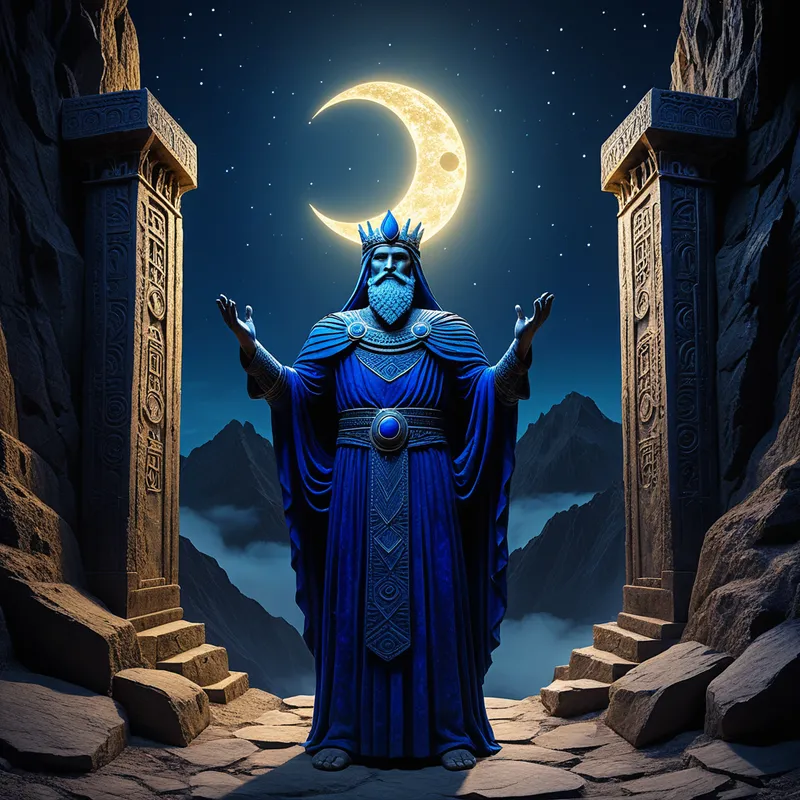
Hear now the tale whispered by the reeds along the Two Rivers, a story written in the silent waning of the silver orb in the night sky. In the time when the gods walked the earth and the heavens were close, a great stillness fell upon the world. The barley in the field grew thin and pale. The ewes gave no milk. The people of Ur looked up and their hearts grew cold, for the moon, their gentle father Nanna, was shrinking. Night by night, his luminous boat of the sky grew thinner, a sliver of its former self, sailing toward a hidden horizon from which it seemed it might not return.
This was no ordinary fading. This was a sickness of the cosmos. Ereshkigal, the mighty and terrible queen of the Kur, had cast her baleful gaze upward. A profound inertia, a gravity of despair, pulled at the celestial lights. The rhythms of life—the tides of women, the flow of rivers, the germination of seed—all faltered, tied as they were to the moon’s steady pulse.
Nanna, from his high ziggurat, felt the pull. He heard the laments of his people carried on the dry wind. He saw the order of Me unraveling. A father does not abandon his children. A king does not flee his failing realm. And so, the Lord of Wisdom made a fateful decision. He would not wait for the darkness to take him. He would go to meet it.
Leaving his radiant crown upon its altar, Nanna set forth. He did not descend on a beam of light, but walked the hidden paths, the roads that lead downward. He passed the first gate of the Kur, where the guardian demanded his outer cloak of authority. At the second gate, he surrendered his scepter. At the third, his royal seals. Gate by gate, the luminous god of Ur was stripped. His celestial light dimmed. His form grew heavy with the dust of the forgotten earth. The air grew thick and silent, a silence that pressed upon the ears like stone.
Finally, he stood in the dust-filled hall of Ereshkigal herself. She sat upon her throne of lapis lazuli and despair, crowned with the sorrows of the dead. Here, in the heart of the land of no return, the Lord of the Measured Month was no longer a sovereign. He was a supplicant, naked to the absolute power of the Great Below. He stood before the still heart of all endings. And there, in that ultimate confrontation, he offered not a challenge, but his presence. He offered the full weight of his fading light, his concern for the world above, his very identity as the shining one. He did not fight the darkness; he entered into its law.
And in that offering, something shifted in the iron order of the Kur. The balance was acknowledged. The sacrifice was witnessed. A decree was spoken in the silent language of the underworld. The moon could not die, for its death was the death of time itself. Having submitted to the law of the below, Nanna was granted the law of return. Cloakless, scepterless, but imbued with a new, hard-won understanding, he began the ascent. And as he climbed back toward the world of the living, night by night, the people of Sumer saw the sliver of light in the west grow. The waxing moon was not just a celestial body; it was a god returning from the land of the dead, bringing with him the restored promise of cycle, of growth, of life that follows even the deepest descent.
Cultural Origins & Context
This myth, part of the broader corpus of Mesopotamian “descent” literature, finds its roots in the very soil of Sumer. It was not mere entertainment but a foundational narrative recited by temple gala priests during crucial lunar festivals and periods of agricultural crisis. The primary cult center of Nanna was the magnificent E-kiš-nu-ĝal ziggurat in Ur, where the moon god’s cycles were meticulously observed and ritually mirrored.
The story functioned as a divine etiology for the moon’s phases, explaining the terrifying monthly “death” of the moon as a voluntary, heroic journey to the underworld. For an agrarian society utterly dependent on cyclical time—the flooding of the rivers, the planting of crops, the gestation of livestock—the moon’s predictable disappearance and return was a matter of existential importance. The myth reassured the people that this disappearance was purposeful, a necessary negotiation with the powers of the Kur to ensure fertility’s return. It positioned their patron god not as a capricious deity who abandoned them, but as a heroic ruler who risked his own sovereignty to maintain the cosmic Me for their sake.
Symbolic Architecture
At its core, the Descent of Nanna is a masterful map of a fundamental psychic process: the conscious ego’s necessary journey into the unconscious. The moon god represents the principle of conscious light, order, measurement, and cyclical time—the known world of the ego. The Kur is the collective unconscious, the realm of the forgotten, the repressed, and the archetypal powers that ultimately govern life and death.
The hero is not who conquers the darkness, but who consents to be unmade by it, in service to a wholeness greater than the self.
The stripping at each gate is not a punishment, but an alchemical necessity. Nanna surrenders his titles (persona), his symbols of power (ego-inflation), and finally his very radiance (conscious identity). He arrives at the throne of Ereshkigal not as a conqueror, but in a state of psychic nakedness. Ereshkigal herself symbolizes the ultimate, often terrifying, aspect of the Anima or the Great Mother in her devouring, transformative aspect. The confrontation is the ego facing the totality of the unconscious without defenses. The “resolution” is not a battle won, but a law understood—the law of psychic equilibrium. Life (the upper world) cannot exist without acknowledging and integrating the reality of death (the underworld).
The Dreamer’s Resonance
When this mythic pattern stirs in the modern psyche, it often manifests in dreams of profound descent: finding oneself in basements that deepen endlessly, riding elevators that plummet below the earth, or walking down long, dark staircases into forgotten parts of one’s own home. The somatic feeling is one of heavy gravity, of being pulled down, of a vital energy (libido) sinking inward.
Psychologically, this signals a necessary depressive phase, not as pathology, but as process. The conscious attitude has become barren, “waning.” The ego’s familiar light and strategies are failing. The dream-ego is being compelled to follow the libido into the underworld of the psyche—into long-ignored grief, buried shame, or dormant complexes. Like Nanna, the dreamer may feel stripped of their social roles, their confidence, their sense of purpose. This is the psyche’s innate ritual, forcing a confrontation with the inner Ereshkigal—the accumulated, frozen pain or rage that holds a piece of one’s soul captive. The dream is the beginning of the descent, the acknowledgment that to be whole, one must go where one fears to go.
Alchemical Translation
For the individual, this myth models the stage of nigredo in the journey of individuation. The conscious personality, identified with its light and its achievements (the full moon), must willingly submit to its own dissolution. The “descent” is the withdrawal of projections, the end of inflation, the painful but necessary immersion in one’s own shadow material.
The treasure hard to attain is not found in the light, but forged in the agreement made with the darkness.
The gates represent the successive letting-go required: of the need to be perceived a certain way, of outdated self-concepts, of the pride that keeps one isolated from one’s own depths. Standing before the throne of the inner queen of the dead is the ultimate inner work—facing the core wound, the primal fear, the source of one’s deepest nihilism or despair, without flinching and without the intention to “fix” it. One simply bears witness to its existence within the self.
The return, the waxing, is the albedo. It is not a return to the old, naive light, but the emergence of a new, tempered consciousness. One returns with the knowledge of the below integrated. The cycles of creativity, relationship, and life itself are no longer threatened by periodic “wanings,” because one knows these phases are not failures, but essential journeys to the source. The individual becomes like the moon—a being who contains both light and darkness, whose wholeness is expressed in the graceful, inevitable rhythm of showing and hiding, of engagement and retreat.
Associated Symbols
Explore related symbols from the CaleaDream lexicon:
- Moon — The central deity and symbol of cyclical time, conscious light, and the ego’s journey through phases of visibility and integration with the unconscious.
- Descent — The core action of the myth, representing the voluntary journey into the depths of the psyche, the underworld, or the unconscious to retrieve lost vitality.
- Gate — The sequential thresholds of the underworld, symbolizing the stages of surrender, where aspects of the persona and ego-identity must be relinquished.
- Underworld — The realm of Ereshkigal, representing the collective unconscious, the shadow, repressed memories, and the psychic substrate from which all life emerges and returns.
- Sacrifice — Nanna’s voluntary offering of his light and sovereignty, modeling the necessity of ego-sacrifice for the sake of psychic renewal and cosmic balance.
- Rebirth — The waxing moon’s return, symbolizing the renewal of consciousness, fertility, and creative life that follows a fully experienced descent and confrontation.
- Darkness — Not merely absence of light, but the fertile, transformative ground of the unconscious where dissolution precedes re-formation.
- Cycle — The eternal pattern of waning and waxing, descent and return, which governs not only the cosmos but the individuation process of the soul.
- Moon Phase — The visible manifestation of the myth in the sky, a constant reminder of the necessity of periodic withdrawal, introspection, and renewal.
- Temple — The ziggurat of Ur, representing the structured, conscious world that falters without its connection to the divine cycle enacted through the god’s journey.
- Order — The Me that is disrupted by the moon’s waning and restored by his return, symbolizing the psychic equilibrium between conscious and unconscious forces.
- Shadow — The personal and collective contents of the Kur that must be faced and integrated for the individual or culture to become whole.