The Descent of Nergal Myth Meaning & Symbolism
The god Nergal, insulted by an underworld messenger, descends to conquer death itself, only to find his throne in the realm he sought to destroy.
The Tale of The Descent of Nergal
Hear now the tale of the god who stormed the silent land. In the high places, where the air is thin with power, the great gods feasted. Anu presided, and Ea counseled, and the light was a palpable thing, heavy with incense and decree. But to this assembly came a messenger from the deeps, from the dust-choked halls where light is a memory. Her name was Ereshkigal, and she sent her vizier, Namtar, to claim her portion.
Namtar entered, a chill moving with him. One by one, the celestial lords rose in respect, honoring the claim of the Queen Below. All rose, save one. Nergal remained seated, a statue of smoldering pride. He did not rise for a servant of dust. This insult, a spark in the dry tinder of cosmic protocol, was carried back through the seven gates, down the slope of no return, to the ear of the lonely queen. Her wrath was a cold fire. She demanded the offending god be sent to her, to be slain for his arrogance.
The council of gods was troubled. To refuse was to invite chaos; to consent was to sacrifice a son of heaven. Ea, the cunning, devised a path. He instructed Nergal, not to go in submission, but to go as a storm. He gave him a chair, a disguise, and a company of fourteen demons. “Do not sit, do not eat, do not wash, do not anoint yourself,” Ea warned. “Show no courtesy of the living world, for they are traps in the land of the dead.”
Nergal descended. He passed through the first gate, and the second, and the third, each stripping away a layer of the world above, until he stood in the Kur. Before the throne of Ereshkigal, he saw not a monster, but a formidable power, naked in her sovereignty, rising from her throne to bathe. Here was the ultimate shadow, the totality of all that the bright gods feared and denied. He did not bow. He seized her by her hair, dragging her from the dais with the fury of a wildfire meeting permafrost. He raised his axe to strike the final blow.
But in that suspended moment, between the rage and the fall, her eyes met his. A plea was uttered. Not for mercy, but for partnership. “Be my husband,” she said. “Share my throne.” The fury in Nergal’s heart stilled, transformed. He laid down his weapon. For six days, they shared the throne and the bed of the underworld, and the realms of sun and shadow were, for a time, united.
Then, as if waking from a dream, Nergal fled. He raced back through the seven gates, up to the world of light, leaving the queen in renewed desolation. But the Kur had changed him. The air of heaven now felt thin, insubstantial. The pursuits of war and plague felt like a child’s game. A restless power gnawed at him. Meanwhile, Namtar again ascended, bearing a new, more terrible demand from the abandoned queen.
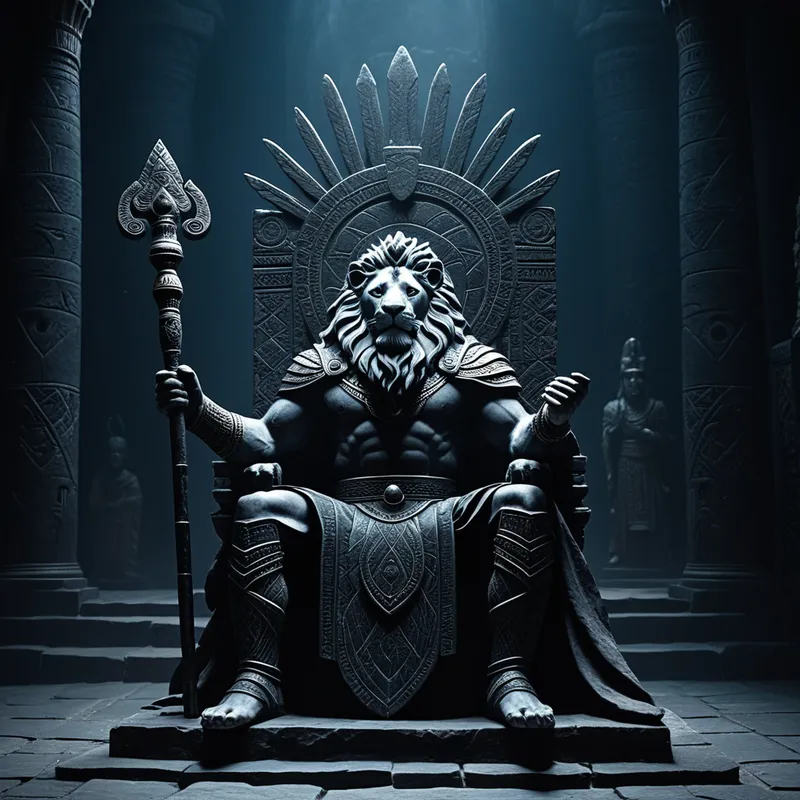
Understanding dawned upon Nergal. His true throne was not above, waiting for him. It was below, forged in his own defiant act and the intimacy that followed. He turned his back on the sun. Voluntarily, purposefully, he descended a second time. He did not storm the gates. He walked through them as their master. He returned to Ereshkigal, not as a conqueror or a fugitive, but as a king claiming his realm. He took his seat beside her, forevermore the god-king of the underworld, the lord of the dead. The scorching sun god had found his true domain in the eternal shade.
Cultural Origins & Context
The myth of The Descent of Nergal is preserved primarily on cuneiform tablets from the late Babylonian period, found at sites like Nineveh and Sultantepe. It belongs to a rich genre of Mesopotamian “descent” literature, most famously exemplified by The Descent of Inanna. This story functioned as more than entertainment; it was a theological narrative explaining the divine order. It answered the profound question: who rules the realm of the dead? The myth establishes Nergal’s sovereignty over Kur not as a primordial fact, but as a hard-won destiny, a result of divine conflict, fate, and reconciliation.
It was likely recited in ritual contexts, perhaps during ceremonies related to the cult of the dead or in periods of plague (one of Nergal’s domains). The tale reinforces a core Mesopotamian worldview: the cosmos is a tense, negotiated balance between opposing powers—heaven and earth, order and chaos, light and darkness. The gods themselves are subject to this balance, and their conflicts ultimately serve to define and stabilize the structure of reality. Nergal’s journey from an insolent youth in the pantheon to the co-regent of the underworld mirrors the human understanding of fate (shimtu) as an inescapable force that even gods must ultimately embrace.
Symbolic Architecture
At its [heart](/symbols/heart “Symbol: The heart symbolizes love, emotion, and the core of one’s existence, representing deep connections with others and self.”/), this is a myth of the encounter with the Absolute Other, and the [discovery](/symbols/discovery “Symbol: The act of finding something previously unknown, hidden, or lost, often representing personal growth, new opportunities, or hidden aspects of the self.”/) that the Other is, in fact, one’s own completion. Nergal begins as a god of destructive, externalized power—war, fire, [plague](/symbols/plague “Symbol: A symbol of widespread affliction, collective suffering, and uncontrollable forces that threaten social order and personal survival.”/). His refusal to rise for Namtar is the ego’s [rejection](/symbols/rejection “Symbol: The experience of being refused, excluded, or dismissed by others, often representing fears of inadequacy or social belonging.”/) of the [shadow](/symbols/shadow “Symbol: The ‘shadow’ embodies the unconscious, repressed aspects of the self and often represents fears or hidden emotions.”/), of all that is deemed lowly, dark, and mortal.
The throne you refuse to acknowledge is the throne you are destined to occupy.
His forced descent is the psyche’s inevitable confrontation with what it has repressed. Ea’s instructions are the fragile defenses of the conscious mind (“don’t sit, don’t eat”) attempting to navigate the unconscious. They fail, of [course](/symbols/course “Symbol: A course represents direction, journey, or progression in life, often choosing paths to follow.”/), because a true encounter with the archetypal shadow, here embodied by Ereshkigal, is transformative, not avoidable. His initial violent [impulse](/symbols/impulse “Symbol: A sudden, powerful urge or drive that arises without conscious deliberation, often linked to primal instincts or emotional surges.”/) to destroy her is the ego’s last attempt to annihilate the threatening unconscious content. Her offer of [marriage](/symbols/marriage “Symbol: Marriage symbolizes commitment, partnership, and the merging of two identities, often reflecting one’s feelings about relationships and social obligations.”/) is the shadow’s proposal for [integration](/symbols/integration “Symbol: The process of unifying disparate parts of the self or experience into a cohesive whole, often representing psychological wholeness or resolution of internal conflict.”/), not annihilation. His [flight](/symbols/flight “Symbol: Flight symbolizes freedom, escape, and the pursuit of one’s aspirations, reflecting a desire to transcend limitations.”/) back to the light represents the painful, often necessary, [period](/symbols/period “Symbol: Periods in dreams can symbolize cyclical patterns, renewal, and the associated emotions of loss or change throughout life.”/) of recoil after a profound psychological [insight](/symbols/insight “Symbol: A sudden, deep understanding of a complex situation or truth, often arriving unexpectedly and illuminating hidden connections.”/). The final, voluntary return is the act of conscious integration, where the ego aligns itself with a new, greater center of [personality](/symbols/personality “Symbol: Personality in dreams often symbolizes the traits and characteristics of the dreamer, reflecting how they perceive themselves and how they believe they are perceived by others.”/)—the Self. Nergal becomes the Ruler not by conquering the external world, but by accepting his innate [authority](/symbols/authority “Symbol: A symbol representing power structures, rules, and control, often reflecting one’s relationship with societal or personal governance.”/) over the inner one.
The Dreamer’s Resonance
When this myth stirs in the modern dreamer, it often signals a profound confrontation with one’s own “underworld.” This is not a nightmare of mere fear, but a somber, powerful descent narrative. You may dream of being forced to go down into a basement, a cave, or a submerged city. There is a sense of inevitability and gravity. You may encounter a formidable, often initially terrifying, feminine or masculine figure (the Ereshkigal/Nergal composite) who holds immense power in the dream.
The somatic experience can be one of heavy dread giving way to a strange, calm authority. Psychologically, this dream pattern accompanies life phases where a long-held identity—often one built on achievement, pride, or a specific role (the “heavenly” persona)—is being dismantled. The dreamer is being called to acknowledge a disowned power, a rage, a grief, or a capacity for darkness that they have refused to “rise for.” The resolution of such a dream cycle is not escape, but the dreamer finding, often to their own surprise, a sense of “rightness” or sovereignty in that dark place. They realize they are not a prisoner there, but potentially its regent.
Alchemical Translation
The alchemical journey of The Descent of Nergal is a perfect map for the individuation process, specifically the stage of confronting the shadow and achieving a form of inner sovereignty. The initial state is Nigredo, the blackening: Nergal’s insult and his subsequent expulsion from the heavenly consensus is the crisis that begins the work.
The gold of the spirit is found not by ascending from the lead of the soul, but by discovering the throne at the heart of the leaden realm.
His first descent and battle represent the Mortificatio, the killing of the old, solar-hero attitude. His union with Ereshkigal is the sacred Coniunctio, the marriage of opposites (conscious/unconscious, solar/lunar, active/receptive). This produces the new substance. His flight is the Separatio, a necessary distillation where the integrated insight is purified from the initial traumatic shock. His final, willing return is the Coagulatio, the embodiment and permanent fixing of the new state. He becomes the Lapis Philosophorum, the stone that is also a king, ruling from a center that unites all opposites. For the modern individual, this translates to the difficult but liberating process where a personal crisis (a fall from grace, a failure, a deep depression) forces a confrontation with the rejected parts of the self. The triumph is not in climbing back to the old “heaven” of one’s former identity, but in discovering an unshakable, deeper authority and peace within the very experience that seemed to destroy you. You become the ruler of your own inner kingdom, shadows and all.
Associated Symbols
Explore related symbols from the CaleaDream lexicon:
- Door — The seven gates of the underworld represent the sequential stages of descent into the unconscious, each requiring a surrender of a conscious attachment.
- Throne — The dual thrones of heaven and the underworld symbolize the centers of conscious and unconscious power; the ultimate goal is to claim the throne in the realm of shadow.
- Shadow — Ereshkigal and the entire Kur embody the personal and collective shadow, the repository of all that the conscious ego denies and fears.
- Pride — Nergal’s initial refusal to rise is the spark of hubris that initiates the entire transformative journey, forcing a confrontation with fate.
- Journey — The double descent—one forced, one voluntary—maps the necessary psychic voyage from resistance to acceptance of one’s deepest nature.
- Rage — Nergal’s furious assault on Ereshkigal represents the ego’s violent reaction to the shadow before it can be understood and integrated.
- God — Nergal’s transformation from a celestial deity to a chthonic king illustrates the archetype of divinity that encompasses both destructive and sovereign, solar and infernal aspects.
- Goddess — Ereshkigal is the archetypal goddess of the absolute depths, representing the terrifying yet ultimately integrative power of the unconscious feminine.
- Death — The underworld is not merely physical death but the psychic death of the old persona, a necessary dissolution for true rebirth of the self.
- Light — The light of the upper world represents the initial, incomplete conscious attitude that must be abandoned to find a more authentic power in the dark.
- Marriage — The union of [Nergal and Ereshkigal](/myths/nergal-and-ereshkigal “Myth from Sumerian culture.”/) symbolizes the coniunctio oppositorum, the sacred marriage of conscious and unconscious that creates psychic wholeness.
- Key — Nergal’s final, voluntary return is the key that permanently unlocks his sovereignty, showing that integration is a conscious choice, not a passive fate.