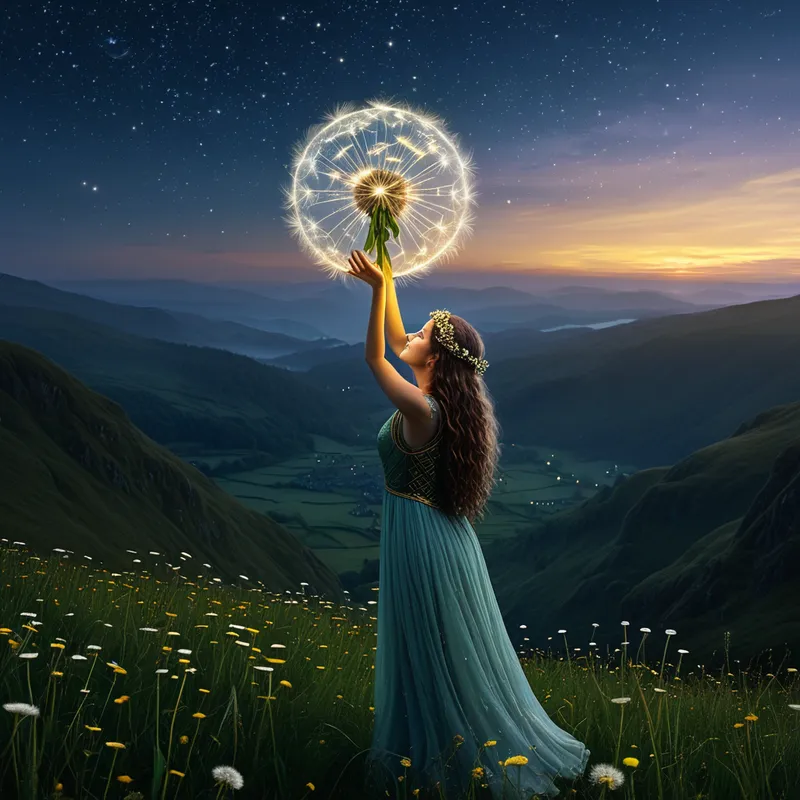
The Dandelion Clock Myth Meaning & Symbolism
A tale of a mortal granted a clock of living dandelions to see all time, who learns that true wisdom lies in accepting the moment's fleeting bloom.
The Tale of The Dandelion Clock
Listen, and let [the hearth](/myths/the-hearth “Myth from Norse culture.”/)-fire’s crackle fade. Let [the wind](/myths/the-wind “Myth from Various culture.”/) outside the roundhouse settle. I will tell you of a time not measured by sun or moon, but by a breath, and a wish.
In the days when the hills were younger and the rivers sang louder, there lived a man named Cernán. He was a farmer, his hands calloused from the plough, but his mind was a restless bird, forever flying ahead of the season. He looked at the green shoot and fretted for the ripe ear. He saw the full moon and mourned its coming wane. “If only,” he would whisper to the stones, “if only I could see the shape of time. To know the end of the story before I live the middle.”
His longing was a scent on the wind, and it drifted to the ears of Danu herself, she whose veins are the silver streams and whose breath is the morning mist. She who holds the threads of all that is, was, and will be. She saw in Cernán not arrogance, but a deep, human ache—the terror of the unseen path.
One evening, as Cernán stood at the edge of the wildwood, despair thick in his throat, the air before him shimmered like heat over summer stone. From the shimmer stepped Danu, not in towering majesty, but as a woman clad in simple green, her eyes the colour of deep, still pools under the forest canopy. In her hands, she cradled not a jewel or a sword, but a simple, perfect dandelion gone to seed—a globe of fragile white.
“Cernán Oak-heart,” she said, her voice the sound of [water](/myths/water “Myth from Chinese culture.”/) over moss. “You seek to hold time. Very well. I give you not a vision, but a clock.” She breathed upon the dandelion head. It did not scatter. Instead, it grew, until it was a sphere the size of a cupped skull, hovering between her palms. Each delicate seed-parachute glimmered with a faint, [inner light](/myths/inner-light “Myth from Buddhist culture.”/). “This is the Dandelion Clock. Blow upon it, with intention, and a seed will detach. In its drifting fall, you will see a moment—a possible moment—of what is to come. You may see the next hour, or the next year. But heed this: the clock is whole but once. When the last seed flies, the clock is gone, and with it, your sight.”
With a touch as light as a falling leaf, she placed the floating clock into Cernán’s trembling hands. Then she was gone, leaving only the scent of damp earth and elderflower.
Cernán returned to his farm, the clock hovering beside him like a silent familiar. At first, he used it sparingly, with great ceremony. He would blow a single seed and watch, entranced, as a vision unfolded in the air: his cow giving birth to a healthy calf; a summer rain ending a drought. He felt like a god, his anxiety soothed by certainty.
But the human heart is a hungry [thing](/myths/thing “Myth from Norse culture.”/). The “maybe” began to gnaw again. What if the vision he saw was not the best outcome? He blew a second seed to see an alternative. Then a third, to be sure. He stopped living his days and began auditing them, comparing the reality before him to the phantom futures drifting in his hut. The vibrant, messy, present world grew dull beside the shimmering possibilities.
The clock dwindled. Half its seeds were gone, then two-thirds. Cernán, now gaunt and hollow-eyed, clutched at the remaining seeds, terrified of the emptiness to come. He had seen so much, yet he knew nothing. He had witnessed futures but forgotten how to feel the sun on his own skin in the now.
One bleak morning, with only a handful of seeds left aglow, a true crisis struck. His only child, a daughter, fell burning with fever. The healer shook her head. Desperate, Cernán took the clock to [the child](/myths/the-child “Myth from Alchemy culture.”/)’s bedside. He prepared to blow, to search the [threads of fate](/myths/threads-of-fate “Myth from Greek culture.”/) for a future where she lived. But as he looked at her small, flushed face, and then at the beautiful, tragic artifact in his hands, a profound understanding broke upon him like dawn.
He saw that each seed he had blown was a moment of his own life he had not truly lived, traded for a phantom. He saw that Danu’s gift was not control, but a lesson. The future, like the dandelion seed, is destined to scatter on the wind—unknowable, uncontrollable. Its beauty and its purpose lie in that very release.
He did not blow the seed. Instead, he carried the dwindling Dandelion Clock outside, to the meadow where the real, humble dandelions grew. He knelt, placed his lips near the remaining seeds, and with a soft, final breath, he blew them all at once.
A storm of light filled the air. Not visions of separate futures, but a single, overwhelming sensation: the interconnectedness of all things—the past root, the present bloom, the future seed, all one. He felt his daughter’s life not as a thread to be traced, but as a pulse in the great heart of [the world](/myths/the-world “Myth from Tarot culture.”/). When the light faded, the clock was gone. Only the simple, sun-warmed meadow remained.
He returned to his daughter’s side, and simply sat, holding her hand, present to her breath, her struggle, her life. By nightfall, the fever broke.

Cultural Origins & Context
The tale of the Dandelion Clock is a piece of seanchas, belonging not to the grand mythological cycles of gods and battles, but to the folk wisdom of the hearth and field. It is a “teaching tale,” likely told by elders or filí during the liminal times—at twilight, or during the quiet days of winter. Its function was not to record history, but to shape understanding.
In a culture deeply attuned to natural cycles—the turning of the seasons (Imbolc, Beltane, [Lughnasadh](/myths/lughnasadh “Myth from Celtic culture.”/), [Samhain](/myths/samhain “Myth from Celtic culture.”/)), the phases of [the moon](/myths/the-moon “Myth from Tarot culture.”/), the life-death-rebirth of the land—the concept of time was cyclical, not linear. Yet, within that cycle, the human experience of time—of anticipation, memory, and the anxiety of the future—was keenly felt. This myth served as a cultural container for that anxiety. It acknowledges the human desire to know fate (a concept tied to the Morrígna and the weaving of destiny) while firmly rooting its resolution in the core Celtic value of presence and reciprocal relationship with the immediate, animate world.
Symbolic Architecture
The myth’s power is woven from simple, universal symbols. The Dandelion [Clock](/symbols/clock “Symbol: Clocks symbolize the passage of time, reminding us of life’s temporality, deadlines, and the urgency to act.”/) itself is a perfect [symbol](/symbols/symbol “Symbol: A symbol can represent an idea, concept, or belief, serving as a powerful tool for communication and understanding.”/) of [fate](/symbols/fate “Symbol: Fate represents the belief in predetermined outcomes, suggesting that some aspects of life are beyond human control.”/) and the fragility of time. Each seed is a potential future, a “maybe,” beautiful in its possibility but insubstantial. To cling to it is to lose it.
The future is not a picture to be seen, but a seed to be released. Its destiny is the wind; its meaning is found only in the letting go.
Cernán represents the conscious ego, the part of us that seeks control, certainty, and [linear](/symbols/linear “Symbol: Represents order, predictability, and a direct, step-by-step progression. It symbolizes a clear path from cause to effect.”/) [progression](/symbols/progression “Symbol: Symbolizes forward movement, development, or advancement through stages toward a goal or state of being.”/). His initial use of the clock is the intellect’s attempt to manage the [anxiety](/symbols/anxiety “Symbol: Anxiety in dreams reflects internal conflicts, fears of the unknown, or stress from waking life, often demonstrating the subconscious mind’s struggle for peace.”/) of existence by plotting a [course](/symbols/course “Symbol: A course represents direction, journey, or progression in life, often choosing paths to follow.”/), a classic [defense](/symbols/defense “Symbol: A protective mechanism or barrier against perceived threats, representing boundaries, security, and resistance to external or internal challenges.”/) against the [chaos](/symbols/chaos “Symbol: In Arts & Music, chaos represents raw creative potential, uncontrolled expression, and the breakdown of order to forge new artistic forms.”/) of [life](/symbols/life “Symbol: The symbol of ‘Life’ represents a journey of growth, interconnectedness, and existential meaning, encompassing both the joys and challenges that define human experience.”/). Danu represents [the Self](/myths/the-self “Myth from Jungian culture.”/)—the greater, unconscious totality of the [psyche](/myths/psyche “Myth from Greek culture.”/) and the world. She does not deny his desire but offers a tool that will ultimately teach him its own futility, guiding him toward a wiser, more integrated state.
The final act of blowing all remaining seeds is not surrender, but [integration](/symbols/integration “Symbol: The process of unifying disparate parts of the self or experience into a cohesive whole, often representing psychological wholeness or resolution of internal conflict.”/). It is the [moment](/symbols/moment “Symbol: The symbol of a ‘moment’ embodies the significance of transient experiences that encapsulate emotional depth or pivotal transformations in life.”/) [the ego](/myths/the-ego “Myth from Jungian culture.”/) relinquishes its illusion of control and accepts its [role](/symbols/role “Symbol: The concept of ‘role’ in dreams often reflects one’s identity or how individuals perceive their place within various social structures.”/) as a participant within a larger, mysterious [pattern](/symbols/pattern “Symbol: A ‘Pattern’ in dreams often signifies the underlying structure of experiences and thoughts, representing both order and the repetitiveness of life’s situations.”/). The resulting [vision](/symbols/vision “Symbol: Vision reflects perception, insight, and clarity — often signifying the ability to foresee or understand deeper truths.”/) of unity is the psychic experience of wholeness that follows such an [acceptance](/symbols/acceptance “Symbol: The experience of being welcomed, approved, or integrated into a group or situation, often involving validation of one’s identity or actions.”/).

The Dreamer’s Resonance
When this myth stirs in the modern dreamer, it often manifests as dreams of frantic preparation for an unseen event, of watching clocks with missing hands, or of holding something beautiful and fragile that is disintegrating (sands, petals, smoke). The somatic feeling is one of tightness in the chest, a held breath, a sense of racing against an invisible tide.
Psychologically, this signals a point of tension between the ego’s planning function and the soul’s need for presence. The dreamer is likely caught in a state of future-tripping or obsessive forecasting, sacrificing present-moment vitality for the illusion of security. The psyche is presenting the Dandelion Clock as a diagnostic image: “You are trying to hold time. You are counting seeds instead of living in the field.” The anxiety is not about the future itself, but about the ego’s exhausted, futile effort to encapsulate it.

Alchemical Translation
The myth models the alchemical process of [putrefactio](/myths/putrefactio “Myth from Alchemical culture.”/) and coniunctio. Cernán’s initial state is one of separation—he is divided from the flow of time, an observer critiquing life’s narrative. The gift of the clock begins the [putrefactio](/myths/putrefactio “Myth from Alchemical culture.”/): his old mindset of control festers and decays as he becomes a prisoner of possibility, isolated in a cage of his own making. His despair at the dwindling seeds is the crucial [nigredo](/myths/nigredo “Myth from Alchemical culture.”/), the blackening.
The alchemy of the soul requires the dissolution of the clock—the willing destruction of our personal, constructed timelines to make space for the eternal now.
His decision not to use the final seed for his daughter is the turning point, the first act of true will aligned with the Self, not the ego. The final, deliberate scattering is the coniunctio. By releasing all remaining futures into the wind, he symbolically releases his ego’s claim to know and direct his life. He is no longer a reader of the book, but a word within its sentence. This unites him with the cyclical, participatory time of nature—Danu’s time.
For the modern individual, the “alchemical translation” is the practice of relinquishing the obsessive mental time-travel that causes suffering. It is the movement from asking “What will happen?” to engaging with “What is happening?” It is understanding that our deepest wisdom does not come from forecasting the weather of our lives, but from learning to stand, present and open, in whatever weather arrives. We are not the holders of the clock. We are the meadow from which it grows, and to which its seeds, in their perfect time, return.
Associated Symbols
Explore related symbols from the CaleaDream lexicon: