The Dagda's Cauldron Myth Meaning & Symbolism
The myth of the Dagda's magical cauldron, which endlessly provides nourishment and restores life, symbolizing inexhaustible abundance and deep psychic renewal.
The Tale of The Dagda’s Cauldron
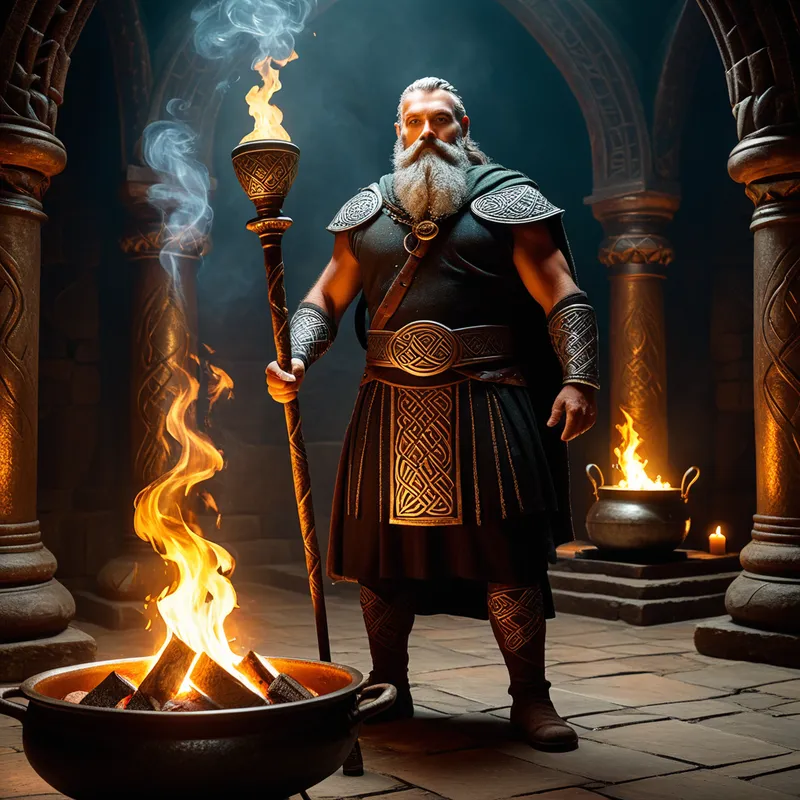
Listen. In the time before memory hardened into history, when the world was woven from song and shadow, there lived the Dagda. He was the Good God, the All-Father, whose belly was a rolling hill and whose laughter shook the roots of the oak. Among his treasures—the club that could kill with one end and resurrect with the other, the harp that commanded the seasons—there was one that held the very breath of the tribe: the Cauldron of the Dagda.
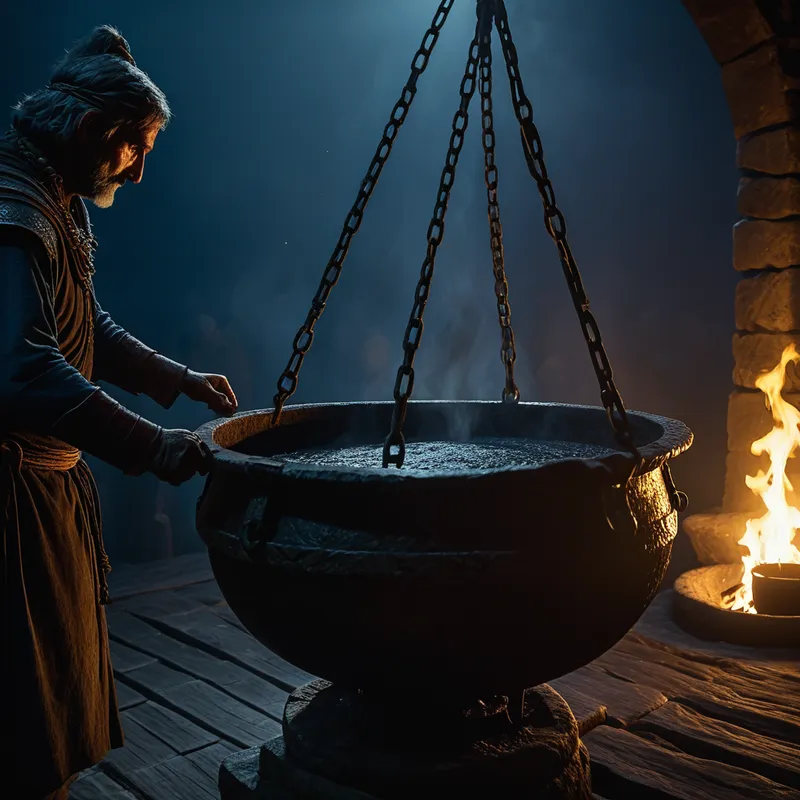
It rested in the heart of his bruidean, his great hall, a vessel of dark, pitted iron so vast a man could bathe in it. But it was not for bathing. From its depths came the Fleadh, the Feast. No man, no matter how ravenous his hunger from a day’s labor or a season’s war, ever left its ladle unsatisfied. The cauldron knew no bottom. It gave not according to what was placed within, but according to the need of the one who approached. It was the promise made flesh and iron: you will not be empty.
Then came the fog of war. The Tuatha Dé Danann faced the monstrous Fomorians in a battle for the soul of the land. The Second Battle of Mag Tuired was a day of screaming metal and dying light. Warriors fell, their strength spent, their bodies broken. And in the grim aftermath, as the crows gathered, a more profound work began.
They would bring their fallen to the Dagda’s hall. Not for burial, but for the cauldron. With chants that were more groan than song, they would lift a lifeless form and lower it into the warm, dark depths of the vessel. There was no blaze of light, no thunderclap of magic. Only a slow, seeping warmth, a stirring in the water that was more than water. And in time, the warrior would rise. Not as a ghost, but whole, weary to the bone, yet alive. The cauldron did not grant immortality—it granted return. It offered the body back to itself, and the spirit back to the tribe. It was the deep, slow heartbeat of the people, a refusal to let death have the final word. While the cauldron stood, the tribe endured. It was the unspoken covenant: from this vessel, you will be filled, and to this vessel, you may return.
Cultural Origins & Context
This myth survives in the medieval Irish textual tradition, primarily within the cycle of tales concerning the Lebor Gabála Érenn (The Book of Invasions) and the saga of Cath Maige Tuired (The [Second] Battle of Mag Tuired). These manuscripts, penned by Christian monks, preserved older oral traditions of the Druidic filid, the poet-historians. The Dagda’s Cauldron is named as one of the Four Great Treasures of the Tuatha Dé Danann, brought from their mythical cities.
Its societal function was multifaceted. On a literal level, it spoke to a culture for whom communal feasting was a core social and political act, a redistribution of wealth and a cementing of bonds. The cauldron that never empties is the ultimate symbol of chiefly generosity and the security of the tribe. On a spiritual level, it reflects a worldview where the boundaries between life and death were more permeable, where regeneration was a constant, cyclical force. The cauldron was not a miracle in a foreign sense, but an amplification of a natural, sacred principle—that from the dark, nourishing earth (the womb of the cauldron) comes endless sustenance and the potential for rebirth.
Symbolic Architecture
The cauldron is the archetypal vessel. It is the womb, the crucible, the container of transformation. It does not create ex nihilo; it transmutes. It takes the raw, the wounded, the spent, and through a process of immersion in a primal medium, returns it renewed.
The cauldron represents the psyche’s innate, containing capacity to hold our experiences—our hungers, our traumas, our exhaustions—and, through the alchemy of time and attention, render them nourishing.
The Dagda himself is the archetype of the nourishing father, the ruler whose power is expressed not in domination but in provision. His cauldron ensures that no member of the psychic community goes unfed or is abandoned to the finality of despair. The “magic” is in the unconditional nature of its gift: it gives according to need, not merit. This speaks to a foundational layer of the self that offers support not because we have earned it, but because we are.
The act of restoring warriors is particularly potent. It symbolizes the psyche’s ability to heal from psychic “death”—from burnout, fragmentation, or profound loss. The revival is not a return to a pristine, untouched state, but a return weary. One is brought back to life, but life is still work. The healing is real, but it is not a fantasy of erasure.
The Dreamer’s Resonance
When this myth stirs in the modern unconscious, it often manifests in dreams of profound nourishment or restoration. The dreamer may find a simple pot on the stove overflowing with a delicious, comforting meal for a crowd. They may dream of sinking into a deep, warm bath that seems to soak away not just dirt, but grief or fatigue. Alternatively, the dream may present a wound or a broken object being placed into a container—a box, a lake, a cave—and emerging whole, though perhaps scarred.
Somatically, this points to a process of replenishment. The psyche is signaling a depletion of its deepest resources—not just energy, but the vital sense of being held and sustained. The dream is an image of the self-care that is needed, not as a luxury, but as a fundamental, vessel-based ritual. It can also appear during periods of grief or post-traumatic stress, where the psyche is attempting the slow, submerged work of integrating a shattering experience, of finding a way to “bring the fallen warrior back” into the community of the self. The feeling upon waking may be one of deep comfort, or a poignant longing for the very container the dream depicts.

Alchemical Translation
The individuation process modeled here is not one of heroic conquest, but of receptive restoration. The ego is not the Dagda wielding the club, but the warrior approaching the cauldron. The first alchemical step is the recognition of emptiness or injury—the admission of hunger, of wounding. This is the “Fomorian” moment, where our inner resources are besieged.
The second step is the submission to the vessel. This is the critical, non-heroic act: allowing oneself to be lowered into the containing medium. In psychological terms, this is the descent into the unconscious, into therapy, into meditation, into any practice that holds us in a structured, nourishing space without immediate demand for output. It is the trust that a part of the self (the Self, symbolized by the Dagda and his hall) has provided this cauldron.
The alchemical work happens in the dark, warm suspension of the cauldron. It is the slow, unattended process where fragmentation begins to cohere again, where exhaustion is metabolized into potential energy.
The final step is the return. One emerges not “cured” in a simplistic sense, but renewed for purpose. The revived warrior can rejoin the battle of life, not because the battle has ended, but because his connection to the source of renewal has been reaffirmed. The alchemical translation is thus a cycle: expenditure, emptying, immersion, renewal. To individuate is to become, like the Dagda, the steward of one’s own cauldron—to build the inner hall where exhaustion can be met with endless stew, and where despair can be immersed in the waters of return. It is the cultivation of an inner abundance so deep that it can, again and again, say to the starving, wounded parts of the self: you will be filled, and you will return.
Associated Symbols
Explore related symbols from the CaleaDream lexicon: