The Cubit Myth Meaning & Symbolism
The story of the sacred measure, bridging the infinite divine to the finite human, establishing order from chaos through the architecture of the soul.
The Tale of The Cubit
In the beginning, there was the Word, and the Word was measureless. The heavens stretched without end, and the earth was a formless deep, a churning womb of potential without boundary or bone. The Creator spoke light from darkness, but the spaces between—the distances of the firmament, the depths of the seas—remained a divine mystery, known only to the mind that conceived them.
Then came the time of making. Not just world, but dwelling. A place for the holy to touch the dust. The divine architect gazed upon the chaos of human endeavor—the piles of stone heaped without plan, the walls built crooked, the temples that reached for the sky only to crumble under their own ambition. There was fervor, but no form. There was devotion, but no door.
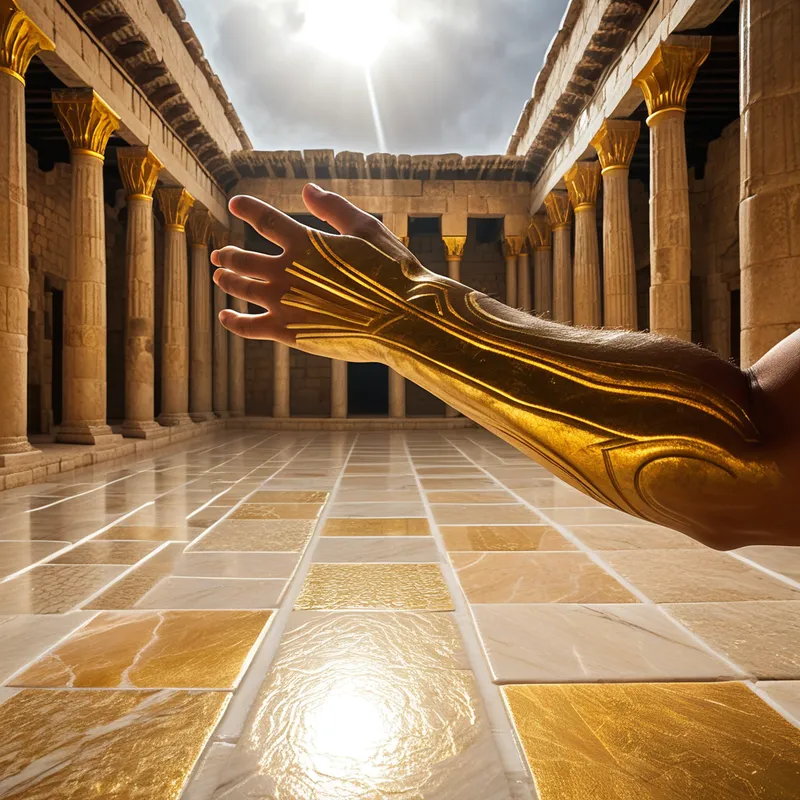
And so, from the place beyond places, a revelation descended. It was not a thunderclap, but a silent imposition of order. Before the eyes of the chosen builder—a man of heart and skill, whose spirit was wise and hands were calloused—the very air between the divine elbow and the tip of the divine middle finger solidified. It was a length of captured radiance, a beam of condensed intention. It pulsed with a soft, gold light, humming a frequency that resonated in the marrow of the stones waiting to be cut.
This was the Cubit. It was given, not invented. The builder fell to his knees, not in fear, but in profound recognition. Here was the bridge. Here was the translation. With this, the infinite could instruct the finite. With this rod of light, he could take the unutterable proportions of the heavenly sanctuary and render them in cedar and olive wood, in quarried limestone and beaten gold.
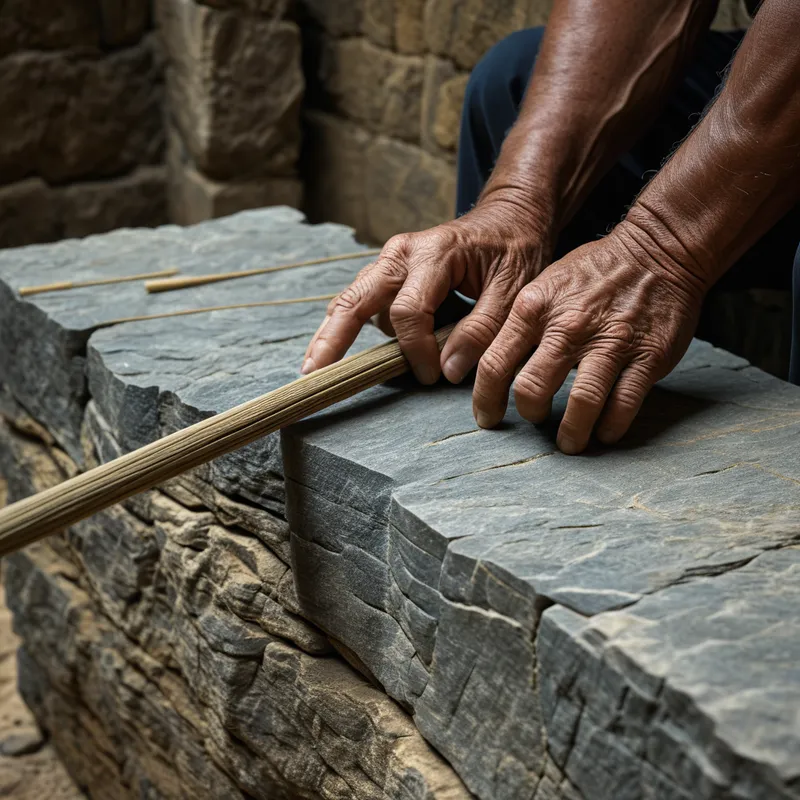
He rose, and the luminous measure became solid in his hand—a rod of acacia wood, inlaid with bands of silver, its length now an absolute truth in the world of men. He laid it against the foundation stone. He measured the porch, the inner sanctuary, the Holy of Holies. Every wall found its true height, every chamber its perfect proportion. The temple rose not as a human guess at glory, but as an earthly echo of a celestial blueprint. The Cubit was the covenant of geometry, the silent promise that where humanity builds with this sacred measure, the divine will consent to dwell.
Cultural Origins & Context
The Cubit is not a myth in the narrative sense of gods and heroes, but a foundational mythologem—a sacred conceptual unit embedded in the legal, architectural, and cosmological texts of the Hebrew Bible. Its primary context is the construction of sacred space: the Tabernacle (Exodus 25-27) and later, Solomon's Temple (1 Kings 6).
Its transmission was priestly and precise, recorded in scrolls that served as both building manuals and theological treatises. The society that held this myth was one defined by covenant—a binding agreement between the limitless Divine and a people living within very real physical and moral boundaries. The Cubit was a tangible expression of this relationship. It was a tool for the Levitical artisans, a standard for judges, and a symbolic reminder that a well-ordered society, like a well-built temple, requires an authoritative, transcendent standard against which all things are measured. Its function was to translate transcendent law into immanent form, making the invisible order of the cosmos visible in the pillars and curtains of the dwelling place for God.
Symbolic Architecture
Psychologically, the Cubit represents the principle of limitation as the precondition for creation. It is the archetypal "measure" that differentiates chaos from cosmos, the unconscious from the conscious.
The infinite cannot be built with. Only the finite can become a vessel.
The Cubit symbolizes the necessary boundary of the ego—the conscious personality. Before its imposition, the inner world is a "formless void," full of potential but also of terror and dissolution. The divine arm, from elbow to fingertip, signifies a span that is both of the body and beyond it—a unit derived from the divine anthropos (the God-image), making it relatable, yet its origin is transcendent. This is the perfect symbol for a psychological standard: it must feel innate and human (elbow to fingertip is a natural measure), yet it must carry the authority of the Self (the total, organizing center of the psyche) to effectively order the personal realm.
The conflict in the myth is not a battle, but the tension between the unmeasured, chaotic potential of raw material (the unconscious) and the demanding, clarifying discipline of the sacred standard (the differentiating consciousness). The triumph is the arising of a temenos—a sacred, protected space within the psyche where the numinous can be encountered without destroying the individual.
The Dreamer's Resonance
When this mythologem activates in the modern dreamer, it often manifests in dreams of measuring, building, or encountering a mysterious, authoritative standard. One might dream of frantically trying to use a ruler that keeps changing length, representing the anxiety of living without a stable inner value system. Another might dream of discovering a perfect, glowing rod in a cluttered attic, symbolizing the nascent emergence of a new, authentic personal ethic from the clutter of the past.
Somatically, this process can feel like a contraction—a slight tightening or focusing in the solar plexus or the mind, as diffuse energy or emotion is given a specific form and limit. It is the psychological process of discernment. The dreamer is moving from a state of vague possibility or chaotic impulse toward making concrete choices that define who they are and what they stand for. The dream Cubit is the psyche's own tool for saying, "This far, and no further. To this height, and no other. This is the proportion of my life."

Alchemical Translation
The alchemical work modeled by the Cubit is coagulatio—the process of making the spiritual solid, of bringing the volatile insights of the unconscious down to earth in a durable, lived form. It is the stage in individuation where one stops merely experiencing numinous fantasies or chaotic emotions and begins to "build the temple"—to construct a conscious life structured around authentic, self-derived principles.
The raw materials are the instincts, talents, relationships, and experiences of a lifetime. The divine blueprint is the unique, latent pattern of the Self. The Cubit is the mediating function, the critical faculty of consciousness that measures, cuts, and fits these materials according to the inner law.
Individuation is not becoming infinite; it is becoming a finite vessel of precise and beautiful proportion, capable of holding the infinite.
The struggle is the resistance of the material—the stubbornness of old habits, the weight of societal expectations, the fear of making a defining choice. The triumph is not a finished product, but the ongoing, faithful application of the measure. Each time we choose integrity over convenience, set a boundary out of self-respect, or craft a work or a relationship with conscious care, we wield the Cubit. We are no longer slaves to the formless deep within or the chaotic demands without. We become, ourselves, the sacred builder, translating the whisper of the eternal into the enduring architecture of a soul.
Associated Symbols
Explore related symbols from the CaleaDream lexicon: