The Crossroads of Hecate Myth Meaning & Symbolism
A story of thresholds and choices, where the goddess of magic and ghosts awaits travelers at the place where three roads meet, offering guidance or terror.
The Tale of The Crossroads of Hecate
Listen, and let the veil between worlds grow thin. Let us travel to a place that is not a place, a time that is not a time—the hour when the sun has fled and the moon has not yet claimed her throne. This is the hour of the threshold, the hour of in-between. And in this hour, all roads lead to her.
The air is still, heavy with the scent of dust, cypress, and distant salt. The path beneath your feet is worn smooth by countless journeys, but here, it does not continue. It fractures. It becomes three. A fork is a simple choice, a binary of here or there. But a trivium, a meeting of three ways, is a different magic entirely. It is a geometry of possibility, a sigil drawn upon the earth. This is the Crossroads.
And here she waits.
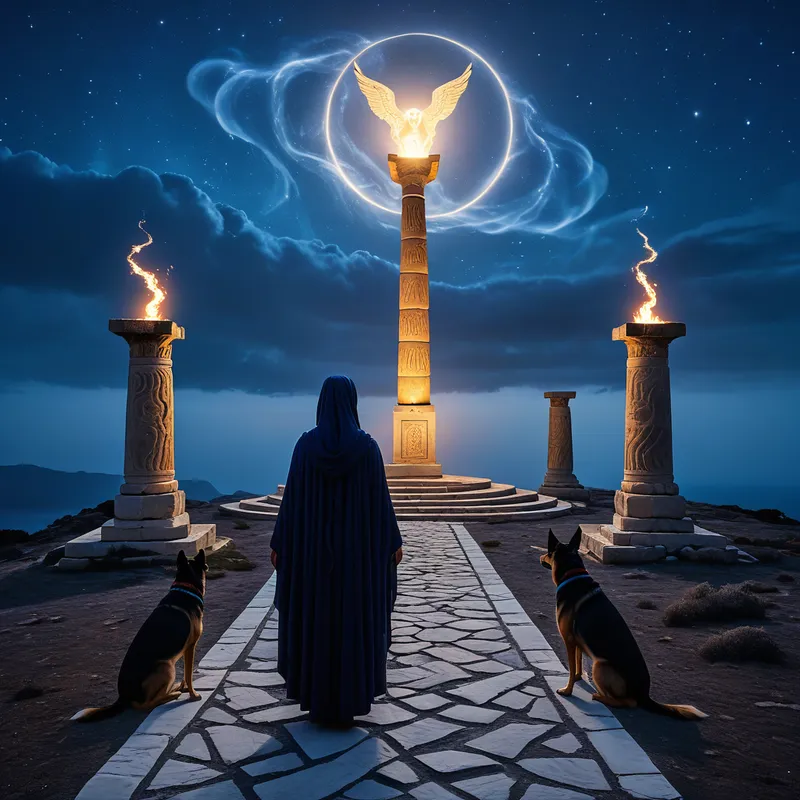
You do not see her at first. You feel her—a pressure in the silence, a watchfulness that raises the hair on your neck. Then, the light of her torches manifests, twin flames that burn without smoke, casting long, dancing shadows that seem to have a life of their own. From the gloom, she emerges. She is one, and she is three. Perhaps she has three bodies, standing back-to-back-to-back, each facing a different road. Perhaps she has one form with three faces, seeing all that was, is, and could be. She is Hecate, daughter of stars, keeper of keys.
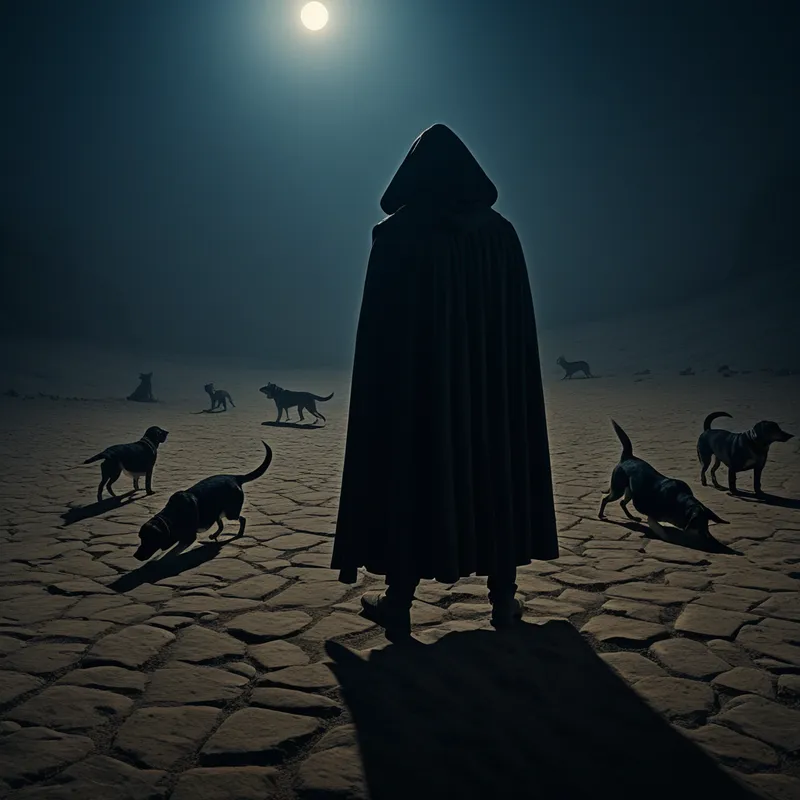
Her cloak is the color of a moonless midnight. At her feet coil the whispers of the earth, taking shape as hounds with eyes like polished jet—her sacred dogs, who bay at spirits, not the moon. She is attended by the restless dead, those who cannot find the final road, drawn to her liminal power.
The traveler arrives, soul weary, purpose uncertain. The journey has led them to this point of decision, but which path? One road leads home, to familiar hearths and known loves. Another winds toward the city, toward ambition and the clamor of men. The third descends into a deep wood, toward the unknown, the wild, the secret self. All are true. All are perilous.
The traveler freezes, the weight of the choice a stone in their chest. This is the moment of the myth. Will they rush forward in fear, choosing blindly? Will they fall paralyzed, becoming another ghost at the crossroads? Or will they remember the old ways?
With trembling hands, the traveler reaches into their pack. Not for a weapon, but for sustenance—a honey cake, a handful of olives, a libation of wine. They place it carefully at the central point where the roads converge, a humble altar of earth and intention. They whisper a prayer, not for a specific outcome, but for clear sight. For the wisdom to choose.
Hecate observes. The torches dip. The spectral hounds grow still. This act of reverence, this acknowledgment of the sacredness of the threshold, is the key. It does not bribe the goddess; it aligns the traveler with the moment. In the newfound silence, an understanding blooms—not in words, but in the gut, in the bones. The right path feels different. It pulls. It resonates. It is not about safe or unsafe, but about true.
The traveler takes a step. The chosen path accepts them. Hecate and her torches fade back into the liminal dark, her work complete. Guidance was not given as a command, but was unlocked by the courage to stand at the center and truly see.
Cultural Origins & Context
The figure of Hecate and her dominion over crossroads is ancient, with roots likely stretching back into pre-Greek Anatolian worship. In the Homeric Hymns and later in the works of poets like Hesiod, she is portrayed as a powerful Titaness honored by Zeus himself, given a share of dominion over earth, sea, and sky. Her association with crossroads solidified in the classical and Hellenistic periods.
The crossroads ritual, known as the “Hecate’s Deipnon,” was a tangible, household practice. On the last day of the lunar month, families would leave offerings of food—“the meal of Hecate”—at a three-way crossroads outside their city or town. This was not merely superstition; it was a profound civic and spiritual hygiene. The offerings purified the household, appeased restless spirits (Keres) drawn to such places, and sought the favor of the goddess for the month to come. The crossroads was the perfect “outside” place to deposit psychic and literal pollution, a boundary between the ordered community (polis) and the wild unknown.
Thus, the myth was lived monthly. It was passed down not just by bards, but by mothers and fathers preparing the offering plate. Its societal function was dual: it provided a structured way to confront the unknown and the fearful (ghosts, bad luck) while also reinforcing the concept that major life choices were sacred acts, deserving of ritual attention and respect for the forces that govern fate.
Symbolic Architecture
The Crossroads of Hecate is a master symbol of liminality—the critical, transformative threshold between two states of being. It is the psychological space after an ending but before a new beginning.
The crossroads is not about the roads themselves, but about the potent, pregnant emptiness where they meet. That center point is the alembic of the soul.
The Three Roads represent the fundamental trichotomy of human experience: the Past (the road that brought you here), the Present (the road of conscious, known life), and the Future (the road of potential and the unconscious). Hecate, as the triple-formed guardian, embodies the simultaneous awareness of all three. She is the integrated Self that can hold memory, present reality, and possibility without being fractured.
The Offering is the crucial act of symbolic exchange. It represents the sacrifice of one’s egoic certainty, the humility to admit “I do not know the way,” and the willingness to engage with the numinous, shadowy aspects of life (the ghosts, the unknown). You cannot pay for a answer; you must pay attention. The offering ritualizes this paying of attention.
The Torches Hecate carries light the liminal space, but they do not illuminate the roads far ahead. Their light is for the immediate moment of decision, revealing the first step, not the entire journey. They symbolize the kind of insight that comes from confronting the dark, not avoiding it.
The Dreamer’s Resonance
When this myth pattern erupts in the modern dreamscape, the dreamer is at a profound existential or psychological junction. The crossroads may appear as a literal intersection, a career decision point, a choice between relationships, or a feeling of being stuck between three equally compelling or terrifying life paths.
Somatically, this dream is often accompanied by feelings of paralysis, vertigo, or a heavy pressure on the chest—the “weight of choice.” The dreamer may search frantically for a map or signpost that isn’t there, or they may see shadowy figures (Hecate’s “ghosts”) on each path, which often represent unlived lives, past traumas, or future anxieties.
The psychological process is one of integration under pressure. The unconscious is presenting the ego with a mandatory choice point, forcing a confrontation with the fact that stagnation (staying at the center forever) is a form of psychic death. The appearance of a mysterious, powerful feminine figure (even if not named as Hecate) signals that the wisdom to choose lies not in logical pros-and-cons lists, but in a deeper, intuitive, perhaps terrifying engagement with the Self. The dream is an invitation to make your “offering”—to consciously acknowledge the gravity of the transition and to seek guidance from within.
Alchemical Translation
In the alchemy of individuation, the Crossroads of Hecate models the stage of mortificatio and ablutio, followed by the dawn of illuminatio. The old identity or life structure has reached its end (the road behind). The ego stands in the chaotic, confusing nigredo of the threshold, surrounded by the shadow contents of the psyche (the ghosts, the dogs, the unknown roads).
The offering is the alchemical solve: the conscious dissolution of the ego’s insistence on controlling the outcome. By ritualizing the surrender, “I place this here and ask for sight,” the ego aligns with the larger Self.
Hecate, in this process, is the archetypal embodiment of the anima as guide to the underworld. She is not the loving mother, but the dark, magical, demanding sage who presides over transformations. Her torches provide the illuminatio—not a blinding flash, but enough light to see the immediate truth of one’s situation. This light often reveals that the “choice” is not between good and bad, but between different aspects of the Self yearning for expression.
The chosen road is then the beginning of a new coagulatio. The traveler integrates the lesson of the crossroads: that true direction is found not by fleeing the dark, liminal places, but by honoring them, making an offering of one’s confusion, and proceeding with the hard-won, torch-lit clarity of a single, committed step. The myth teaches that we become whole not by avoiding the crossroads, but by learning to stand courageously at their center, again and again.
Associated Symbols
Explore related symbols from the CaleaDream lexicon: