The Creator's Game Myth Meaning & Symbolism
A cosmic lacrosse game between the animals and birds, played for the life of a human child, revealing the sacred balance between earth and sky.
The Tale of The Creator’s Game
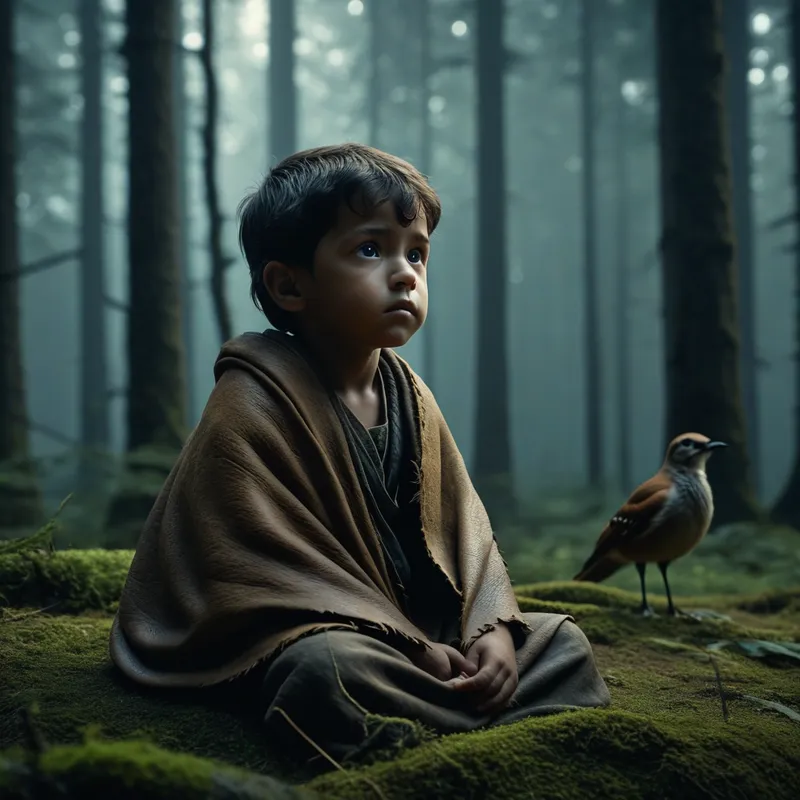
In the time before memory, when the world was still soft with newness, a shadow fell upon the heart of the People. A child, a boy of tender years, fell into a deep and unshakable sickness. No herb could cool his fever, no song could lift the weight from his chest. His breath grew shallow, a fragile thread connecting him to the world of the living. His people wept, for they knew the signs; the orenda was leaving him, drawn back to the sky from which it came.
From her place in the celestial realms, the Sky Woman looked down and saw the suffering. Her heart, which holds the balance of all things, was moved. But the laws of life and death are ancient and stern, woven into the fabric of the world itself. They could not be broken, only… contested.
So she sent a vision, a dream of fire and feather, to the wisest healers. The message was clear: the child’s life would be decided not by plea, but by contest. A great game would be played. Not a game of children, but The Creator’s Game—a sacred contest of lacrosse. Two teams would form: the Four-Leggeds, the animals of the forest and field, would champion the earth-bound child. The Winged Ones, the birds of the air and sky, would champion the pull of the spirit world. They would play for the child’s orenda.
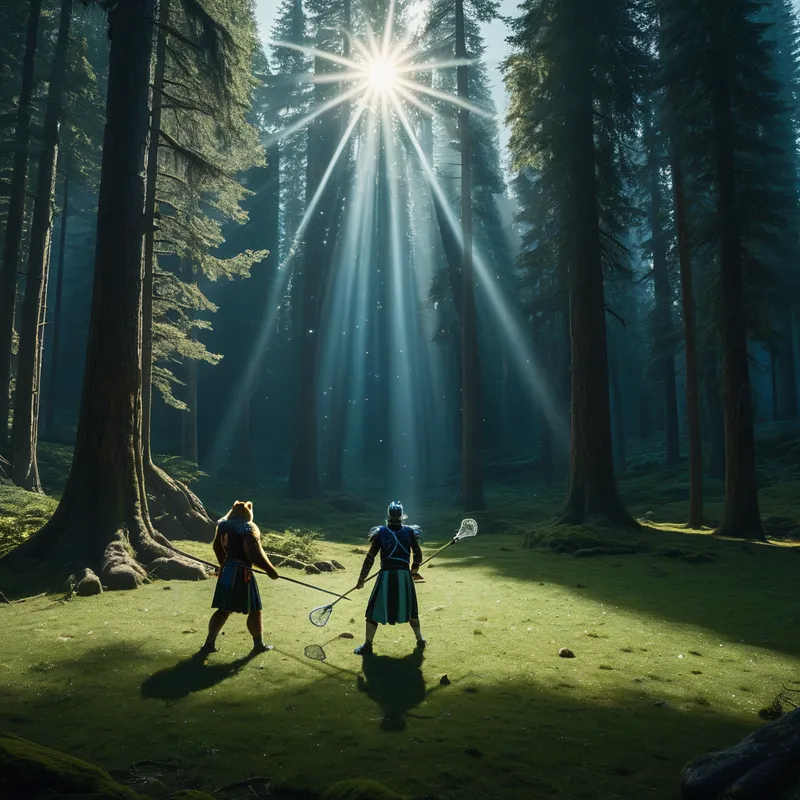
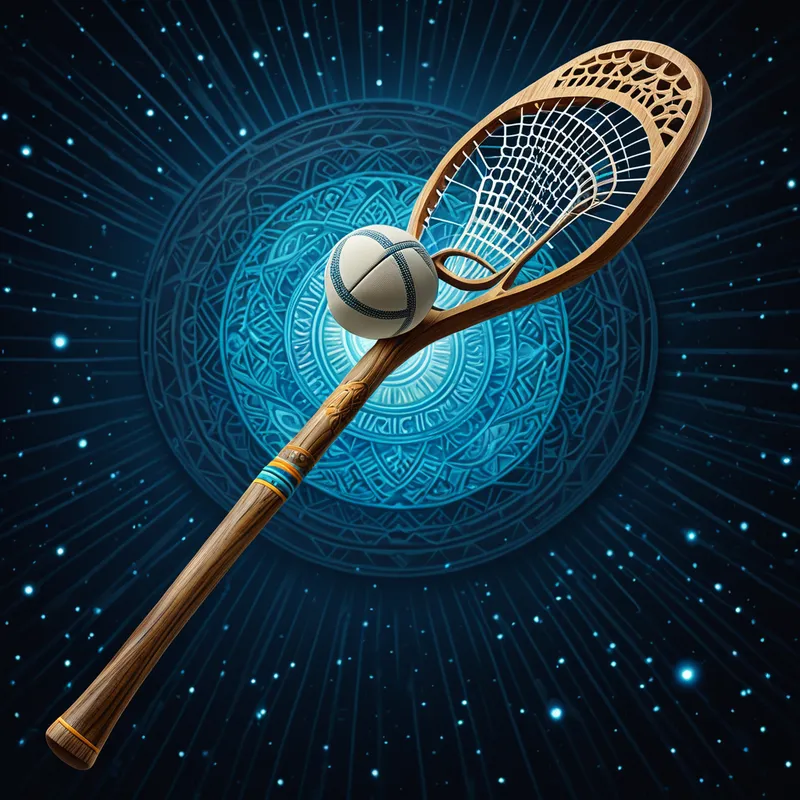
The call went out, a vibration through root and branch, a whisper on the wind. From the deepest woods came the Four-Leggeds. The bear, massive and implacable, his strength a promise of endurance. The deer, swift and sure-footed, a blur of grace. The wolf, cunning and relentless, with eyes that saw the whole field. They took up their sticks of hickory, carved with the patterns of their power.
From the high canopy and the open sky came the Winged Ones. The hawk, whose sight could pin a heartbeat from a cloud’s height. The owl, silent and knowing, a shadow with purpose. The eagle, whose wings beat with the rhythm of storms. Their sticks were of ash, light and strong, feathered with their own plumes.
The field was a great clearing, hallowed for this purpose. The goals stood at either end, gateways between worlds. At the center lay the ball, no simple sphere of hide, but a glowing orb of medicine, containing the very essence of the child’s fate. The air crackled with tension, thick with the scent of pine, damp earth, and ozone.
The game began not with a shout, but with a collective intake of breath from the world itself. It was chaos given order, a violent ballet. The bear thundered, shaking the ground, using his bulk to shield the ball. The hawk dove, a feathered arrow, snatching it from the dust. The deer darted through legs and talons, a streak of brown lightning. The owl swept low in the twilight of the struggle, a silent thief.
Back and forth the medicine ball flew—a comet trapped between earth and sky. Sticks clashed like thunder. Wings beat the air into a gale. The child, wrapped in hides, watched from the sidelines, his wide eyes reflecting the magnificent, terrifying struggle for his own soul.
The contest wore on, the sun arcing across the sky. Neither side could gain lasting ground. The strength of the earth met the freedom of the sky, and they were matched, perfectly, terribly balanced. It seemed the game would last until the stars fell, a perpetual stalemate.
Then, in a moment of sheer, desperate cunning, the smallest player made his move. The mouse, who had clung to the bear’s great shoulder throughout the game, saw his chance. As the eagle swooped in for a final, triumphant score, the mouse leapt. He was not fast like the hawk, nor strong like the bear. But he was unseen. He landed upon the soaring ball itself, a tiny weight of pure will. His slight touch altered its course by a hair’s breadth. The glowing orb veered, not into the sky’s goal, but past the post, to land gently at the feet of the stricken child.
A great silence fell. The wind stilled. The warriors, animal and bird, stood frozen, their fierce energy dissolving into a watchful calm. The medicine ball pulsed once, softly, and its light flowed into the child like water into dry earth. Color returned to his cheeks. His chest rose with a deep, clear breath. The thread had not been severed; it had been reaffirmed, won back from the brink through sacred contest.
The teams lowered their sticks. There was no jeering from the losers, no boasting from the winners. There was only the solemn understanding of the balance that had been tested and upheld. The child belonged to the earth, for now. But the sky’s claim remained, patient and eternal. The game was over. The law was satisfied.
Cultural Origins & Context
This myth, known as the origin story for the game of lacrosse or baggataway, is central to the spiritual and social life of the Haudenosaunee. It was not merely a folktale but a living narrative embedded in ritual, recounted by elders and storytellers, particularly in the long winter nights when the spiritual world felt closest. The telling was an act of cultural memory and instruction.
The story functioned on multiple levels. Practically, it sanctified the game of lacrosse, elevating it from sport to a ceremonial re-enactment of cosmic balance. Games were often played for healing, to settle disputes between communities, or to train warriors, each contest a miniature reflection of the original. Societally, it reinforced key values: the power of community (the team), the importance of every member regardless of size (the mouse), and the acceptance of life’s cyclical nature—the constant, sacred tension between life (earth) and death/spirit (sky). It taught that some conflicts are not won by domination, but through a respectful struggle that honors both sides of a paradox.
Symbolic Architecture
At its core, the myth is a profound map of psychic equilibrium. The child represents the nascent human self, the individual soul caught between two immense, competing realities.
The game is the psyche itself—the eternal contest between the terrestrial and the celestial, the instinctual and the spiritual, the body and the soul.
The Four-Leggeds symbolize the chthonic world: the instincts, the body, grounding, familial ties, and the raw, embodied will to live. The Winged Ones represent the uranic world: spirit, intellect, vision, transcendence, and the soul’s longing to return to a unified state. The child’s sickness is the trauma of incarnation—the soul’s dis-ease at being lodged in mortal flesh.
The medicine ball is the prize of consciousness, the very life-force of the individual. It is not static but must be fought for, passed, and protected. The field is the liminal space where these opposites engage, the arena of life where our deepest conflicts are played out. The mouse, the unexpected hero, embodies the cunning of the unconscious, the subtle, often overlooked insight or intervention that emerges not from brute force, but from a moment of attuned connection. It is the archetypal trickster-as-savior, proving that the whole self is saved only when every part, even the smallest and most hidden, is allowed to participate.
The Dreamer’s Resonance
When this myth stirs in the modern dreamer, it often manifests as dreams of being a spectator or an unwilling participant in a vast, incomprehensible contest. One might dream of watching a brutal but beautiful sport where the rules are unknown, feeling acute anxiety for an unnamed “prize” that feels intimately connected to one’s own survival.
Somatically, this can feel like being torn in two directions—a pressure in the chest (the confined spirit) and a heaviness in the limbs (the burdened body). Psychologically, it signals a critical point of inner conflict where two fundamental aspects of the self are at war. Perhaps the dreamer is torn between a secure, grounded career (the animals) and a lofty, spiritual calling (the birds), or between familial obligations and the need for individual transcendence. The dream is the psyche’s way of staging this conflict on its own symbolic field, indicating that a resolution—a “game”—must be consciously engaged. The sickness of the child in the myth mirrors the dreamer’s own feeling of being stuck, paralyzed, or “dying” in some aspect of their life due to this unresolved tension.
Alchemical Translation
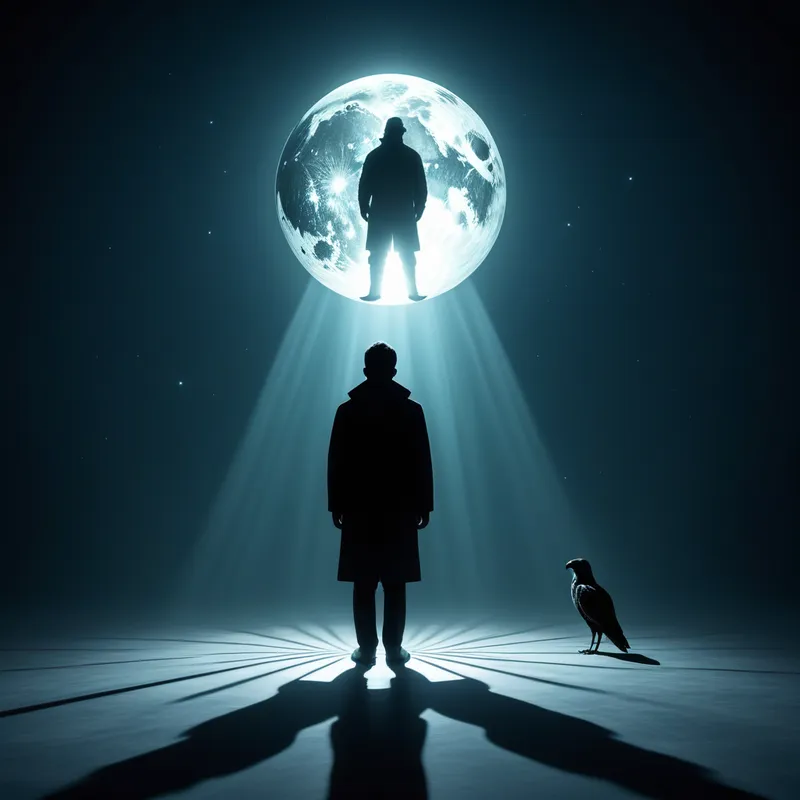
The individuation process, the journey toward psychic wholeness, is perfectly modeled in this myth. It begins with the sickness—the neurosis, depression, or profound dissatisfaction that signals the self is out of balance, favoring one realm (often the mundane) at the expense of the other.
The calling of the “game” is the conscious acknowledgment of the inner conflict. One must consent to become the field where the opposites engage. This is not a passive act but an active, often painful, participation. The modern individual must “pick up the stick” for both teams: to honor their animal nature—their instincts, needs, and physicality—while also giving voice to their bird nature—their ideals, visions, and spiritual yearnings.
The goal of the game is not for one side to obliterate the other, but for both to play so fiercely and respectfully that the prize—the integrated self—is transformed and secured.
The “mouse moment” is the crucial intervention of the unconscious, the synchronicity, the dream insight, or the sudden intuitive leap that occurs only when the conscious ego has exhausted its strategies. It is the alchemical coniunctio, the sacred marriage, achieved not through force but through a subtle, unexpected union of opposites. The healing of the “child” is the emergence of a new, more resilient center of consciousness, one that has faced the tension between heaven and earth and has been validated by the struggle. The individual learns that their vitality depends not on choosing a side, but on maintaining a dynamic, sacred tension between the two. They become, like the healed child, a living testament to the Creator’s Game—forever of the earth, yet forever touched by the sky.
Associated Symbols
Explore related symbols from the CaleaDream lexicon: