The Creation of the Visayan Islands
A Filipino myth where the Visayan Islands were born from a cosmic clash between sky and sea deities, forming a breathtaking archipelago.
The Tale of The Creation of the Visayan Islands
In the time before time, when [the world](/myths/the-world “Myth from Tarot culture.”/) was a canvas of pure potential, there existed only two primordial forces: Kaptan, the mighty Sky God, and [Maguayan](/myths/maguayan “Myth from Filipino culture.”/), the profound Sea Goddess. Kaptan’s domain was an endless, luminous vault of wind and light, while Maguayan’s was a boundless, silent abyss of dark, nurturing waters. For eons, they existed in a state of separate harmony, a tense equilibrium of above and below.
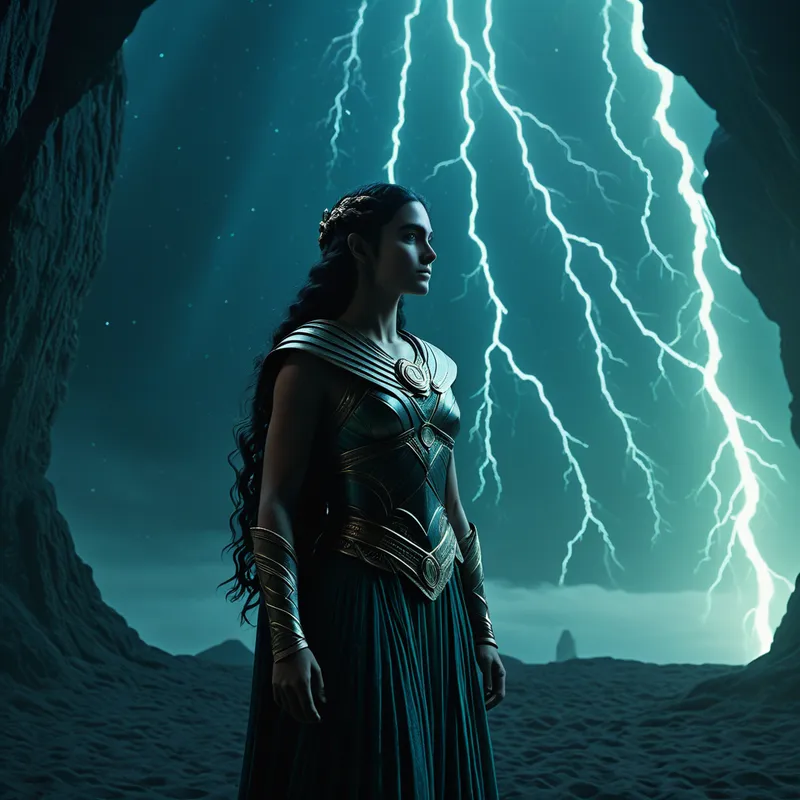
But creation is born of tension, and the first stirring of the world began with a quarrel. Some say it was over a stolen jewel of light, a [pearl](/myths/pearl “Myth from Chinese culture.”/) of the dawn. Others whisper it was a deeper, more fundamental clash of natures—[the sky](/myths/the-sky “Myth from Persian culture.”/)’s desire for dominion meeting [the sea](/myths/the-sea “Myth from Greek culture.”/)’s resistance to being contained. Whatever the spark, their conflict erupted into a cosmic war. Kaptan, in his fury, hurled colossal bolts of lightning—not mere sparks, but great jagged spears of solidified sky—down into Maguayan’s realm. Each strike was a cataclysm, a scream of celestial rage.
Maguayan, wounded and enraged, did not cower. She summoned her own power, heaving the depths upward in titanic waves and whirlpools, her waters rising like furious hands to claw at the sky itself. The sea sought to drown the light; the sky sought to pierce the dark. Their battle was the first storm, a [chaos](/myths/chaos “Myth from Greek culture.”/) of screaming winds and mountainous waves, of deafening thunder and hissing, boiling brine.
Yet, in this divine violence, something unexpected was forged. Where Kaptan’s lightning spears struck the rising mountains of [water](/myths/water “Myth from Chinese culture.”/), they did not simply vanish. They were cooled and captured, their celestial fire transformed. The lightning became stone, but a stone that remembered its origin as fire. It solidified into jagged peaks that pierced the surface, refusing to sink. And where Maguayan’s waves crashed against these newborn stones, they were shattered and gentled, their fury spent in carving bays and cradling shores.
Exhausted, their great anger spent, Kaptan and Maguayan finally stilled. As the tumult faded, they looked upon what their conflict had wrought. Scattered across the now-calm sea were countless fragments of their battle: the lightning-turned-stone stood as rugged islands, some still smoldering with inner fire, while the sheltered waters between them glowed a deep, serene blue—the color of Maguayan’s forgiveness. The violent meeting of sky-stuff and sea-stuff had given form to the formless. The Visayan archipelago was born, not from a gentle word, but from a passionate, creative clash. Each island was a testament to a strike; each strait, a memory of a retreating wave. They named this new, broken-beautiful world Visayas, and in its very landscape, the story of its violent, passionate birth was forever written.
Cultural Origins & Context
This myth originates from the pre-colonial animist and polytheistic belief systems of the peoples of the central Philippine islands. It belongs to a rich corpus of creation narratives that predate and exist alongside the more widely known Malakas at Maganda story. Recorded and preserved largely through oral tradition by Spanish chroniclers like Miguel de Loarca and Pedro Chirino in the 16th and 17th centuries, these tales offer a window into a worldview where the environment is not a passive setting but an active, divine character.
The choice of sky and sea as the primary combatants is profoundly ecological. The Visayas are an archipelago defined by [the horizon](/myths/the-horizon “Myth from Various culture.”/)—the constant, dynamic line where the sky meets the sea. Typhoons, volcanic eruptions, and the fertile yet unpredictable marine life are daily realities. The myth does not shy away from this inherent tension; it sacralizes it. Creation is not a neat, orderly event but a dramatic, even traumatic, process born from the interaction of opposing, equally powerful forces. This reflects a deep understanding of a world where life emerges from the fertile silt after a flood, where new land is born from volcanic fury, and where community (the islands) exists in a state of both separation and connection (the sea).
Symbolic Architecture
The myth’s power lies in its elemental [architecture](/symbols/architecture “Symbol: Architecture in dreams often signifies structure, stability, and the framing of personal identity or life’s journey.”/). It presents a cosmology built on duality: Sky/Sea, Male/Female, Fire/[Water](/symbols/water “Symbol: Water symbolizes the subconscious mind, emotions, and the flow of life, representing both cleansing and creation.”/), Light/Dark, Vertical/Horizontal. Yet, it is in the [collision](/symbols/collision “Symbol: A sudden, forceful impact between objects or forces, often representing conflict, unexpected change, or the meeting of opposing elements in life.”/) of these dualities, not their [separation](/symbols/separation “Symbol: A spiritual or mythic division between realms, states of being, or consciousness, often marking a transition or loss of connection.”/), that [reality](/symbols/reality “Symbol: Reality signifies the state of existence and perception, often reflecting one’s understanding of truth and life experiences.”/) is shaped. The islands themselves are the enduring symbols of this [synthesis](/symbols/synthesis “Symbol: The process of combining separate elements into a unified whole, representing integration, resolution, and the completion of a personal journey.”/)—solid land born from liquid sea, fiery essence cooled by watery embrace.
The volcanic peak is not just a mountain; it is a fossilized moment of divine anger, a lightning bolt made permanent. It symbolizes trauma transformed into foundation, a violent impulse that becomes the ground of being.
The deep blue waters between islands represent the enduring presence of the feminine, nurturing principle—not as passive submission, but as the necessary medium that receives, cools, and ultimately gives meaningful form to the masculine principle’s explosive creativity. The sea contains and contextualizes the fire’s act.
This narrative avoids a simple [hierarchy](/symbols/hierarchy “Symbol: A structured system of ranking or authority, often representing social order, power dynamics, and one’s position within groups or institutions.”/). Neither Kaptan nor Maguayan is declared the “winner.” Instead, their exhausted truce results in a new, third [thing](/myths/thing “Myth from Norse culture.”/): the [archipelago](/symbols/archipelago “Symbol: A cluster of islands separated by water, symbolizing both connection and isolation within a larger whole.”/). The world is born from a [relationship](/symbols/relationship “Symbol: A representation of connections we have with others in our lives, often reflecting our emotional state.”/), however conflicted, establishing a [paradigm](/symbols/paradigm “Symbol: A fundamental model or framework in arts and music that shapes creative expression, perception, and cultural understanding.”/) where [nature](/symbols/nature “Symbol: Nature symbolizes growth, connectivity, and the primal forces of existence.”/) is seen as a dynamic, sometimes violent, [dialogue](/symbols/dialogue “Symbol: Conversation or exchange between characters, representing communication, relationships, and narrative flow in games and leisure activities.”/) between complementary powers.
The Dreamer’s Resonance
For the modern dreamer or [psyche](/myths/psyche “Myth from Greek culture.”/), this myth offers a profound metaphor for inner creation. It suggests that our most enduring “landscapes”—our character, our art, our life’s work—are often forged not in peace, but in the clash of internal opposites. The “sky” may represent our aspirational spirit, our ideals, and our lightning-bolt insights. The “sea” is the unconscious, the emotional depths, the chaotic wellspring of feeling and instinct.
A period of inner conflict, of turbulent emotion (the sea rising) clashing with piercing realizations or rigid ideals (the lightning strike), can feel like a personal cataclysm. Yet, this myth proposes that this very process is creative. The cooled lava of our struggles forms the stable islands of our identity. The calm channels between them are the wisdom earned, the compassion born from understanding both sides of our own nature. The archipelago of [the self](/myths/the-self “Myth from Jungian culture.”/) is disparate, fragmented by experience, yet beautifully interconnected. To be whole is not to be a single, uniform continent, but to be a constellation of selves born from creative tensions.
Alchemical Translation
In alchemical terms, this myth is the opus magnum writ large upon the world. The initial state is [Nigredo](/myths/nigredo “Myth from Alchemical culture.”/)—the primeval, undifferentiated darkness of the abyssal sea and the chaotic potential of the sky. The quarrel is the necessary [Separatio](/myths/separatio “Myth from Alchemical culture.”/), the division of the cosmic unity into distinct, opposing principles ([Sulfur](/myths/sulfur “Myth from Alchemical culture.”/) and Salt, volatile and fixed).
The great battle is the fierce, transformative fire of [Calcinatio](/myths/calcinatio “Myth from Alchemical culture.”/) and [Solutio](/myths/solutio “Myth from Alchemical culture.”/)—burning by celestial fire and dissolving by primal water. This violent interaction is [the crucible](/myths/the-crucible “Myth from Alchemical culture.”/) of change.
The formation of the islands is the Coagulatio—the moment the volatile is made solid, spirit is made matter, and the divine conflict precipitates into tangible, earthly form. The fiery lightning (Spirit) is fixed by the watery womb (Soul) to create the body of the world.
The resulting archipelago, where opposing elements coexist in harmony, represents the [Coniunctio Oppositorum](/myths/coniunctio-oppositorum “Myth from Alchemical culture.”/)—[the sacred marriage](/myths/the-sacred-marriage “Myth from Various culture.”/) of sky and sea. It is not a return to the original blur, but a higher synthesis: a created world that holds the memory of its violent birth in its very beauty and fragility. The Visayas are the Philosopher’s Stone of Philippine mythology—the proof that from primal conflict, a perfected, enduring creation can emerge.
Associated Symbols
Explore related symbols from the CaleaDream lexicon:
- Island — A solid self born from turbulent depths, a place of both isolation and unique identity formed in the crucible of conflict.
- Lightning — A sudden, piercing insight or divine intervention that fractures the old order and implants the seed of new form.
- Ocean — The primordial, unconscious depths that are the source of all life and the receiver of all creative impulses, capable of both nurturing and terrifying fury.
- Mountain — The enduring testament to a cataclysmic event, a landmark of trauma transformed into stable, awe-inspiring strength.
- Conflict — The necessary, often violent, engagement between opposing forces that generates the heat and pressure required for all creation.
- Fire — The transformative, purifying, and creative force that forges new realities from raw potential.
- Water — The receptive, shaping, and life-giving medium that cools passion into form and connects all separate lands.
- Sky — The realm of spirit, aspiration, and overarching order, whose engagements with the below define reality.
- Land — The achieved reality, the solid ground of being that emerges from dynamic processes, offering a place to stand and build.
- Creation — The fundamental act of bringing form from chaos, often born not from stillness, but from a profound and dynamic clash.
- Nature — The ultimate manifestation of divine interplay, where beauty and terror, creativity and destruction, are inseparable aspects of one living system.