The Creation of the Pickaxe Myth Meaning & Symbolism
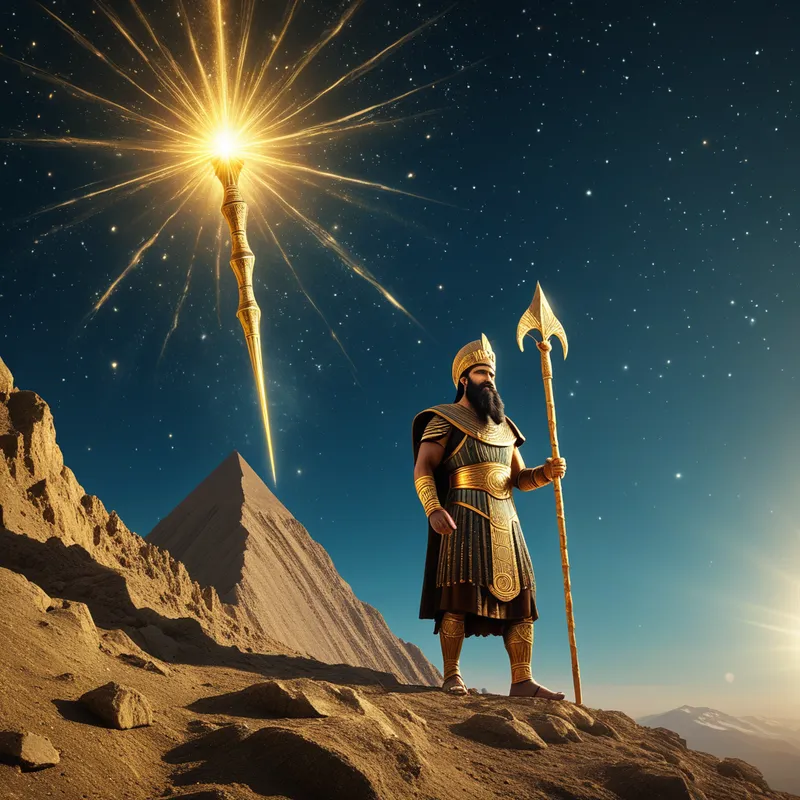
The god Enlil cleaves the world-mountain with a pickaxe forged by the gods, creating the fertile plains and the blueprint for human civilization.
The Tale of The Creation of the Pickaxe
In the time before time, when the world was a single, unbroken mass—a great, slumbering mountain of materia prima—the gods looked upon the formless earth and saw no place for life to take root. The sky, An, pressed down heavily upon the breast of the earth, Ki. Between them, in the stifling closeness, nothing could breathe, nothing could grow. It was a world of pure potential, trapped in a stony womb.
Then arose Enlil, the son of An and Ki, the force that separates and defines. He felt the urgent need for space, for distinction, for a realm where things could be. But the primal mountain resisted. It was solid, stubborn, a monolithic dream of unity that refused to yield. The gods gathered in council, their luminous forms casting long shadows on the unyielding stone. They knew a tool was needed, an instrument of decisive action that could perform what will alone could not.
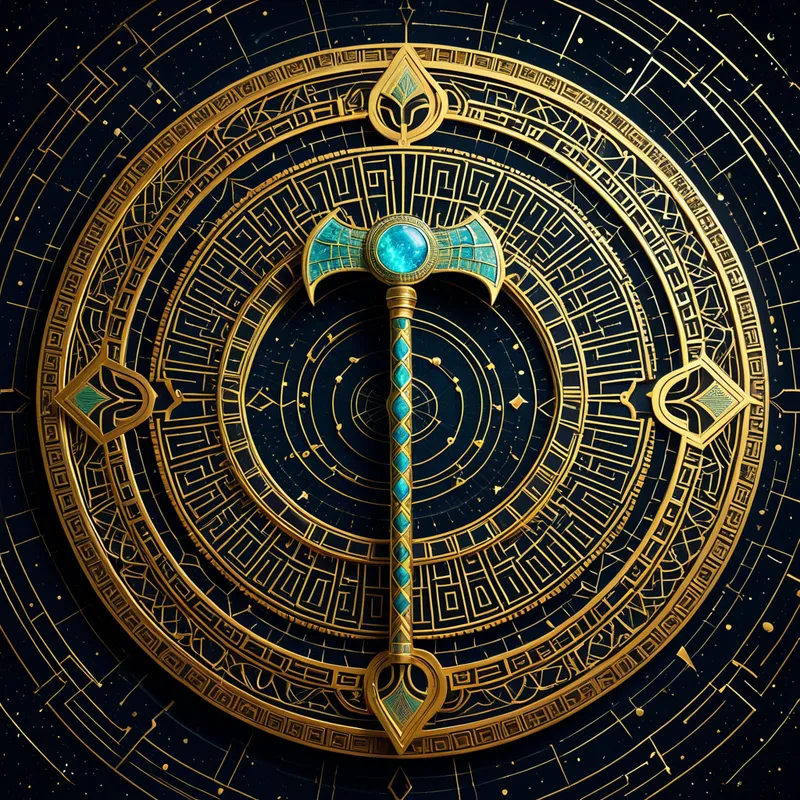
So they called upon the divine craftsman, the one who shapes essence into form. With the breath of Enki to cool the intent, and the fierce heat of Gibil's forge, they worked. They took the very bones of the cosmos—the idea of hardness, the principle of leverage, the spirit of the directed blow—and fused them. What emerged was not merely a tool, but an extension of divine will: the first Pickaxe. Its head was of gleaming, unearthly metal, its handle was the trunk of the world-tree, bound with the tendons of destiny.
Enlil took up the instrument. He did not swing it in rage, but with a profound and solemn purpose. He positioned its gleaming point against the seamless flank of the world-mountain. A hush fell over all creation. Then, with a cry that was both a command and a lament—for to create is also to sunder—he brought it down.
The sound was not of breaking, but of becoming. A crack, sharp as lightning, echoed through the firmament. Where the pickaxe struck, the monolithic unity split. The sky, An, was wrenched upward, gasping into a vast, open blue. The earth, Ki, settled, her stony crust cracking into fertile plains and river valleys. From the very wound made by the pickaxe, the Tigris and Euphrates sprang forth, their waters the first tears and the first blessings of the separated world.
The pickaxe fell from Enlil's hand, embedding itself in the newborn soil. Where it landed, the first city, Nippur, would rise. The gods then placed the pickaxe, now called the al, into the hands of humanity. They said: "As we have done for the world, so you must do for your life. With this, you shall build your homes, channel the waters, and lay the foundations of your days. It is the maker of your world."

Cultural Origins & Context
This myth is not a simple folktale; it is a foundational charter, recorded on clay tablets like the "Song of the Pickaxe". It originates from the very heart of the Sumerian world-view, a culture born between two rivers in a land with no stone, no metal, and little timber. Every brick of their ziggurat, every canal that watered their fields, was a re-enactment of this primordial drama. The myth was likely recited during temple rituals, at the founding of new cities, and at the start of major construction projects, transforming manual labor into a sacred act of cosmic imitation.
The pickaxe was, in practical terms, the most essential tool for Mesopotamian civilization—used for digging, breaking ground, and shaping mud-bricks. The myth elevates this mundane object to a divine origin, sanctifying the hard, foundational work of creating order from a resistant environment. It answered the profound question: "Why do we labor so?" The answer: because the gods did it first. Our toil participates in the ongoing work of creation.
Symbolic Architecture
At its core, the myth symbolizes the necessary violence of differentiation. The primal mountain represents the unconscious, undifferentiated state—a state of potential but also of stagnation. It is the uroboric condition, where everything is one and nothing can proceed.
The first act of consciousness is not gentle contemplation, but a decisive strike that creates a boundary. To know a thing, you must separate it from yourself.
Enlil embodies the archetypal force of consciousness, will, and decisive action. He is the principle that says, "Let there be distinction." The pickaxe is the directed application of this will—the focused effort, the specialized skill, the concrete action that translates intention into reality. It is the archetype of the philosopher's stone for the earthly realm: the tool that transforms chaos into cosmos.
The resulting separation of sky and earth is the creation of psychic space—the distance between subject and object, self and other, idea and manifestation. The flowing rivers symbolize the life, emotion, and creativity that can only move in the space created by that initial, difficult act of separation.
The Dreamer's Resonance
When this myth stirs in the modern psyche, it often manifests in dreams of foundational labor or breaking ground. You may dream of swinging a tool against an immovable wall, digging in hard earth, or trying to split a giant, dark rock. Somatically, this can feel like pressure in the chest or shoulders—the weight of the unformed.
Psychologically, this dream pattern signals a critical moment of individuation. The dreamer is confronting a monolithic aspect of their life: a fused identity (e.g., still seeing oneself only as a parent's child), a stagnant situation that feels "just the way it is," or an undifferentiated mass of emotion (like a nameless depression or anxiety). The dream is the psyche's preparation for the "Enlil moment"—the recognition that a conscious, willful, and perhaps difficult action is required to create space for a new way of being. The resistance felt in the dream is the inertia of the primal mountain, the psyche's fear of losing its old, familiar, if suffocating, unity.
Alchemical Translation
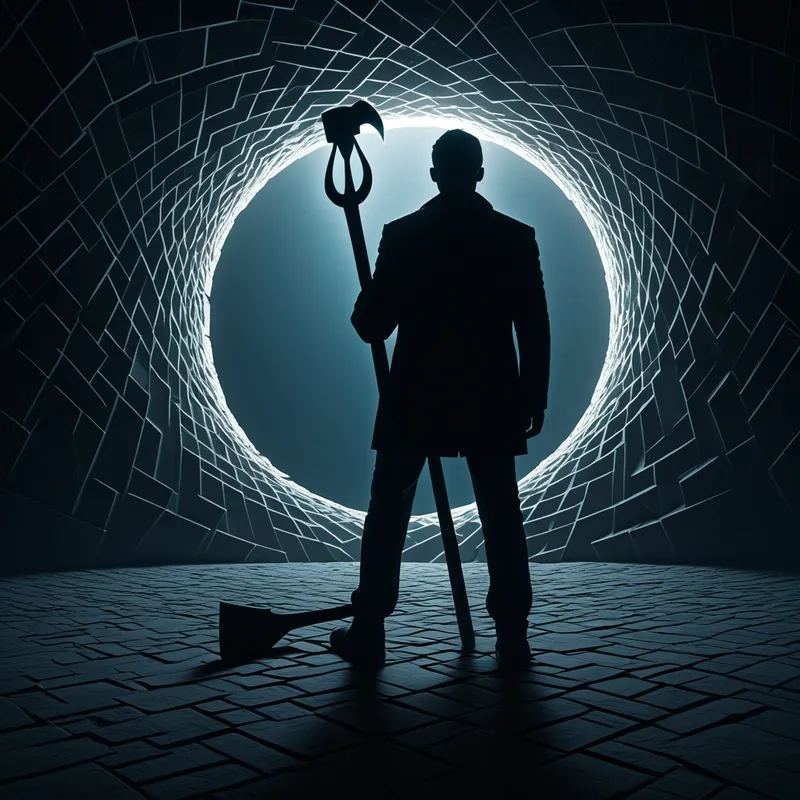
The alchemical journey begins in the massa confusa, the chaotic primal mountain. The process of nigredo is the painful recognition of this stuck, fused state. The forging of the pickaxe is the albedo—the refinement of one's own will and skill into a precise instrument. It is the development of a conscious attitude, a focused discipline, or a therapeutic insight that can serve as the tool.
The strike itself is the rubedo, the culmination. It is the moment of application where insight meets resistance, where the soul's decision alters the very landscape of the self.
For the modern individual, this myth models the process of building a conscious life. The "mountain" might be an inherited family narrative, a paralyzing fear, or a career that no longer fits. The "pickaxe" is the specific, often humble, action taken: setting a boundary, enrolling in a course, having the honest conversation, writing the first sentence. The "rivers" that flow are the new energies, relationships, and creative outlets that become possible only after that foundational, difficult work is done. We are not meant to remain on the formless mountain. We are meant to take up the divine tool we have been given—our focused consciousness and effort—and participate in the ongoing creation of our world.
Associated Symbols
Explore related symbols from the CaleaDream lexicon:
- Mountain — The primal, undifferentiated mass of potential and stagnation, representing the unconscious state that must be broken apart for creation to begin.
- Pickaxe — The divine tool of directed will and focused effort, the instrument that separates sky from earth and enables the foundational work of civilization and consciousness.
- God — Embodied here by Enlil as the archetypal force of decisive action, consciousness, and the will to create distinction and order.
- Earth — The fertile, receptive ground that is revealed and made viable only after the hard crust of the primal mountain is broken open.
- River — The life-giving flow of emotion, creativity, and sustenance that springs forth from the wound of separation, making growth possible.
- Order — The cosmic and psychic structure that is the ultimate goal of the myth, emerging from the deliberate act of imposing form on chaos.
- Foundation — The stable ground upon which civilization and identity are built, created through the labor symbolized by the pickaxe.
- Chaos — The original, formless state of the world-mountain, the necessary precursor that holds all potential but requires an act of will to actualize.
- Creation — The central theme of the myth, depicting not an ex nihilo generation but a creation through separation, differentiation, and hard labor.
- Tool — The pickaxe as the archetypal instrument that extends human (and divine) capability, transforming intention into tangible reality.