The Creation at Teotihuacan
The Aztec creation myth where gods gather at Teotihuacan to sacrifice themselves, birthing the sun and moon from divine self-immolation.
The Tale of The Creation at Teotihuacan
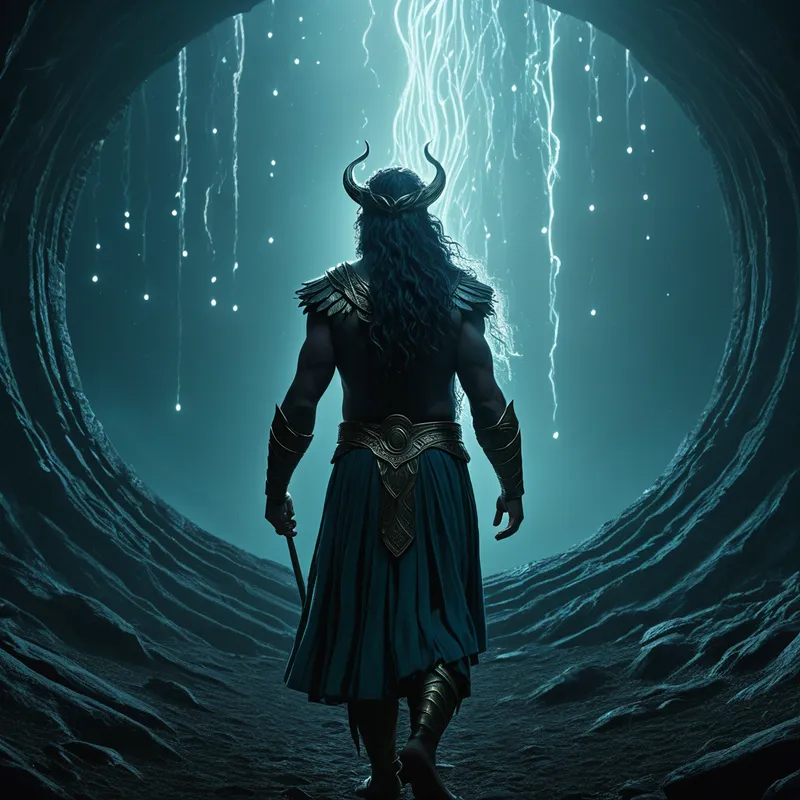
[The world](/myths/the-world “Myth from Tarot culture.”/) was dark. Not the gentle dark of night, but a formless, sunless void, the fourth in a cycle of failed creations. The gods, weary and burdened with the weight of potential, gathered in the sacred, silent plain of Teotihuacan. A terrible question hung in the primordial air: who would bear the unbearable? Who would become the light to banish this eternal darkness?
Two gods stepped forward, their essence burning with potential. One was Tecuciztecatl, adorned in rich feathers and gold. The other was Nanahuatzin, whose body was covered in sores, clad in simple paper garments. Both volunteered to leap into a colossal, divine bonfire, to be consumed and reborn as celestial bodies. Tecuciztecatl, in his pride, saw a glorious apotheosis. Nanahuatzin, in his humility, saw only a necessary duty.
A great pyre was built, a mountain of sacred wood that burned for four nights. When the moment of immolation arrived, Tecuciztecatl approached first, his arrogance faltering before the roaring, devouring heat. Four times he retreated, his courage melting away. Then Nanahuatzin, without hesitation, without a final boast, closed his eyes and ran. He cast himself fully into the heart of the flames, his body vanishing in a hiss of steam and a burst of incandescent light. Shamed by this humble sacrifice, Tecuciztecatl finally followed, leaping into the fire’s edge.
The gods waited in the profound silence that follows a supreme act. Then, from the east, [the sky](/myths/the-sky “Myth from Persian culture.”/) began to glow. A great, radiant disc—the Sun—rose, burning with fierce, life-giving light. It was Nanahuatzin, transformed. Close behind, another light rose: [the Moon](/myths/the-moon “Myth from Tarot culture.”/), shining with a dimmer, reflected glow. It was Tecuciztecatl. Yet the cosmos was inert; the new sun hung motionless in [the sky](/myths/the-sky “Myth from Persian culture.”/). It needed vital force, tonalli, to move.
The gods understood the dreadful truth. The first sacrifice was not enough. Creation demanded payment in the very substance of divinity. One by one, the god <abbr title=""Wind Serpent,” a major creator deity”>[Quetzalcoatl](/myths/quetzalcoatl “Myth from Aztec culture.”/) began to cut out their hearts, offering the sacred chalchihuatl—the precious liquid of life—to the newborn sun. With each divine [death](/myths/death “Myth from Tarot culture.”/), the sun shuddered and began its slow, eternal journey across the sky. The moon followed in its wake. [The Fifth Sun](/myths/the-fifth-sun “Myth from Aztec culture.”/), the Sun of Movement, Nahui Ollin, was born from a double sacrifice: [the self](/myths/the-self “Myth from Jungian culture.”/)-immolation of the chosen and the collective heart-blood of the gods. At Teotihuacan, existence was purchased, not with gold, but with divine essence itself.
Cultural Origins & Context
This myth, central to the Aztec (or Mexica) worldview, is preserved primarily in the Historia de los Mexicanos por sus pinturas and the Leyenda de los Soles. It is not merely a story of beginnings but the foundational justification for the core Aztec cosmological principle: that life, order, and cosmic stability are sustained through sacrifice (nextlahualli, “the paying of debt”). The gods performed the primary, archetypal sacrifice; humanity, born from the ground mixed with the bones of previous ages and the blood of the gods, inherited this sacred debt. Our very existence was a credit extended by the divine, requiring repayment through ritual bloodletting and heart-offerings to nourish the sun and stave off a final, cataclysmic end.
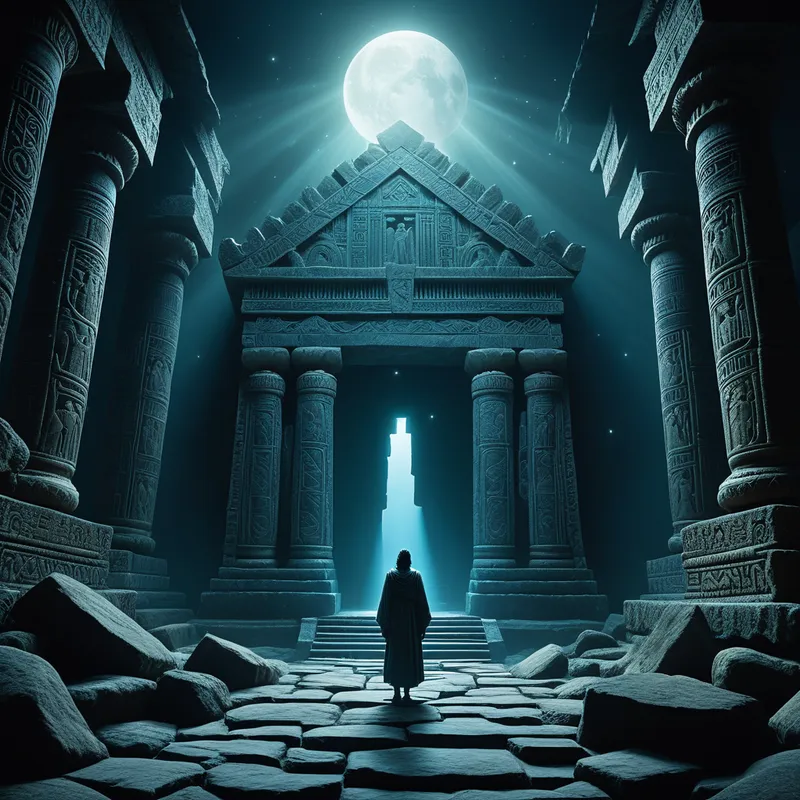
The setting, Teotihuacan, was a real, massive ruined city whose original builders were unknown to the Aztecs. They interpreted its awe-inspiring pyramids as evidence of a divine event, naming it “The Place Where Gods Are Created.” This layers the myth with a profound sense of historicity and tangible geography, rooting the cosmic in the earthly. The myth explains the nature of the current age—vibrant yet fragile, demanding constant vigilance and offering—and establishes a hierarchy of value where humble devotion (Nanahuatzin) surpasses proud ambition (Tecuciztecatl).
Symbolic Architecture
The myth’s [structure](/symbols/structure “Symbol: Structure in dreams often symbolizes stability, organization, and the framework of one’s life, reflecting how one perceives their environment and personal life.”/) is a masterwork of sacred geometry. Two volunteers become two celestial bodies. Four nights of fire-building precede the act. Four times Tecuciztecatl hesitates. This [numerology](/symbols/numerology “Symbol: The study of numbers’ mystical significance, suggesting divine patterns, life paths, and hidden meanings in numerical sequences.”/) reflects the Mesoamerican [cosmos](/symbols/cosmos “Symbol: The entire universe as an ordered, harmonious system, often representing the totality of existence, spiritual connection, and the unknown.”/), organized around the four directions and the central [axis](/symbols/axis “Symbol: A central line or principle around which things revolve, representing stability, orientation, and the fundamental structure of reality or consciousness.”/). The narrative itself is an architectural [blueprint](/symbols/blueprint “Symbol: A blueprint represents the foundational plan or design for something, often symbolizing potential, structure, and the mapping of one’s inner self or future.”/): the [axis](/symbols/axis “Symbol: A central line or principle around which things revolve, representing stability, orientation, and the fundamental structure of reality or consciousness.”/) mundi is the sacrificial pyre, the point where matter (the gods’ bodies) is annihilated to become [energy](/symbols/energy “Symbol: Energy symbolizes vitality, motivation, and the drive that fuels actions and ambitions.”/) (light), structuring [chaos](/symbols/chaos “Symbol: In Arts & Music, chaos represents raw creative potential, uncontrolled expression, and the breakdown of order to forge new artistic forms.”/) into the ordered paths of the sun and [moon](/symbols/moon “Symbol: The Moon symbolizes intuition, emotional depth, and the cyclical nature of life, often reflecting the inner self and subconscious desires.”/).
The fire at Teotihuacan is not destructive but alchemical. It is the crucible of transformation where identity is incinerated to birth function. Nanahuatzin’s diseased body, a vessel of corruption, becomes the pristine sun—a perfect metaphor for redemption through total surrender.
The duality is critical but non-oppositional. Sun and Moon are not rivals; they are a necessary pair, a cosmic [dyad](/symbols/dyad “Symbol: A fundamental pair or duality representing unity, opposition, and the foundational structure of existence in spiritual and mythological traditions.”/) born from contrasting qualities of [character](/symbols/character “Symbol: Characters in dreams often signify different aspects of the dreamer’s personality or influences in their life.”/). Their alternating [journey](/symbols/journey “Symbol: A journey in dreams typically signifies adventure, growth, or a significant life transition.”/) across the sky represents the eternal cycle of [payment](/symbols/payment “Symbol: Symbolizes exchange, obligation, and value. Represents what one gives to receive something in return, often tied to fairness, debt, or spiritual balance.”/) and renewal, the [heartbeat](/symbols/heartbeat “Symbol: The heartbeat represents life, vitality, and the essence of being alive, symbolizing emotional connectivity and personal integrity.”/) of the Fifth World, driven by the initial, irreversible expenditure of divine [life](/symbols/life “Symbol: The symbol of ‘Life’ represents a journey of growth, interconnectedness, and existential meaning, encompassing both the joys and challenges that define human experience.”/).
The Dreamer’s Resonance
To the dreaming [psyche](/myths/psyche “Myth from Greek culture.”/), Teotihuacan is the inner theater where the Self confronts the cost of consciousness. Nanahuatzin represents the wounded, ashamed, or “unworthy” part of the psyche that must be offered up to the transformative fire for renewal to occur. His leap is the ultimate act of psychological courage: accepting annihilation of the old self for the possibility of a new, radiant identity. Tecuciztecatl embodies [the ego](/myths/the-ego “Myth from Jungian culture.”/)’s hesitation, its prideful attachment to its current form, which ultimately results in a secondary, reflective existence (the moon) rather than a primary, generative one (the sun).
The subsequent sacrifice of the gods mirrors the ongoing psychological work required to sustain a conscious life. Each new insight, each step toward wholeness, often feels like a sacrifice—a cherished belief, a comfortable pattern, a fragment of the ego, must be “cut out” and offered to fuel the forward movement of the developing Self. The myth tells the dreamer that life is not free; consciousness is a costly flame that must be fed, and its primary fuel is what we are willing to surrender.
Alchemical Translation
In the alchemical vessel, the myth describes the opus magnum. The [prima materia](/myths/prima-materia “Myth from Alchemical culture.”/) is the dark, chaotic world and the flawed gods themselves. The fire is the sustained heat of the alchemical process ([calcinatio](/myths/calcinatio “Myth from Alchemical culture.”/)). Nanahuatzin’s humble, diseased state is the base lead, the despised starting point. His voluntary plunge is the moment of dissolution ([solutio](/myths/solutio “Myth from Alchemical culture.”/)), where the fixed ego is utterly dissolved in the fiery solution.
The birth of the sun is the rubedo, the reddening, the emergence of the Philosopher’s Stone—the perfected, radiant gold of the Self. The moon’s birth is the accompanying albedo, the whitening, the silver of the purified soul. They are the coniunctio oppositorum, the sacred marriage of solar and lunar principles birthed from a single, fiery womb.
The ongoing sacrifice of the gods represents the cyclical, iterative nature of the work. Each stage of coagulation requires a new dissolution; each gain demands a payment. The cosmos itself, in this view, is not a static creation but a perpetual alchemy, a dynamic equilibrium maintained by the continuous transformation of substance from one state to another.
Associated Symbols
Explore related symbols from the CaleaDream lexicon:
- Sun — The radiant, life-giving consciousness born from total self-surrender, requiring constant nourishment to sustain its journey.
- Moon — The reflective light born from hesitation and pride, a reminder that not all transformations yield primary brilliance, yet it remains essential to the cosmic balance.
- Fire — The alchemical crucible of transformation, the agent that annihilates form to liberate essence and light.
- Sacrifice — The foundational currency of existence; the voluntary offering of a valued substance (life, identity, comfort) to fuel a greater cosmic or psychological process.
- Heart — The sacred center of life and vitality offered as sustenance; the core essence that must be given to set things in motion.
- Temple — Teotihuacan as the physical and metaphysical site of divine transformation, where the boundary between earth and cosmos is thinnest.
- Blood — The precious liquid of life (chalchihuatl), the tangible essence of vitality offered as payment for cosmic and psychic debt.
- Disease — The flawed, wounded, or corrupt state that, when offered willingly to the transformative fire, becomes the source of ultimate purity and strength.
- Remains of a Sacrifice — The enduring evidence of the sacred debt paid; the bones of the old world over which the new is built, a reminder of the cost of being.
- Starlit Sacrifice Site — The mythic plain of Teotihuacan, eternally hallowed by the primordial act, representing the inner space where profound, life-altering offerings are made.