The Cosmic Tree of the Sufi Myth Meaning & Symbolism
A mystical tree bridges all realms, its roots in the unseen, its branches in the divine. The seeker's journey is to climb its interior, dissolving into unity.
The Tale of The Cosmic Tree of the Sufi
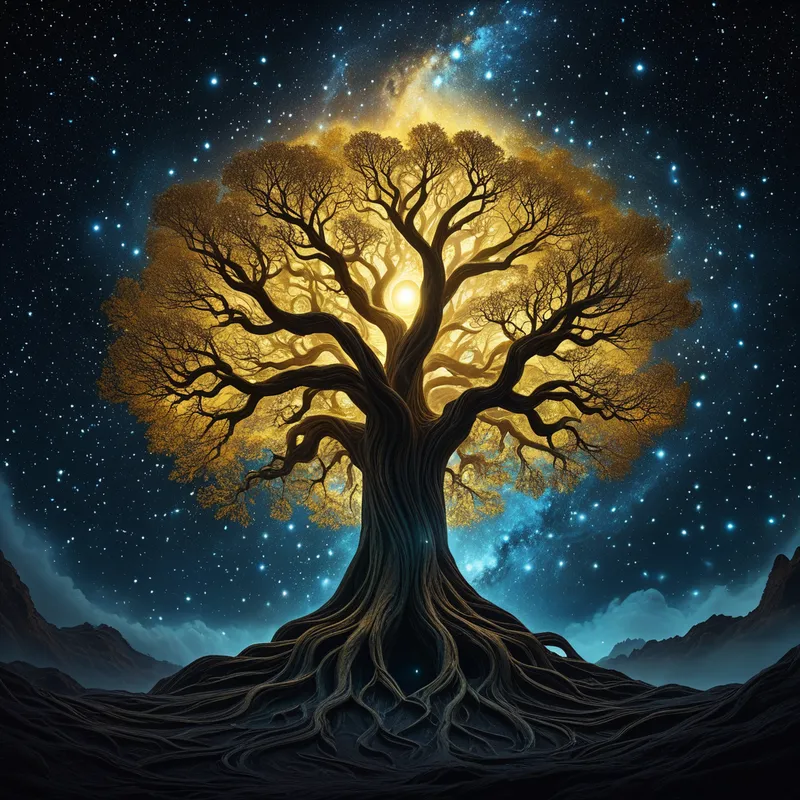
Listen, and let the veils thin. In the time before time was counted, in the realm where silence speaks louder than thunder, there stood—there stands—the Tree. It is not a tree of wood and leaf as you know it, but the First Form, the Great Axis. Its roots are not in soil, but in the al-Ghayb, the Unseen, drinking from the spring of al-Haqq. They coil in the darkness that is not empty, but full of potential, tangled with the secrets of before-beginning.
Its trunk is the pillar of all worlds. It is not still; it vibrates with a silent, ceaseless Dhikr, a hum that structures reality. Upon its bark are inscribed the names of all things that were, are, and shall be—every star, every thought, every tear. To touch it is to know the texture of destiny.
And its branches… they do not reach for a sun, for they are themselves light. They fork and multiply into the seventy thousand veils of light and fire that separate creation from the Creator. They are the pathways of angels, the trajectories of souls, the ascent of prayer. At their zenith, they do not end but dissolve into a brilliance that has no name, the Wajh of the Beloved.
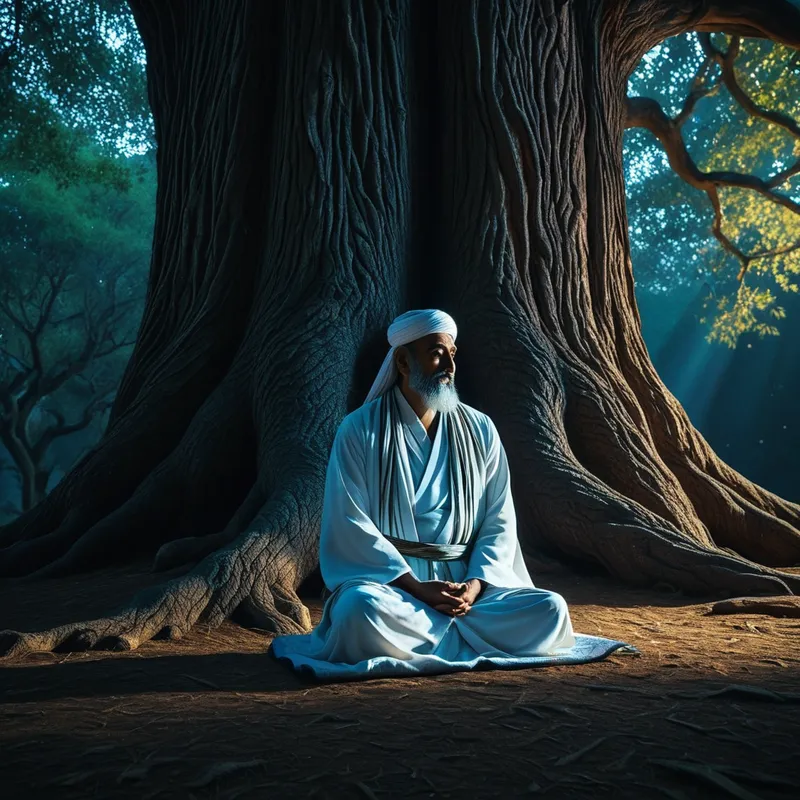
Once, a seeker, heart scorched by the longing for truth, came to the base of this Tree. The world around him—the marketplaces, the deserts, the cities of men—had become a faint echo. He saw not a tree, but a towering vortex of presence. A voice, neither male nor female, but like the sound of roots drinking, spoke: “The journey outward is an illusion. The only journey is inward, upward, through the core.”
With a breath that was also a surrender, he stepped into the trunk. There was no splintering of wood, but a melting of form. Inside, he did not climb but was carried upward through rivers of sap that were melodies, through grain that was layered history. He passed chambers of memory that were not his own—the joy of a first raindrop, the grief of a fallen empire, the peace of a single cell dividing. He saw his own life not as a line, but as a knot in the vast, intricate weave of the Tree’s interior.
The ascent was a stripping. Each layer of branch he passed through burned away a layer of himself: name, story, fear, desire. The light grew more intense, more loving, more terrible. He was becoming less a traveler and more the journey itself. Finally, at the threshold where branch becomes pure radiance, there was no “he” left to enter. There was only the entering, a drop returning to the ocean, a note harmonizing with the eternal chord. The Tree had not been a thing to find, but the path of his own annihilation and, in that annihilation, his true discovery.
Cultural Origins & Context
The imagery of the Cosmic Tree, while not a single, standardized narrative like those in canonical scripture, is a profound and recurring motif woven through the poetic, philosophical, and visionary literature of the Sufi tradition. It finds its roots in the Qur’anic Sidrat al-Muntaha and the Shajarat al-Khuld, but is elaborated in the metaphysical explorations of poets like Rumi and Ibn ‘Arabi, and in the allegorical writings of others like Attar in The Conference of the Birds.
This myth was not told around campfires but whispered in the khanqah, elaborated in mystical commentaries (ta’wil), and most powerfully, encoded in poetry. The poet, functioning as a mystic bard, used the Tree as a symbolic language to express the inexpressible structure of reality and the soul’s place within it. Its societal function was pedagogical and transformative. It served as a cosmic map for the salik, offering a visionary model of the universe that was simultaneously external and internal. It reinforced the core Sufi doctrine of Tawhid—not as a philosophical abstraction, but as a living, breathing, ascending architecture in which every seeker is a cell.
Symbolic Architecture
The Cosmic Tree is the ultimate symbol of the interconnectedness of all levels of existence—mineral, vegetable, animal, human, angelic, and divine. Its roots in the Unseen (al-Ghayb) represent the divine source, the unconscious depths of the Godhead and the personal psyche. The trunk is the axis mundi, the pillar of the individual soul and the world itself, the path of spiritual discipline (Tariqa). The branches signify the manifold manifestations, the diversity of creation, and the multiple states (maqamat) and stations (ahwal) of the mystic’s experience.
The Tree does not grow toward the light; it is generated from the light, and its growth is the light remembering itself in form.
Psychologically, the Tree represents the Self in the Jungian sense—the total, integrated psyche that connects the personal ego (a small knot in the trunk) to the collective unconscious (the roots) and the transpersonal spirit (the branches). The seeker’s journey into the Tree is the process of interiorization, where exploration of the outer world is recognized as a projection of the need to explore the inner, vaster cosmos. The dissolution at the summit is the ego’s surrender to the Self, a death that is the only true birth.
The Dreamer's Resonance
When this myth stirs in the modern dreamer, it often manifests not as a literal tree, but as an experience of profound, awe-inspiring verticality and interconnection. One might dream of a skyscraper that is alive, a towering nervous system, a DNA helix of light reaching into the clouds, or a vast network of roots under one’s city that pulse with energy. The somatic feeling is one of being both incredibly small at the base and paradoxically vast, as if one’s own body contains the entire structure.
This dream pattern emerges at crossroads of identity, when the conscious personality feels fragmented or disconnected from purpose. The psyche is presenting the archetype of wholeness. The dream may evoke both terror (the fear of dissolution, of losing the familiar “I”) and profound longing (the pull of the roots, the allure of the light). It signals a psychological process of recentering—a call to stop seeking externally for validation or answers and to begin the daunting, glorious work of descending into one’s own depths to find the trunk from which one’s life truly grows.
Alchemical Translation
The alchemy modeled by this myth is the transmutation of the lead of fragmented, egoic consciousness into the gold of unitive awareness. The prima materia is the seeker’s life of separation. The nigredo, the initial blackening, is the despair of longing, the feeling of being at the base of an impossible climb. The journey into the Tree is the albedo—the whitening, the purification through self-knowledge, where one encounters and integrates the memories, knots, and shadows (the personal and collective unconscious) woven into one’s being.
The fruit of this Tree is not an apple of knowledge, but the seed of annihilation, which contains the whole tree within it.
The ascent through the branches is the citrinitas, the yellowing or illumination, where insight flares. Finally, the dissolution at the summit is the rubedo, the reddening, the culmination. This is not a destruction but a consummation. The ego, having served its purpose as the vessel for the journey, surrenders its boundaries. The individual is not lost but found in a broader context. For the modern individual, this translates to the process of individuation: moving from identification with the persona (the outer bark) to engagement with the personal shadow (the dark, nourishing roots), to dialogue with the inner figures of soul and spirit (the ascending branches), culminating in a relationship with the Self (the whole Tree). One learns to live not from the isolated ego, but through the rooted, branching totality of one’s being.
Associated Symbols
Explore related symbols from the CaleaDream lexicon:
- Tree of Life — The ultimate symbol of interconnected existence and divine emanation, directly mirroring the Cosmic Tree's role as the axis linking all realms of being.
- Root — Represents the hidden, nourishing connection to the divine source and the unconscious, the foundational ground from which all growth emerges.
- Seed — Symbolizes the divine spark or primordial potential within the soul that contains the blueprint for the entire journey of ascent and unfolding.
- Journey — The central motif of the myth, representing the inward and upward path of the soul from multiplicity and separation toward unity and essence.
- Light — The substance of the Tree's branches and its destination, representing divine knowledge, consciousness, and the ultimate reality toward which the seeker ascends.
- Door — The point of entry into the Tree's trunk, symbolizing the critical moment of surrender and turning inward, the threshold between ordinary and mystical consciousness.
- Mirror — The polished surface of the seeker's heart that must be cleansed to reflect the light of the Tree, representing self-knowledge as the prerequisite for divine knowledge.
- Circle — The cyclical nature of the journey—from the One, through manifestation, and back to the One—and the wholeness represented by the complete Tree.
- Soul — The traveler itself, the conscious essence that undertakes the ascent through the various layers of its own composite being toward its origin.
- Cosmic Gateway — The Tree in its function as the axis mundi, a portal or passage connecting the earthly realm directly with the celestial and divine dimensions.
- Awakening Tree — The Tree as an active agent of transformation, not a passive symbol, whose very presence calls the sleeper (the seeker) out of spiritual slumber.
- Fruit-Laden Tree — The Tree in its aspect of generosity and manifestation, bearing the fruits of spiritual realization, wisdom, and grace for those who learn its ways.