
The Communion Table Myth Meaning & Symbolism
A sacred ritual where bread and wine become a vessel for divine presence, forging a covenant of remembrance and unity between the human and the eternal.
The Tale of The Communion Table
Listen. The air was thick with the scent of roasted lamb and unleavened bread, a night charged with the memory of flight and the whisper of coming storm. The Teacher gathered his companions in an upper room, a hidden chamber where lamplight danced on anxious faces. The weight of ages pressed upon his shoulders, a gravity they could feel but not name.
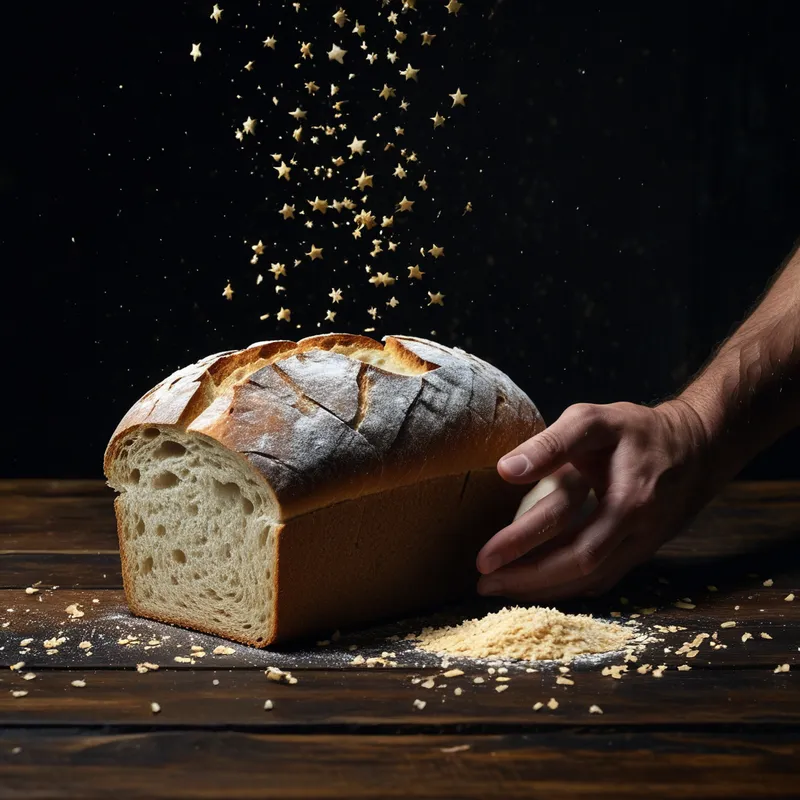
He took the bread, the common sustenance of the poor and the pilgrim. His hands, familiar with wood and wave, held it aloft. He gave thanks, his voice a low river in the quiet. Then he broke it. The sound was sharp, final—a crack that echoed in the stillness of each heart. “Take, eat,” he said, his eyes holding a universe of sorrow and love. “This is my body, broken for you.” He passed the fragments. They took, they ate, and the simple act became a sacrament. The bread was no longer just bread; it was a testament, a willing fracture, a sustenance of a different order.
Then he took the cup, the cup of the covenant, filled with the fruit of the vine. Again, he gave thanks. “Drink from it, all of you,” he commanded, his gaze sweeping the room, meeting fear and confusion. “This is my blood of the new covenant, which is poured out for many for the forgiveness of sins.” He shared the cup. Each man drank, and the wine, sharp and sweet, became a river of promise, a seal written not on stone but in the very substance of life.
He spoke of remembrance. “Do this,” he said, the words settling like dust on the table, soon to be carried through centuries, “in remembrance of me.” In that moment, the table ceased to be mere wood. It became an altar outside of time, a point of convergence where a final meal bled into an everlasting feast. He spoke of a kingdom to come, of drinking it new with them, a future promise woven into the present act. Then they sang a hymn—a psalm of ascent—and went out into the dark garden, the taste of bread and wine, of body and blood, lingering on their tongues like a mystery they had swallowed but could not yet digest.
Cultural Origins & Context
This foundational narrative is located within the Communion tradition, drawn directly from the Gospel accounts and the Didache. It was not initially a public spectacle but a rite of the ekklesia—the gathered community. In the catacombs and house churches of the Roman Empire, this “Eucharist” functioned as the core act of identity. It was both a defiant memorial of a state-executed criminal and the joyful anticipation of his promised return.
Societally, it served multiple crucial functions. It was a boundary marker, separating the committed community from the wider pagan world. It was an equalizer, where slave and free, Jew and Greek, shared the same loaf, enacting a radical social vision. Most profoundly, it was a technology of memory, a ritualized re-membering designed to prevent the dispersal of the community’s heart-story. Passed down not as mere doctrine but as a performed, somatic experience—“Take, eat”—it ensured the myth was carried in the body, not just the mind.
Symbolic Architecture
The myth’s power lies in its devastatingly simple, yet infinitely deep, symbolic architecture. The Table itself is the temenos, the sacred precinct where the human and the divine negotiate a new relationship.
The broken bread is the archetype of the divisible made holy, the individual life willingly fragmented to become nourishment for the whole.
The body (soma) symbolizes incarnation, substance, and vulnerability. To break it is to enact the ultimate vulnerability—the scattering of the self. The blood (haima) represents life, lineage, and the ancient seal of covenants. To pour it out is to spend one’s vital essence completely. Together, they transmute violence (breaking, pouring) into gift (nourishment, covenant).
The act of eating and drinking is the psychology of internalization. One does not merely admire or believe; one incorporates. The myth becomes metabolized, part of the cellular structure of the believer. The command “Do this in remembrance” (anamnesis) is key. This is not nostalgic recall, but a ritual invocation that makes the past event powerfully present, collapsing linear time into the eternal now of the ritual moment.

The Dreamer’s Resonance
When this myth surfaces in modern dreams, it rarely appears as a church altar. It manifests as the dreamer finding themselves at a strange, often endless, table. They may be serving a meal they cannot eat, or trying to eat from an empty plate. They may be offered a chalice that is either overflowing or bone-dry.
Such dreams often signal a profound psychological process of assimilation or covenant-making. To dream of partaking at a table can indicate the psyche is ready to integrate a powerful, perhaps difficult, truth or experience—to “take it in” and make it part of oneself. It is the soul’s ritual. Conversely, dreams of being excluded from the table, or of the food turning to ash, may point to a felt sense of spiritual alienation, a broken inner covenant, or a part of the self that feels it cannot receive nourishment.
The somatic resonance is crucial. The dream may be accompanied by an actual taste in the mouth, a feeling of fullness or emptiness in the gut. The psyche is using the ancient, body-based language of the myth to communicate about what is being offered, rejected, or needed for the dreamer’s wholeness.

Alchemical Translation
For the individual on the path of individuation, the Communion Table myth is a precise map for psychic transmutation. The alchemical prima materia is the base substance of one’s own life—the joys, the traumas, the mundane moments.
The ritual is the conscious, willing act of taking this raw material, “giving thanks” for it (accepting it without illusion), and offering it up to be broken and poured out.
The “breaking” is the necessary deconstruction of the ego’s rigid structures—the identities, defenses, and narratives we cling to. The “pouring out” is the sacrifice of our vital energy (libido) from old, fruitless pursuits into a new, inner covenant with the Self. We eat and drink our own transformed experience. The remembered figure of the Teacher becomes the symbolic Self, the inner archetype of wholeness that guides this process.
The final stage is the “kingdom to come”—the promise of the ritual. This translates as the achieved state of relative psychic integration, where the inner conflict is resolved, and one can “drink it new,” experiencing life not as fragmented chaos but as a unified, meaningful whole. The table, therefore, is not a relic but an ongoing, internal altar where the individual repeatedly engages in the alchemy of turning personal history into transpersonal meaning, forging a living covenant between the ego and the deep Self.
Associated Symbols
Explore related symbols from the CaleaDream lexicon: