The Communal Feast Myth Meaning & Symbolism
A myth where the cosmos hungers, a deity offers their essence as food, and humanity learns that true nourishment is found in shared communion, not solitary consumption.
The Tale of The Communal Feast
Listen. [The world](/myths/the-world “Myth from Tarot culture.”/) was young, and its belly was hollow.
In the time before memory, when [the sky](/myths/the-sky “Myth from Persian culture.”/) was a thin sheet of ice and [the earth](/myths/the-earth “Myth from Hindu culture.”/) a hard, silent stone, the people were scattered. They were not yet a people, but lonely sparks huddled in separate caves, gnawing on roots and their own fears. [The wind](/myths/the-wind “Myth from Various culture.”/) carried not song, but the gnashing of teeth and the low, constant groan of empty stomachs. It was a hunger that went deeper than flesh; it was a hunger of the spirit, a longing for a warmth that the meager fire could not provide.
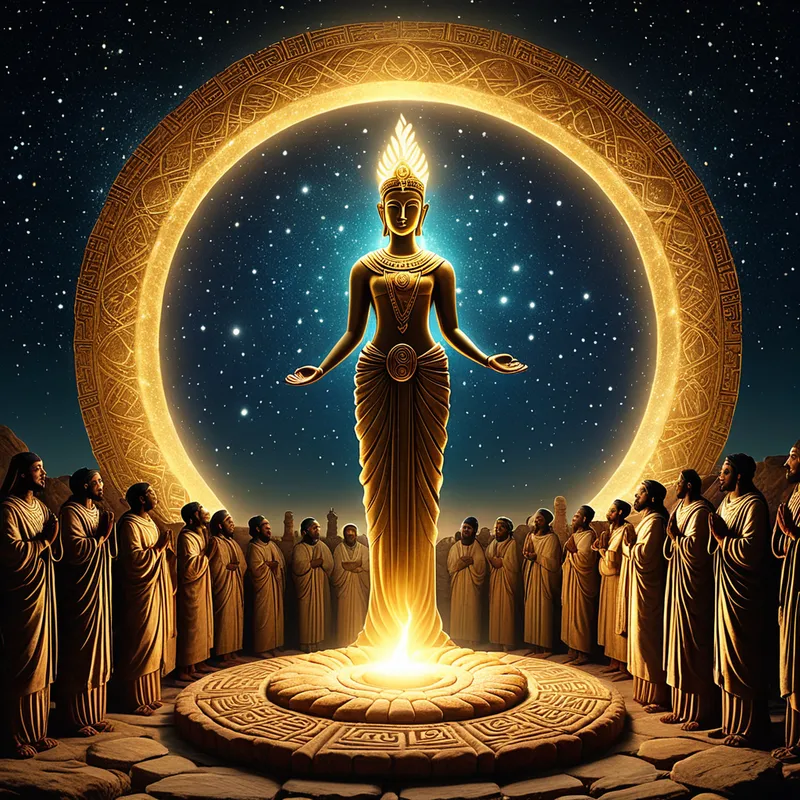
Then, from the place where the first light cracks [the horizon](/myths/the-horizon “Myth from Various culture.”/), came The One Who Hears the Groaning. They were not a deity of thunder or flame, but of the quiet space between heartbeats. Their form was like shifting grain, their eyes like deep wells, and their presence carried the scent of rain on dry soil. They walked among the lonely fires, and where they stepped, a single, stubborn blade of grass would push through the stone.
The One Who Hears saw not just the emptiness of their bowls, but the vast, echoing emptiness between them. “They starve,” the deity whispered to the cold stars, “not for food, but for the other.” The cosmic law was clear: life consumes. The fox eats the hare, the fire consumes the wood. But this consumption bred only more loneliness, a cycle of endless, isolating want.
And so, at the center of the widest, most desolate plain, The One Who Hears the Groaning called out. Not a shout, but a vibration that hummed in the marrow of every creature. The scattered ones, drawn by a pull older than thought, emerged from their holes and shadows. They gathered in a wide, uncertain circle, eyes darting not to the deity, but to each other, with suspicion and a faint, forgotten hope.
“I have heard the hunger of the world,” the deity said, their voice the sound of a river under ice. “And I shall answer it.”
There was no lightning strike, no miraculous conjuring. Instead, The One Who Hears the Groaning knelt upon the hard earth. They placed their hands upon the ground and began to sing. It was a song without words, a melody of dissolution. As they sang, their luminous form began to soften, to blur at the edges. Light streamed from their body—not away into the sky, but downward, into the soil, and outward, toward the circle of watching faces.
Where the light touched the earth, the stone cracked. Not with violence, but with a gentle sigh. From the cracks sprouted stalks of wheat, heavy with grain. Vines curled, bearing fat grapes and strange, sweet tubers. The light that streamed toward the people condensed, materializing into warm loaves of bread, smoked fish, wheels of cheese, and clay jars brimming with honey and wine. A feast, vast and impossible, lay spread upon the barren plain.
But the miracle was not yet complete. The One Who Hears the Groaning was now transparent, a wraith of fading light. “Take,” they breathed, their voice now the rustle of leaves. “But you must not eat alone. The food is my body, and my body is connection. The one who eats in solitude eats only ashes. The one who shares, eats the stars.”
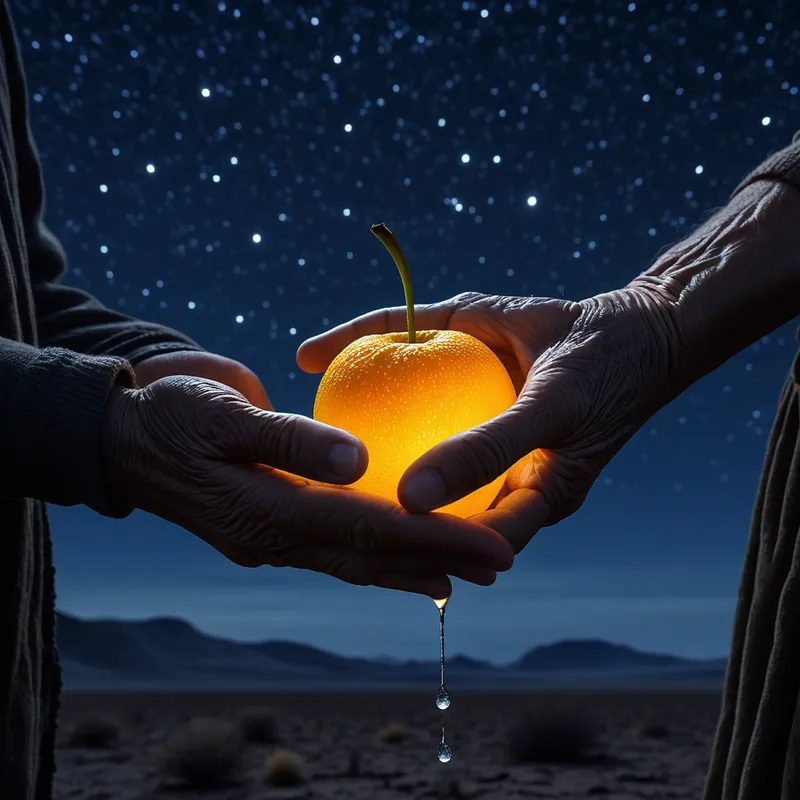
Then, they were gone. Not in a flash, but in a final, soft exhalation that became the evening breeze. The people stood, stunned, before the abundance. The oldest among them, a woman with eyes like cracked clay, was the first to move. She did not lunge for the closest loaf. She broke a piece from it, turned, and offered it to [the child](/myths/the-child “Myth from Alchemy culture.”/) shivering beside her. The child took it, stared, then scrambled to a jar of honey, dipping a berry and holding it out to a wounded hunter.
A ripple moved through the crowd. A man with a broken spear took a fish and gave half to a rival from another cave. A young woman poured wine into a cup and passed it to her left. The feast began. Not as a frantic scramble, but as a slow, deliberate ritual of offering and receiving. Laughter, unfamiliar and rough, broke the ancient silence. Stories were told over shared cups. Hands touched in passing. The food, blessed by sacrifice, did more than fill bellies; it wove the separate sparks into a single, warming fire. They ate, and in the eating, they became a people. The hunger of the world was quieted, not by consumption, but by communion.
Cultural Origins & Context
The myth of The Communal Feast is not the property of a single tribe or scroll. It is a story that has emerged, in countless variations, from the collective human hearth. Anthropologists find its echoes in the Dying-and-Rising God archetypes, from the grain deities of the Ancient Near East to the harvested maize gods of the Americas. It is told by indigenous elders to explain the origins of the [potlatch](/myths/potlatch “Myth from Native American culture.”/) and the sacredness of the first harvest. It is whispered in [the parables](/myths/the-parables “Myth from Biblical culture.”/) of shared [loaves and fishes](/myths/loaves-and-fishes “Myth from Christian culture.”/).
Its societal function was, and remains, foundational. It was not merely an etiological tale for agriculture, but the psychic blueprint for civilization itself. It was recited at seasonal gatherings, at treaty signings, and before great hunts. It served as the sacred charter for the laws of hospitality, the ethics of redistribution, and the very idea that the group’s survival supersedes the individual’s hoard. The myth taught that prosperity is not a material condition to be seized, but a relational state to be co-created through reciprocal offering. It transformed the act of eating from a biological necessity into a theological and social sacrament, binding the community to the divine and to each other through the shared substance of a gift.
Symbolic Architecture
At its core, the myth dismantles the primal, psychological equation that to live is to take. The deity, The One Who Hears the Groaning, represents the ultimate transcendence of [the ego](/myths/the-ego “Myth from Jungian culture.”/)‘s [logic](/symbols/logic “Symbol: The principle of reasoning and rational thought, often representing order, structure, and intellectual clarity in dreams.”/) of [scarcity](/symbols/scarcity “Symbol: A dream symbol representing lack, limitation, or insufficient resources, often reflecting fears of deprivation or unmet needs.”/) and self-preservation. Their sacrifice is not one of [blood](/symbols/blood “Symbol: Blood often symbolizes life force, vitality, and deep emotional connections, but it can also evoke themes of sacrifice, trauma, and mortality.”/), but of [boundary](/symbols/boundary “Symbol: A conceptual or physical limit defining separation, protection, or identity between entities, spaces, or states of being.”/). They dissolve their distinct form to become the connective [tissue](/symbols/tissue “Symbol: Represents emotional release, vulnerability, and the delicate nature of feelings or physical fragility.”/) between isolated beings.
The first hunger is the hunger for separation to end. The first food is the offering of the self to fill the space between.
The barren plain is the inner [landscape](/symbols/landscape “Symbol: Landscapes in dreams are powerful symbols representing the dreamer’s emotional state, personal journey, and the broader context of life situations.”/) of the [psyche](/myths/psyche “Myth from Greek culture.”/) in a state of alienation—the “waste land” of modern parlance. The miraculous feast that springs from the deity’s [dissolution](/symbols/dissolution “Symbol: The process of breaking down, dispersing, or losing form, often representing transformation, release, or the end of a state of being.”/) symbolizes the [abundance](/symbols/abundance “Symbol: A state of plentifulness or overflowing resources, often representing fulfillment, prosperity, or spiritual richness beyond material needs.”/) that can only manifest when the ego sacrifices its claim to solitary ownership and control. The [food](/symbols/food “Symbol: Food in dreams often symbolizes nourishment, both physical and emotional, representing the fulfillment of basic needs as well as deeper desires for connection or growth.”/) is not magic; it is [relationship](/symbols/relationship “Symbol: A representation of connections we have with others in our lives, often reflecting our emotional state.”/) made tangible. The loaf that is passed hand-to-hand is the physical manifestation of trust, the berry dipped in shared [honey](/symbols/honey “Symbol: A sweet, viscous substance produced by bees, symbolizing natural sweetness, reward, and nourishment.”/) is the sacrament of mutual [vulnerability](/symbols/vulnerability “Symbol: A state of emotional or physical exposure, often involving risk of harm, that reveals authentic self beneath protective layers.”/).
The critical, non-negotiable commandment—“you must not eat alone”—is the myth’s psychological [keystone](/symbols/keystone “Symbol: The central wedge-shaped stone at the apex of an arch, holding all other stones in place through compression and balance.”/). It outlaws narcissistic consumption. To eat the feast alone is to commit a spiritual [paradox](/symbols/paradox “Symbol: A contradictory yet true concept that challenges logic and perception, often representing unresolved tensions or profound truths.”/): to ingest the [symbol](/symbols/symbol “Symbol: A symbol can represent an idea, concept, or belief, serving as a powerful tool for communication and understanding.”/) of [connection](/symbols/connection “Symbol: Connection symbolizes relationships, communication, and bonds among individuals.”/) while reinforcing [isolation](/symbols/isolation “Symbol: A state of physical or emotional separation from others, often representing a need for introspection or signaling distress.”/), which turns the sacred substance to “ashes,” leaving the [soul](/symbols/soul “Symbol: The soul represents the essence of a person, encompassing their spirit, identity, and connection to the universe.”/) emptier than before. The myth posits that true nourishment is always a triadic [event](/symbols/event “Symbol: An event within dreams often signifies significant life changes, transitions, or emotional milestones.”/): between the eater, the food, and the other who is also fed.
The Dreamer’s Resonance
When this myth stirs in the modern unconscious, it often surfaces in dreams of profound social and spiritual hunger. One may dream of wandering through a lavish, empty supermarket, unable to find anything satisfying. Or of being at a crowded party with a full plate, yet feeling utterly famished and alone. These are dreams of the “unshared feast,” reflecting a life rich in material or achievement but impoverished in authentic, nourishing connection.
Conversely, the healing manifestation of the myth appears in dreams where the dreamer is either offering a simple, heartfelt gift of food to a stranger or receiving such a gift with tearful gratitude. The food in these dreams is often humble—a piece of bread, a bowl of soup—but it glows with an [inner light](/myths/inner-light “Myth from Buddhist culture.”/). These dreams signal a somatic and psychological process of opening the heart’s gates, of allowing the defensive, hoarding ego to soften. The profound warmth felt upon waking is the body remembering the truth the myth encodes: we are fed not by what we consume, but by the circuit of care in which consumption is embedded. The dream is an invitation to identify where in one’s waking life the “feast” is being eaten in solitude, and to begin, however timidly, to break the bread and pass it to the left.

Alchemical Translation
For the individual on the path of individuation, the myth of The Communal Feast models a critical alchemical operation: the transmutation of hunger into hospitality. Our base, leaden state is one of insatiable wanting—for validation, security, love, status. This hunger contracts the soul, making it a fortress that keeps abundance out. The myth instructs us that [the way](/myths/the-way “Myth from Taoist culture.”/) to [the philosopher’s stone](/myths/the-philosophers-stone “Myth from Alchemical culture.”/) of fulfillment is not through better acquisition, but through a radical, inner sacrifice.
The alchemy begins when you offer your own hunger as the first course at a table you have not yet set.
This is the “dissolution” of the deity. Psychologically, it is the dissolution of the identity that says “I am what I have” or “I am what I lack.” It is the willingness to de-structure the hardened self, to let its energies flow outward not as demand, but as gift. This might manifest as offering one’s time without expectation of return, sharing a vulnerability to create intimacy, or contributing one’s unique skill to a collective endeavor without needing sole credit.
The “feast” that results is the integrated Self—no longer a lonely, hungry unit, but a vibrant node in a network of mutual sustenance. The individual becomes like the shared loaf: a distinct form whose substance is meant for communion. In this state, one becomes nourishing. One’s very presence becomes a kind of food for the world’s groaning. The cycle of scarcity is broken not by having more, but by becoming a source. The ultimate alchemical translation is this: your deepest hunger is not a problem to be solved, but the raw material of the sacred meal you are destined to share. The transformation occurs in the passing of the plate.
Associated Symbols
Explore related symbols from the CaleaDream lexicon: