
The Coconut Myth Meaning & Symbolism
A myth where a divine being transforms into the first coconut tree, offering its body as eternal sustenance and connection for humanity.
The Tale of The Coconut
Listen. The sea was not always a giver of fish, nor the land a bearer of fruit. In the time of shadowy beginnings, when the great voyagers had found the scattered jewels of the sea but not yet learned to make them bloom, there was a hunger. Not just of the belly, but of the soul—a longing for a bond with the Papa and the Rangi that was tangible, sustaining.
There was a boy, or perhaps he was more. His name was Tuna, the eel, a creature of both fresh water and salt, of fluid boundaries. He was the cherished son of a great fisherman, a man whose line could hook the stars from the deep. But Tuna was ill, fading like a mist under the morning sun. His strength ebbed; his vibrant light dimmed.
His father, heart a stone in his chest, carried his son to the whispering edge of the world, where the white sand met the black ocean. Under a canopy of unnamed stars, he did the unthinkable, guided by a voice older than the waves. With tears salting the earth, he buried his son’s head in the warm sand, a living seed for a desperate harvest. He sang the old chants, the ones that call to the bones of the earth and the breath of the wind.
“Grow,” he whispered, his voice cracking like dry coral. “Do not return to me as you were. Return as what we need.”
For days, the spot was a sacred vigil. Rain came, gentle and life-giving. Sun beat down, fierce and demanding. Then, a miracle of green pierced the sand. Not a shoot, but a surge—a slender trunk reaching for the sky with the urgency of a drowning man seeking air. It grew swift and tall, a straight-backed warrior. From its crown burst great fronds that sighed with the voice of the trade winds. And then, nestled in the axils, strange fruits formed. Hard, brown, like the skull of the earth itself.
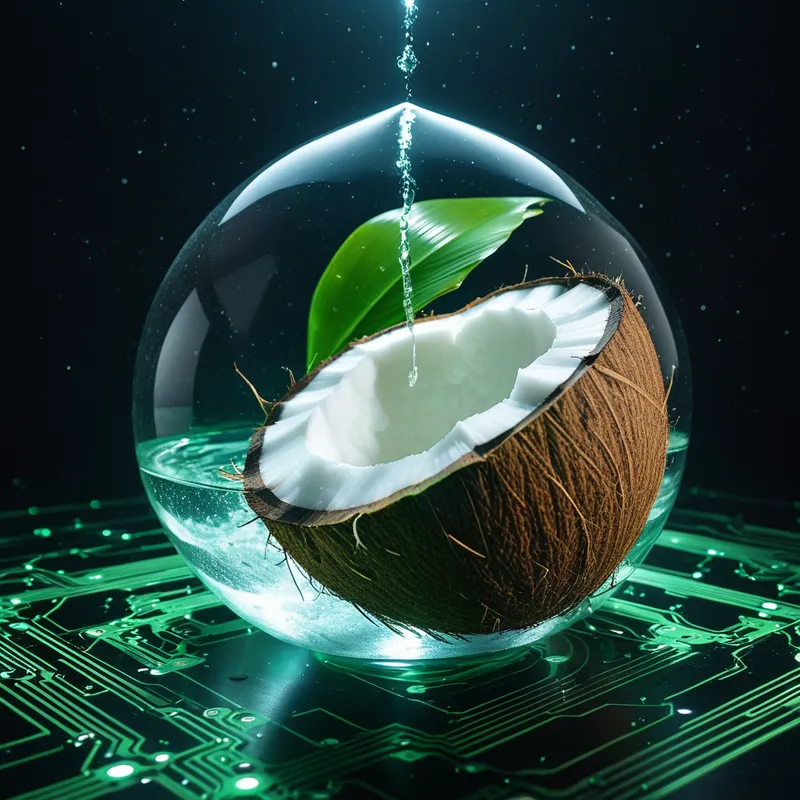
When the first fruit fell with a heavy thud, the father, now an old man, approached. He struck it. The shell cracked, not to reveal bone, but clear, sweet water—the very tears he had shed. And within, firm, white flesh—the substance of his son’s nourishing spirit. He drank. He ate. Life, potent and sweet, flooded his being. He understood. His son was not gone. He had undergone the great transformation. He had become the niu, the coconut tree. His hair was the fibrous husk, his skull the hard shell, his brain the rich meat, his blood and tears the refreshing water. He had offered his entire body so that his people would never thirst, never hunger, and always remember the sacred covenant: that life feeds on life, and love is the ultimate sustenance.

Cultural Origins & Context
This myth, in its many variations, is woven into the fabric of Polynesia, from Aotearoa to Hawaiʻi to Tahiti. It is not a singular, canonical text but a living narrative passed down through the tohunga and storytellers. Its primary function was etiological—explaining the origin of the most vital plant in the Pacific world. The coconut was the literal tree of life: drink, food, oil, fiber, wood, thatch, and cordage.
But its deeper function was pedagogical and psychological. It was told to instill the core values of aloha and tapu. The myth encoded the understanding that the environment is not a resource to be exploited, but a kin network to be honored. The coconut tree was an ancestor, a transformed relative whose continued gift demanded respect and reciprocal care. This story was the spiritual manual for sustainability, teaching that true nourishment arises from sacred sacrifice and conscious relationship.
Symbolic Architecture
The myth’s power lies in its stark, alchemical symbolism. Tuna, the eel-hero, represents the liminal, transformative principle itself—the entity that moves between realms (water/land, life/death, human/plant). His “illness” is the necessary dissolution of one form to make way for another.
The most profound nourishment is always born from a willing surrender of a previous, bounded self.
The burial is not an end, but a planting. The head, the seat of identity and consciousness, is the seed. This signifies that transformation requires the death of the old ego, the old way of being. The resulting tree is the new, enduring identity—one that serves a purpose greater than individual survival. Every part of the coconut corresponds to a part of the human body, creating a literal, edible map of the archetype of the caregiver. The tree stands as a permanent axis mundi, connecting the underworld (roots), the human world (trunk), and the heavenly world (fronds and fruit), offering its bounty at all levels.
The Dreamer's Resonance
When this myth stirs in the modern dreamer, it often surfaces during periods of profound personal depletion or a crisis of purpose. To dream of burying a loved one’s head, or finding one’s own head planted in sand, points to a deep somatic process of ego-sacrifice. The psyche is signaling that a current identity or cherished ambition must “die” to become something of universal value.
Dreams of cracking open a coconut and discovering not food, but one’s own organs or childhood memories, speak to the process of integrating one’s personal history and essence into a form that can nourish the self and others. The thirst in the dream, quenched by the coconut water, is the soul’s thirst for meaning that can only be slaked by tapping into one’s own inner, transformative sacrifice. The dream is an invitation to stop searching for sustenance externally and to undergo the difficult, sacred work of transmuting personal pain or talent into a gift.

Alchemical Translation
Psychologically, the journey of Tuna is a perfect map of the individuation process. It begins with the “illness,” which in modern terms is the neurosis, the feeling of being out of place, of not fulfilling one’s potential. The conscious ego (the father) must collaborate with the deep Self (the ancestral voice) to perform the ritual of burial—the conscious acceptance of an end.
Individuation is not about becoming a perfected individual, but about becoming a fruitful node in the network of life.
The long wait symbolizes the nigredo, the dark night of the soul where the old form dissolves in the unconscious. The sprouting tree is the albedo, the emergence of a new, purified structure from the psyche’s depths. The bearing of fruit is the rubedo, the reddening, where the transformed self begins to produce tangible “fruit”—creativity, wisdom, compassion—that feeds the inner and outer community.
For the modern individual, the alchemical instruction is clear: What part of you must be willingly “buried”—a selfish desire, a limiting self-image, a hoarded talent—so that it can be transformed from a personal possession into a life-giving tree? The myth teaches that our greatest power lies not in what we accumulate for ourselves, but in what we are willing to transmute, through love and sacrifice, into a perennial source of nourishment for the world. We are called not just to consume life, but to become, like the coconut, a vessel that contains within itself all that is needed to sustain it.
Associated Symbols
Explore related symbols from the CaleaDream lexicon: