
The Clever Men Karadji Myth Meaning & Symbolism
A myth of Aboriginal shamanic healers who journey between worlds to restore balance, wielding song, ritual, and profound connection to Country.
The Tale of The Clever Men Karadji
Listen. The land is not silent. It hums. It sings. Beneath the red dust and the ghost gum’s silver bark, beneath the river’s slow flow, lies the Dreaming—a world of story and law, pulsing like a great, sleeping heart. And there are those who can hear its song, who can walk its hidden pathways. They are the Karadji.
Our story begins not with a bang, but with a sickness. A wrongness. In a camp by a dwindling waterhole, a great hunter lies still. His breath is shallow, his skin hot. The people know this is no ordinary fever. His kurunpa has been stolen, pulled from his body by a malevolent mamu from a distant, jealous clan. The world tilts out of balance. The children are quiet. The fire crackles with unease.
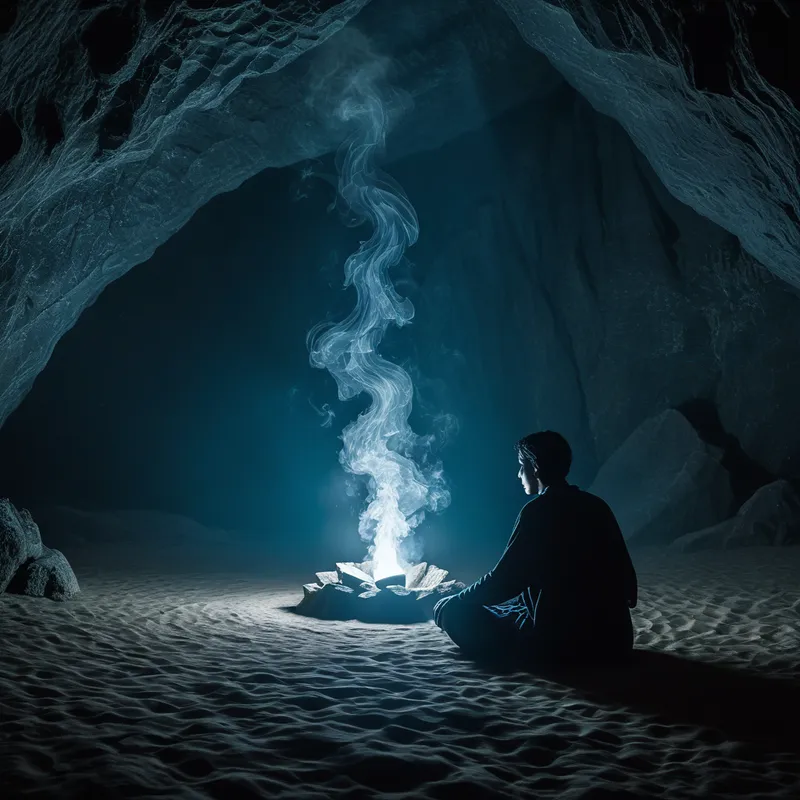
They send for Ngaran, the Karadji. He comes at dusk, his eyes reflecting the last embers of the sun. He does not speak of cure, but of journey. He prepares in silence, painting his chest with sacred white gabunga, patterns that are maps to other worlds. He takes his bullroarer and his bilma. The people sing, their voices low and steady, weaving a net of sound to hold the space.
As the night deepens and the Southern Cross wheels overhead, Ngaran begins. The rhythm of the bilma enters his blood. The drone of the bullroarer becomes the voice of the wind in the Dreaming. He dances, not a dance of joy, but of fierce concentration—a vibration to loosen the soul from its bone-house. And then, he is still. His body sits by the fire, but his eyes see elsewhere. His kurunpa has slipped free, ascending the invisible threads of the songlines.
He travels a landscape of memory and power. He passes the great Ancestors frozen in stone, feels the chill of the mamu’s territory—a place of twisted trees and cold silence. There are battles here, not of spear and shield, but of will and song. He counters poison with older law, illusion with truer vision. He finds the hunter’s stolen spirit-essence, a faint, flickering ember, clutched in a shadowy grasp. Ngaran sings the songs of his own country, songs of water and rock-wallaby, songs so potent with belonging they burn the mamu’s claim away. He retrieives the ember, cradling it in a song-basket woven from breath.
The return is swift, a falling star along the songline. As dawn bleeds pink on the horizon, Ngaran’s body shudders. He exhales a long, misty breath over the sick hunter, transferring the recovered essence. The hunter gasps, his eyes flutter open, seeing the world anew. Balance is restored. The Karadji is exhausted, hollowed out, but the land’s song hums in him once more, complete. He has walked between the worlds and returned, mending the tear in the fabric of life.
Cultural Origins & Context
The narratives of the Karadji are not mere folklore but the living core of a profound spiritual and medicinal system spanning the Australian continent for millennia. Known by many names—Karadji, Marrnggitj, Ngangkari—these individuals were (and in many communities, still are) the intermediaries between the human community and the eternal Dreaming. Their knowledge was not written but inscribed in country, ceremony, and the body itself, passed down through rigorous, often arduous initiation involving ritual, ordeal, and direct spiritual transmission from older practitioners and ancestor beings.
Their societal function was multifaceted: healer, law-keeper, rainmaker, diviner, and custodian of sacred knowledge. A Karadji’s authority derived from their demonstrated capacity to navigate and influence the subtle, yet supremely real, forces of the spiritual landscape. They diagnosed illness as often spiritual or social in origin—a breach of law, a curse, a soul-loss—and their “cures” were acts of cosmological re-alignment. The mythic tales of their journeys served as both validation of their power and a metaphorical map of the non-ordinary realities they were trained to navigate, reinforcing the principle that human health is inseparable from the health of Country and community.
Symbolic Architecture
At its [heart](/symbols/heart “Symbol: The heart symbolizes love, emotion, and the core of one’s existence, representing deep connections with others and self.”/), the myth of the Karadji is a master narrative of [integration](/symbols/integration “Symbol: The process of unifying disparate parts of the self or experience into a cohesive whole, often representing psychological wholeness or resolution of internal conflict.”/). It maps the psyche’s [structure](/symbols/structure “Symbol: Structure in dreams often symbolizes stability, organization, and the framework of one’s life, reflecting how one perceives their environment and personal life.”/) and the process of retrieving wholeness from a state of [fragmentation](/symbols/fragmentation “Symbol: The experience of breaking apart, losing cohesion, or being separated into pieces. Often represents disintegration of self, relationships, or reality.”/).
The sick hunter represents the individual or [community](/symbols/community “Symbol: Community in dreams symbolizes connection, support, and the need for belonging.”/) in a state of psychic dislocation—where a vital part of the self (the kurunpa) has been severed or stolen by unconscious, alienated complexes (the mamu). The illness is the [symptom](/symbols/symptom “Symbol: A physical or emotional sign indicating an underlying imbalance, distress, or message from the unconscious mind.”/) of this inner [division](/symbols/division “Symbol: Represents internal conflict, separation of self, or unresolved emotional splits. Often indicates a need for integration or decision-making.”/). The Karadji embodies the mediating function of [consciousness](/symbols/consciousness “Symbol: Consciousness represents the state of awareness and perception, encompassing thoughts, feelings, and experiences.”/)—the specialized [aspect](/symbols/aspect “Symbol: A distinct feature, quality, or perspective of something, often representing a partial view of a larger whole.”/) of the psyche capable of journeying into the unconscious (the Dreaming) with [purpose](/symbols/purpose “Symbol: Purpose signifies direction, meaning, and intention in life, often reflecting personal ambitions and core values.”/) and skill.
The true healer does not fight the darkness with more darkness, but illuminates the path back to belonging. The cure is not an injection, but a homecoming.
The songlines are the archetypal pathways of the [collective unconscious](/symbols/collective-unconscious “Symbol: The Collective Unconscious refers to the part of the unconscious mind shared among beings of the same species, embodying universal experiences and archetypes.”/), the innate patterns and connections that underlie [reality](/symbols/reality “Symbol: Reality signifies the state of existence and perception, often reflecting one’s understanding of truth and life experiences.”/). The [ritual](/symbols/ritual “Symbol: Rituals signify structured, meaningful actions carried out regularly, reflecting cultural beliefs and emotional needs.”/) tools—song, dance, ochre, bullroarer—are the disciplined techniques (active imagination, ritual, focused [attention](/symbols/attention “Symbol: Attention in dreams signifies focus, awareness, and the priorities in one’s life, often indicating where the dreamer’s energy is invested.”/)) that allow the conscious ego to safely navigate these [depths](/symbols/depths “Symbol: Represents the subconscious, hidden emotions, or foundational aspects of the self, often linked to primal fears or profound truths.”/). The retrieval is not a violent conquest, but a reclamation through authentic [connection](/symbols/connection “Symbol: Connection symbolizes relationships, communication, and bonds among individuals.”/)—the songs of “one’s own [country](/symbols/country “Symbol: Dreaming of a country often symbolizes a quest for belonging, identity, or exploration of one’s inner landscape through the metaphor of physical space.”/)” symbolize the unique, core [identity](/symbols/identity “Symbol: Identity represents the sense of self, encompassing personal beliefs, cultural background, and social roles.”/) that cannot be counterfeit or stolen.
The Dreamer’s Resonance
When this mythic pattern stirs in the modern dreamer, it often signals a profound process of soul retrieval. The dreamer may experience motifs of being pursued, of losing a precious object, of feeling a vital part of themselves is “missing” or trapped in a distant, ominous place. Somatic sensations can include feelings of weightlessness (the spirit-journey), sudden chills (entering a hostile psychic territory), or a powerful, rhythmic vibration (the ritual drumming of the bilma).
Psychologically, this indicates that a significant complex—often rooted in trauma, betrayal, or a deep-seated fear—has split off from the conscious personality, taking with it a charge of life energy. The dream-ego’s journey to recover this lost part is the psyche’s innate healing intelligence at work. The modern “mamu” may appear as a shadowy figure, a former abuser, a symbol of crushing guilt, or the chilling void of depression. The dream is initiating a process of re-connection, urging the dreamer to develop their own inner Karadji—the observing, courageous, and resourceful part of the self that can venture into inner chaos and bring back what was lost.
Alchemical Translation
The Karadji’s journey is a perfect allegory for the Jungian process of individuation—the psychic transmutation of the lead of a fragmented self into the gold of wholeness. The prima materia, the base matter to be worked, is the sick community (the neurotic, suffering psyche). The separatio is starkly presented: the conscious ego (the hunter) is disabled, and the lost soul-fragment exists in the unconscious.
The Karadji represents the emerging ego-Self axis, the connection between personal consciousness and the archetypal core of the psyche (the Dreaming). His ritual preparation is the disciplina—the necessary study, introspection, and ethical grounding required for such deep work. The journey itself is the nigredo, the descent into the shadowy, chaotic unconscious, confronting the mamu of one’s own repressed contents.
The alchemical vessel is not a flask of glass, but the disciplined human body and the sacred space of ritual. The fire is the unwavering focus of intentional consciousness.
The confrontation and retrieval are the albedo—the washing and whitening, where the stolen essence is purified by the “songs of one’s own country,” i.e., by reconnecting it to the individual’s authentic core values and experiences. The return and healing breath are the rubedo and coniunctio—the integration of the redeemed content back into the totality of the self, resulting in a new, more resilient psychological structure. The healed hunter is not the same as before; he has been remade through the ordeal, just as the alchemist is transformed by the work. The individual becomes more fully themselves, more connected to their inner and outer “Country,” achieving a state of psychic balance and increased vitality.
Associated Symbols
Explore related symbols from the CaleaDream lexicon:
- Journey — The central motif of the Karadji’s quest into the spirit world, representing the necessary descent into the unconscious to retrieve lost parts of the self.
- Healing — The ultimate purpose of the myth; not merely curing physical symptoms, but restoring spiritual and communal balance through profound reconnection.
- Dream — The medium of the Dreaming and the altered state of consciousness in which the Karadji travels, symbolizing the realm of archetypal reality and psychic truth.
- Song — The primary tool and weapon of the Karadji, representing vibrational law, authentic identity, and the power of focused intention to shape reality.
- Spirit — The essential kurunpa that is lost and retrieved, symbolizing the vital life force, soul, or core energy of an individual.
- Shadow — Embodied by the malevolent mamu, representing the repressed, hostile, or alienated contents of the personal and collective unconscious.
- Ritual — The structured ceremony of painting, dance, and sound that creates the container for the dangerous journey, symbolizing the disciplined framework needed for profound psychic work.
- Bridge — The function of the songlines and the Karadji himself, connecting the ordinary world with the Dreaming, consciousness with the unconscious.
- Cave — Often the setting for the Karadji’s trance, representing the womb of the earth, a place of deep introspection, and the entrance to the inner world.
- Water — The life-giving element often associated with healing and restoration in the myth; its absence signifies sickness, its presence, wholeness.
- Light — The recovered soul-essence and the illuminating knowledge the Karadji brings back from the Dreaming, symbolizing consciousness, awareness, and redeemed vitality.
- Root — The deep, ancestral connection to Country and the Dreaming that gives the Karadji his power and authority, symbolizing the foundational, nourishing source of identity.