The City of Atlantis Myth Meaning & Symbolism
A tale of a utopian island empire, blessed by gods, corrupted by hubris, and swallowed by the sea in a single day and night of catastrophe.
The Tale of The City of Atlantis
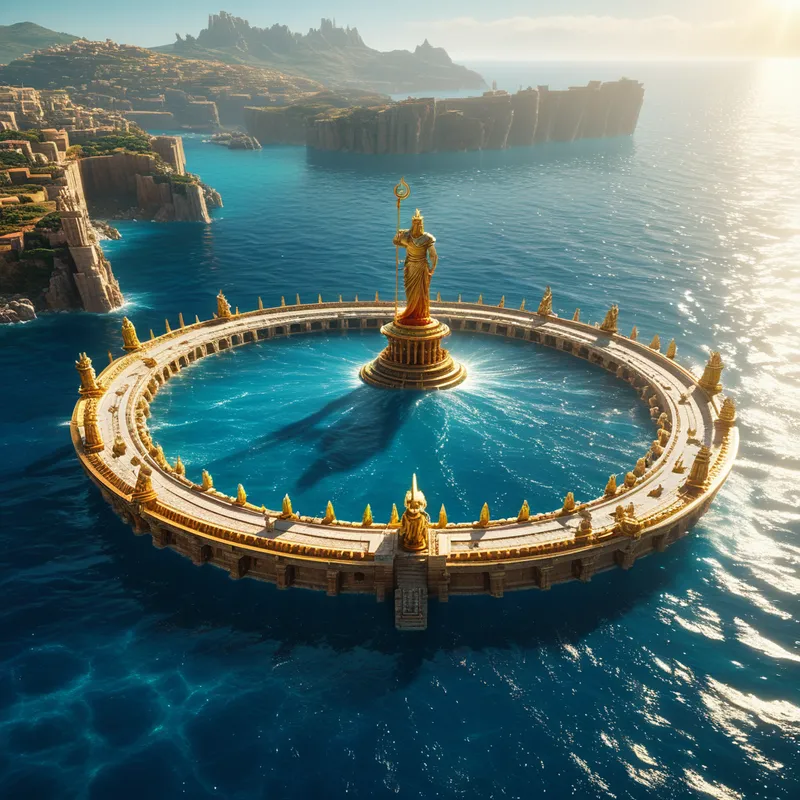
Listen, and hear of a land that was, and is no more. Not in the sun-drenched isles you know, but beyond, in the wine-dark sea that lies past the Pillars of Herakles. There, in an age when gods still walked close to the world, the Earth-Shaker, Poseidon, received an island as his domain. It was a land of surpassing beauty, where mountains touched benevolent clouds and plains yielded fruit without toil. At its heart, a great plain cradled a marvel: a city built in perfect concentric rings of land and sea, carved by divine will.
Poseidon looked upon this island and saw a mortal woman, Cleito, of surpassing beauty. He loved her, and to protect her, he raised a hill at the very center of the island and encircled it with rings of water and earth, two of land and three of sea, as a fortress and a testament to his power. Here, in a palace of white, black, and red stone that gleamed with the touch of Hephaestus, their children were born. The firstborn was Atlas, and to him and his brothers was given the rule of this paradise. The city thrived. Springs of hot and cold water flowed for kings and commoners alike. The earth gave not once, but twice a year. The docks groaned with ships from every land, and the air hummed with the sound of industry and joy. Temples, gymnasia, and racetracks stood in splendor. A great canal connected the outer sea to the heart of the city, and bridges arched over the watery rings, topped with towers and gates. For generations, the people of Atlantis lived in reverence of the gods and in harmony with the divine laws inscribed in a pillar of orichalcum at the center of the island.
But as the divine blood in their veins thinned over the centuries, a rot set in. The noble character bestowed by Poseidon faded. The memory of the laws on the orichalcum pillar grew dim. Ambition curdled into avarice. The harmony of the rings was broken by the clamor for more—more power, more territory, more glory. They turned their gaze eastward, beyond their blessed isle. Their mighty fleet, once a wonder of the world, became an instrument of conquest. They sought to enslave all the lands within the Mediterranean, their pride swelling like a storm cloud. They believed their walls, born of a god, could hold back the very Fates.
They were wrong.
The father of gods, Zeus, looked upon the corruption of Atlantis. He saw the hubris that had poisoned Poseidon’s gift. He convened the council of the gods in their highest hall. And he passed judgment. The tale does not linger on the debate, for the sentence was absolute.
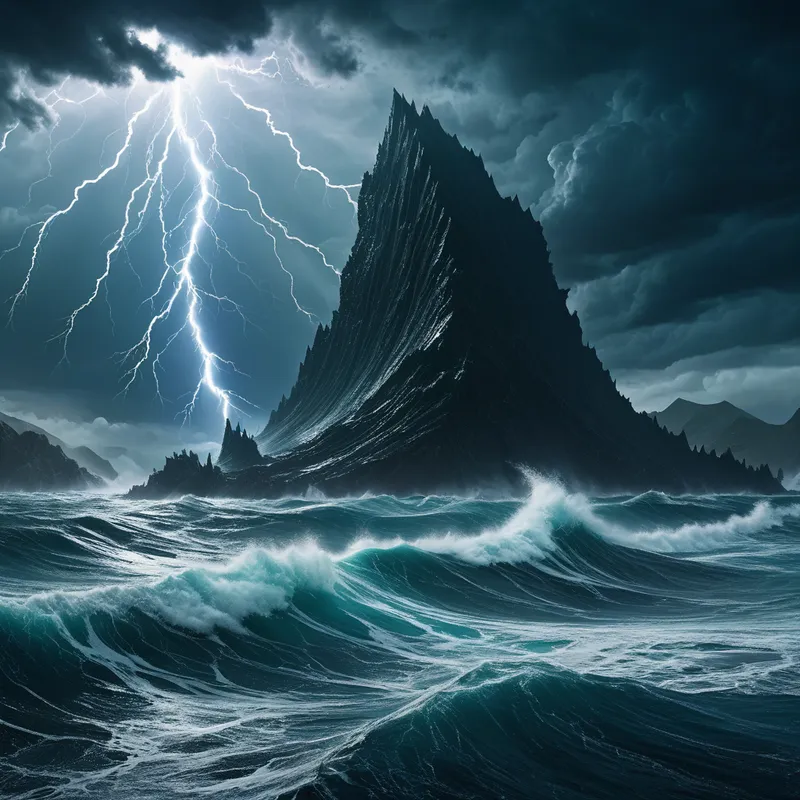
It began with a great trembling, a deep groan from the bones of the earth. Then came the waves, not from the shore, but rising from the abyss itself, mountains of green water that paid no heed to wall or canal. The sky turned the color of lead and ash, and fire leapt from the riven ground. The proud ships were splinters. The gleaming temples sank beneath the roaring tide. The concentric rings, the divine geometry of their origin, became a whirlpool of ruin. In one terrible day and night of fire and flood, the island of Atlantis, with all its warriors, its kings, its dreams, and its sins, was swallowed whole by the hungry sea. The waters closed over it, and a great silence fell. All that remained was a vast, impassable sea of mud, a warning to sailors and a secret to the deep.
Cultural Origins & Context
The myth of Atlantis comes to us from a singular, profound source: the dialogues of the philosopher Plato. In his works Timaeus and the unfinished Critias, written around 360 BCE, Plato introduces Atlantis not as a folk tale, but as a "true" history recounted to the Athenian lawgiver Solon by Egyptian priests at Sais. This framing is critical. For Plato, Atlantis was not mere entertainment; it was a philosophical and political device. It served as the legendary antagonist to his ideal, virtuous "Ancient Athens," which repelled Atlantis's invasion before the cataclysm.
The story’s function was didactic. It was a morality tale about the cyclical nature of civilization and the inevitable decay that follows when a society abandons virtue for material ambition and military might. In the context of 4th-century Greece, with city-states frequently at war and democratic ideals under strain, Atlantis was a potent warning. It was a myth of decline, a counterpoint to the Golden Age narratives. Its transmission was literary and elite, passed from Plato’s academy into the bloodstream of Western esoteric and philosophical thought, where it transformed from a political allegory into a haunting archetype of lost perfection.
Symbolic Architecture
Atlantis is the archetype of the lost ideal, the shattered utopia that exists just beyond the horizon of memory. It represents the pinnacle of human potential when guided by divine principle—a society in alignment with cosmic order, symbolized by its perfect geometric layout. The concentric rings mirror the Platonic Forms themselves: an ideal pattern imposed upon chaotic nature.
The fall of Atlantis is not an accident of geology, but a necessary consequence of spiritual entropy. The ideal, when inhabited by humanity, is always corrupted by time.
The myth maps the psyche’s own structure. The central hill, the citadel where the divine union of Poseidon and Cleito occurred, symbolizes the Self, the sacred inner center. The rings represent the layered complexes of the ego and the personal unconscious. The outer sea is the collective, unknown depths. Atlantis’s tragedy is the ego’s identification with the outer rings—the wealth, power, and grandeur—while forgetting the sacred law at the center. The orichalcum pillar is the core Self, the inner divine law, which is ignored. The cataclysm, then, is a symbolic depiction of a psychic collapse, when an inflated ego-structure, cut off from its foundational Self, must inevitably be dismantled by forces greater than itself.

The Dreamer's Resonance
When Atlantis appears in modern dreams, it rarely manifests as a historical city. More often, it is a feeling—a profound, melancholic nostalgia for a wholeness one has never consciously known. The dreamer may find themselves in a beautiful, advanced, yet strangely familiar place that feels like "home," only to watch it crumble or sink, often with a sense of powerless inevitability.
Somatically, this can feel like a sinking in the gut, a literal weight of loss. Psychologically, this dream pattern signals a confrontation with a "lost paradise" complex. This could be the dissolution of a long-held self-image, the end of a relationship or career that once defined one’s identity, or the painful awareness of a personal golden age that has passed. The dream is not merely about loss; it is about the memory of integration before a fall. It indicates that some part of the psyche—perhaps an idealized self or a naive worldview (the "innocent" or "ruler" in their shadow aspects)—is being submerged by the rising waters of a more demanding reality. The process is one of grieving for an outgrown version of the self, making space for a new, perhaps less grandiose, but more authentic structure to emerge from the depths.
Alchemical Translation
The alchemical process mirrored in the Atlantis myth is the solve et coagula—dissolve and coagulate. Atlantis represents the magnificent, but ultimately flawed, prima materia of the psyche. Its splendid civilization is the initial, naive state of psychic organization, brilliant but brittle, built on identification with divine favor (inflation) rather than earned consciousness.
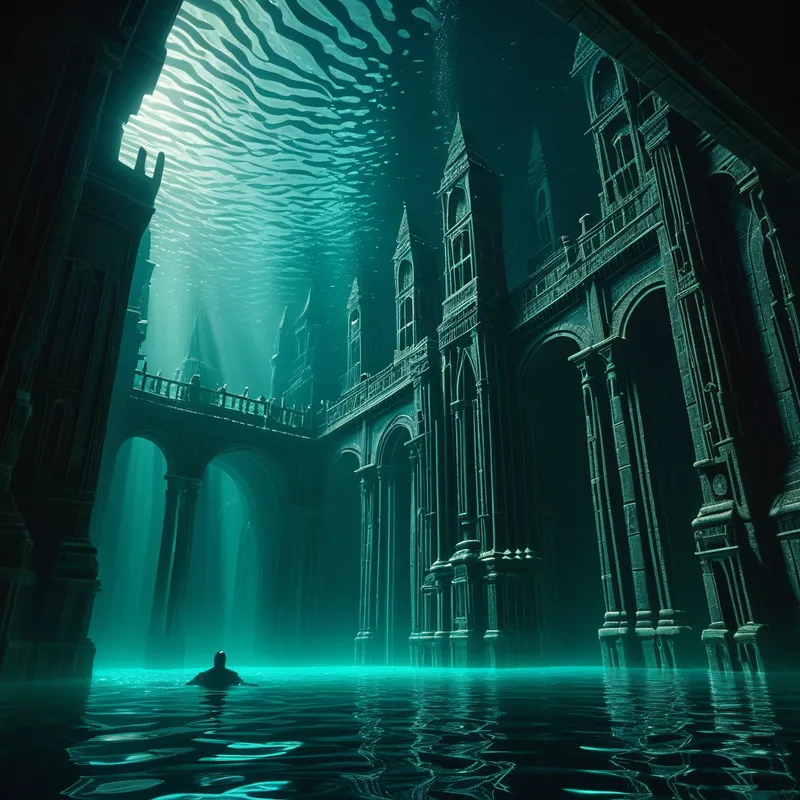
The cataclysm is the necessary nigredo, the blackening, the descent into the chaotic sea of the unconscious. This is not a punishment, but a brutal, transformative reintegration. The ego’s proud rings must be shattered so that the core Self, the orichalcum pillar at the center, can be rediscovered, not as a given right, but as a buried treasure to be recovered through effort.
Individuation requires the drowning of the personal Atlantis so that the soul-kingdom, more resilient and conscious, can be rebuilt on the bedrock of experience, not the sands of inheritance.
For the modern individual, the myth models the journey from naive idealism through catastrophic disillusionment to hard-won wisdom. We all build our Atlantean identities—based on family myths, cultural expectations, or early successes. The "quake" might be a failure, a betrayal, a depression, or a simple, crushing encounter with life’s limits. The alchemical work begins in the aftermath, sifting through the "sea of mud" of our disillusionment. The goal is not to resurrect the lost city in its old form—that is nostalgia, a psychic trap. The goal is to salvage the orichalcum, the essential, imperishable metal of our true character and purpose, and to use it to forge a new life not on an isolated, perfect island, but on the mainland of common, imperfect, but real human experience. The myth, therefore, is not a story of an ending, but a map for the most profound beginning: the birth of consciousness from the ruins of illusion.
Associated Symbols
Explore related symbols from the CaleaDream lexicon: