The Circles of the Same and the Other Myth Meaning & Symbolism
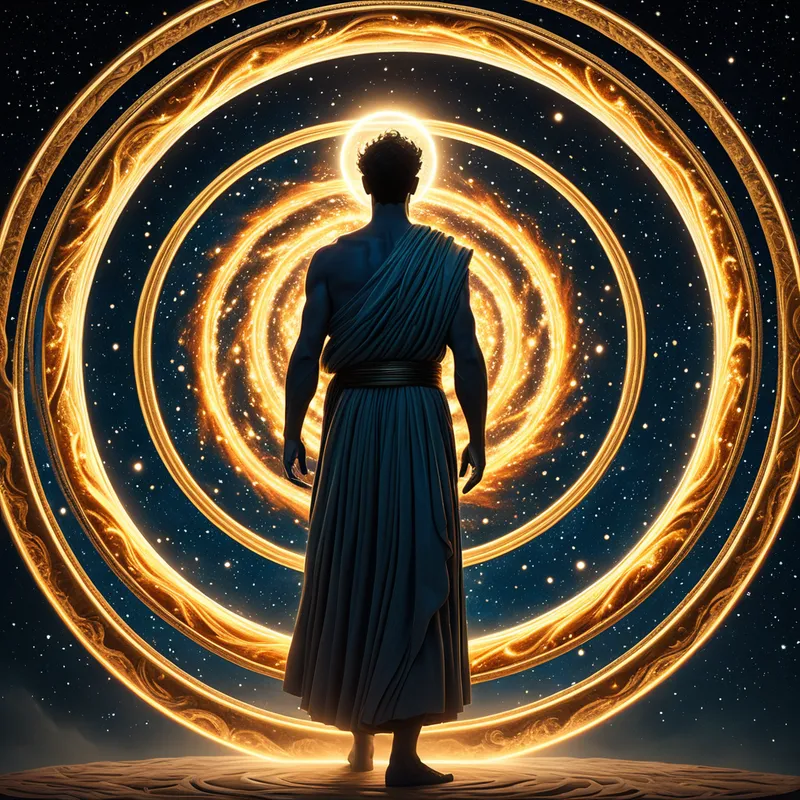
The Demiurge divides the World-Soul into two cosmic circles, one for eternal sameness and one for ceaseless difference, forging the soul of the cosmos.
The Tale of The Circles of the Same and the Other
Listen. Before time had a name, and space had a shape, there was only the Chora—a formless, seething receptacle, a womb of all potential, trembling with unspoken music. From this profound silence, a presence emerged. Not a god of thunder or passion, but a divine Artisan, the Demiurge. His was not the power of creation from nothing, but the sublime craft of persuasion, of bringing harmony to the wild.
He gazed upon the chaos, not with wrath, but with a geometer’s love. His eye saw not disorder, but the ghost of perfect forms waiting to be born. His first thought was not for stone or star, but for soul. For what is a cosmos but a living being? And what animates a being but its soul?
From the very essence of being—blending the indivisible, eternal Same with the divisible, ever-changing Other—he prepared a third, miraculous substance. This was the World-Soul. He took this glowing, psychic alloy, this mixture of permanence and flux, and began to work.
With intellect as his tool, he first fashioned a great Circle. This was the Circle of the Same. He set it to turn, right-wise, with a motion so constant, so serene, it was the very heartbeat of eternity. This circle would govern the fixed stars, the realm of perfect, unchanging ideas—the celestial dome of unwavering truth.
But a soul with only sameness is a statue, beautiful but unmoving. So from the remaining substance, he crafted a second Circle. This was the Circle of the Other. He split this circle into seven lesser circles, and set them within the first, but at a slant—an oblique angle. He gave them a left-wise motion, complex and wandering. These were the circles for the planets, the Seven Wanderers, each with its own speed and song, weaving the music of becoming, of difference, of time.
He then placed this dual-natured soul at the very center of the bodily cosmos he was crafting, stretching it from core to circumference, so that it enveloped the world from within and without. The Circle of the Same spun on the outer rim, a boundary of divine reason. The Circles of the Other danced within, the engine of life and change. And thus, the cosmos breathed its first, rational breath. Conflict was not vanquished, but composed. Chaos was not destroyed, but persuaded into a living, spinning hymn—a universe born from the marriage of unity and diversity, guided by the gentle, unyielding hand of a Craftsman who loved wisdom above all.
Cultural Origins & Context
This is not a myth from the popular cults of Olympus, told in temples to sway the hearts of the multitude. This is a philosopher’s myth, born in the Academy of Athens, from the mind of Plato. It is the central cosmological narrative of his dialogue, the Timaeus, a text that for centuries in the West would be the primary source of cosmological speculation.
Its societal function was profound yet specific: to provide a rational, beautiful, and teleological account of the universe’s origin that upheld the supremacy of reason (Nous) and mathematical order. It was told not by bards to warriors, but by a philosopher (Timaeus of Locri) to his peers (Socrates, Critias) as the most "likely account" of reality. It served to anchor Athenian intellectual culture in a vision of a cosmos that was not capricious, but intelligible; not a product of blind chance, but of benevolent, rational design. It was the foundational story for a worldview that sought the permanent truth behind the fleeting appearances of the world.
Symbolic Architecture
The myth presents a symbolic blueprint for reality itself, mapping the architecture of the macrocosm (the universe) directly onto the microcosm (the human soul).
The Demiurge represents the active principle of ordering intelligence present in the universe and, by reflection, within us. He is not a creator ex nihilo, but the personification of the human (and cosmic) urge to find pattern, meaning, and harmony in the raw material of existence.
The Circle of the Same is the symbol of identity, unity, and rational constancy. It is the principle of the ego, of consciousness that says "I am" across time. It is our capacity for logical thought, for recognizing eternal truths, for maintaining integrity and purpose.
The Circle of the Other is the symbol of difference, motion, and embodied experience. It is the principle of the body, of emotion, of desire, and of the unconscious—all that is other to our conscious "I." It is the realm of time, growth, decay, and the rich, confusing tapestry of sensory life.
The soul’s health—both cosmic and personal—depends on the proper relationship between these two circles. The Demiurge’s act of blending them, then setting them in motion, illustrates that our being is a dynamic tension. We are not meant to eradicate the Other in favor of the Same, nor be lost in the Other’s chaos. We are designed to have the Circle of the Same govern and guide the Circles of the Other, persuading our passions and perceptions into a harmonious orbit around a central axis of selfhood.
The Dreamer's Resonance
When this myth stirs in the modern unconscious, it rarely appears as a literal story. Instead, it manifests as a somatic pattern of conflict and integration.
One may dream of being trapped in a vast, monotonous, and perfectly circular room (the tyranny of the Same—rigid identity, burnout from over-control). Conversely, one may dream of being lost in a labyrinth of twisting, ever-changing corridors where walls melt and floors shift (the chaos of the Other—emotional overwhelm, loss of self in life’s flux).
The most potent dream resonance is the experience of trying to synchronize two different rhythms. Dreaming of trying to conduct an orchestra where one section plays a stately waltz and the other a frenetic jazz solo. Or feeling one’s own heartbeat split into two distinct, competing pulses. These are the somatic expressions of the soul’s two circles falling out of alignment. The psychological process is one of re-calibration: the dream ego is being shown the cost of imbalance and is, in the theater of sleep, rehearsing the act of governance and persuasion needed to restore inner cosmos.
Alchemical Translation
The alchemical work modeled by this myth is the opus contra naturam—the work against our fallen, disordered nature—which is, paradoxically, a work of returning to our original, divine nature. It is the process of Individuation.
The prima materia, our raw psychic stuff, is the chaos of the Chora—our unexamined life, our conflicting impulses and inherited patterns. The Demiurge within is the observing ego, the spark of Nous, that decides to undertake the work.
- The Blending: This is the coniunctio oppositorum, the sacred marriage. The alchemist must first acknowledge and hold both principles: the steadfast gold of the conscious Self (the Same) and the mercurial, dissolving waters of the unconscious and the body (the Other). One must not reject either.
- The Division and Setting in Motion: This is the creation of a functioning psychic system. The ego (Circle of the Same) must establish its central, governing authority—not as a tyrant, but as a wise ruler. It must then consciously engage with and "set the orbits" for the complex, often oblique motions of the instincts, emotions, and archetypal patterns (the Circles of the Other). This is active imagination, shadow work, and somatic practice.
- The Enveloping Soul: The triumph is not a static state, but a dynamic, living system. The fully realized Self is not a point, but a sphere. It is the psyche that has stretched its ordered soul from its core to its boundaries, so that reason permeates its actions, and its experiences are enfolded within a greater, meaningful pattern. The outer circle of identity holds firm, while within, the rich, changing drama of a life is allowed its passionate, planetary dance. The individual becomes a microcosm—a small, well-ordered world, reflecting the original, beautiful persuasion of the divine Artisan.
Associated Symbols
Explore related symbols from the CaleaDream lexicon: