The Christmas Elf / Tomte Myth Meaning & Symbolism
An ancient household spirit, guardian of the farm's soul, demanding respect and reciprocity, embodying the psyche's connection to place and ancestral memory.
The Tale of The Christmas Elf / Tomte
Listen. Listen to the silence that falls when the winter sun flees [the sky](/myths/the-sky “Myth from Persian culture.”/). It is in the deep, blue hour, under the watch of a bone-white moon, that the old world breathes. The farm sleeps, a dark island in a sea of snow. [The hearth](/myths/the-hearth “Myth from Norse culture.”/)’s embers sigh. The cattle shift in their warm, sweet-smelling dark. This is his hour.
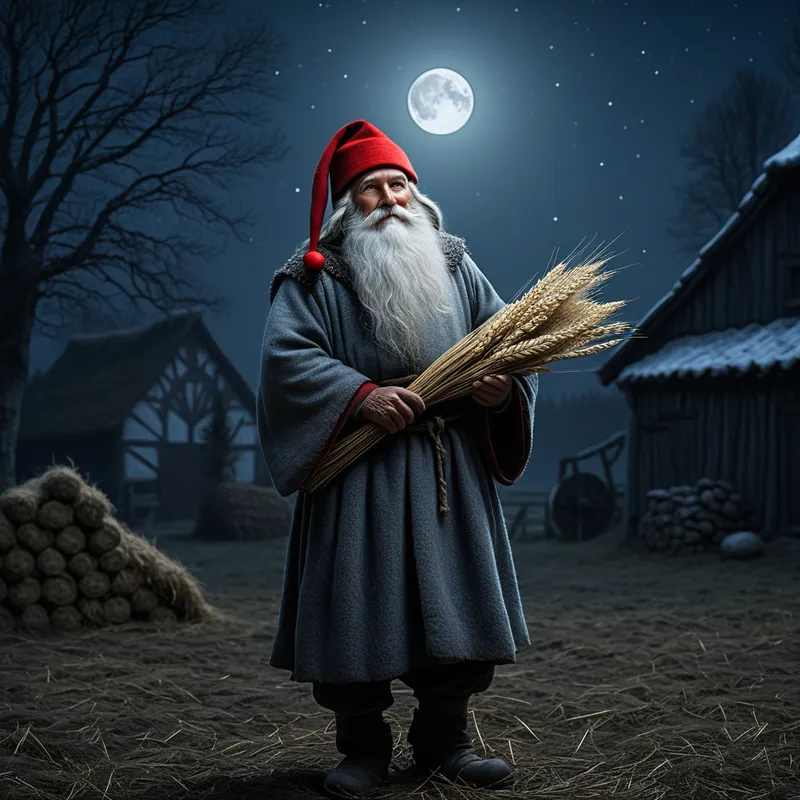
He is older than the farmhouse timbers, older than the family name carved above the door. He is the landvættir of this very plot of earth. You would mistake him for a man, if not for his stature—no taller than a man’s knee—and the eyes that hold the patient, unblinking depth of the soil itself. He wears the grey wool of [the earth](/myths/the-earth “Myth from Hindu culture.”/) and a faded red cap, the color of life’s blood. He is the Tomte.
While you dream of summer, he is working. His small, gnarled hands, strong as tree roots, check every latch. He whispers to the oxen, calming their winter fears. He chases a field mouse from the grain bin with a stern look, not a trap. He ensures the cream will be thick, the barley will sprout, the axe will not slip. The farm’s luck is not magic; it is his ceaseless, unseen vigilance. He is the soul of the place, its memory and its will to endure.
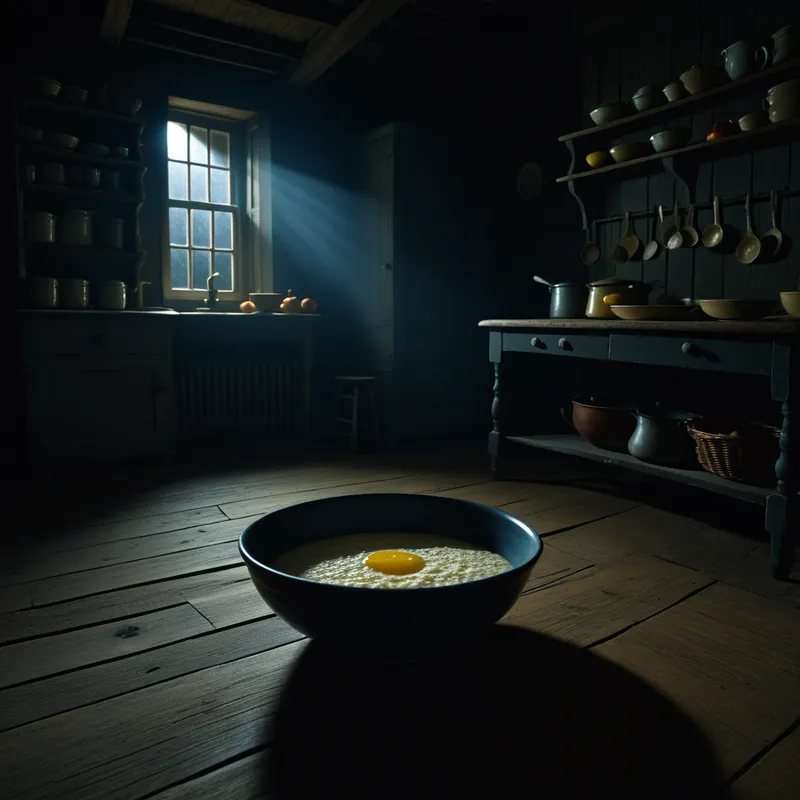
But his guardianship has a price, as sharp and clear as the winter air. It is not gold he desires, but remembrance. Respect. On Christmas Eve, the one night his presence is most keenly felt, a bowl of the finest porridge, crowned with a generous pat of golden butter, must be left for him by the hearthstone. It is an offering, a covenant. It says: We see you. We honor the pact.
Forget, and you will feel the change. The offering forgotten, the butter withheld—this is a deep insult, a tear in the fabric of reciprocity. The milk will sour overnight. The tools will vanish, only to be found in foolish places. A gentle, guiding presence curdles into a mischievous, chilling force. The helpful nisse becomes a spiteful troll. The farm’s luck turns, not with a roar, but with a slow, creeping frost that starts in the heart of the home. The story whispers of farms abandoned not to plague or war, but to a slow, mysterious decay born of a single, repeated slight: negligence of the ancient, unseen guest.
Cultural Origins & Context
The figure of the Tomte (Swedish) or Nisse (Norwegian/Danish) is not a whimsical invention of Christmas cards, but a profound artifact of pre-Christian Northern European animism. He is a descendant of the [household gods](/myths/household-gods “Myth from Ancient Egyptian culture.”/) and land spirits central to Old Norse religion. When Christianity spread across Scandinavia, these deeply ingrained spirits were not eradicated; they were domesticated, folded into the folk consciousness, and eventually grafted onto the Christian calendar, finding a natural home in the liminal, magical time of Yule, which became Christmas.
These stories were not written in sagas but breathed in the smoke of hearthfires. They were told by grandparents to children on long winter nights, serving a crucial societal function. The myth was a behavioral code, an ecological and social ethic. It taught the necessity of honoring the invisible forces that sustain life: the fertility of the land, the health of the livestock, the integrity of the home. It enforced humility, reminding the proudest farmer that his prosperity depended on a covenant with something older and more fundamental than himself. The Tomte was the psychological embodiment of the farm itself—its memory, its demands, and its fragile balance.
Symbolic Architecture
Psychologically, the Tomte represents the autonomous, caring complex within the personal and [collective unconscious](/symbols/collective-unconscious “Symbol: The Collective Unconscious refers to the part of the unconscious mind shared among beings of the same species, embodying universal experiences and archetypes.”/) that is tied to place and tradition. He is the [guardian](/symbols/guardian “Symbol: A protector figure representing safety, authority, and guidance, often embodying parental, societal, or spiritual oversight.”/) of the inner homestead—the structured, cultivated aspects of our [psyche](/myths/psyche “Myth from Greek culture.”/) that provide [stability](/symbols/stability “Symbol: A state of firmness, balance, and resistance to change, often represented by solid objects, foundations, or steady tools.”/), continuity, and daily sustenance.
The offering is not payment for services, but the ritual acknowledgment that consciousness depends on forces it did not create and does not control.
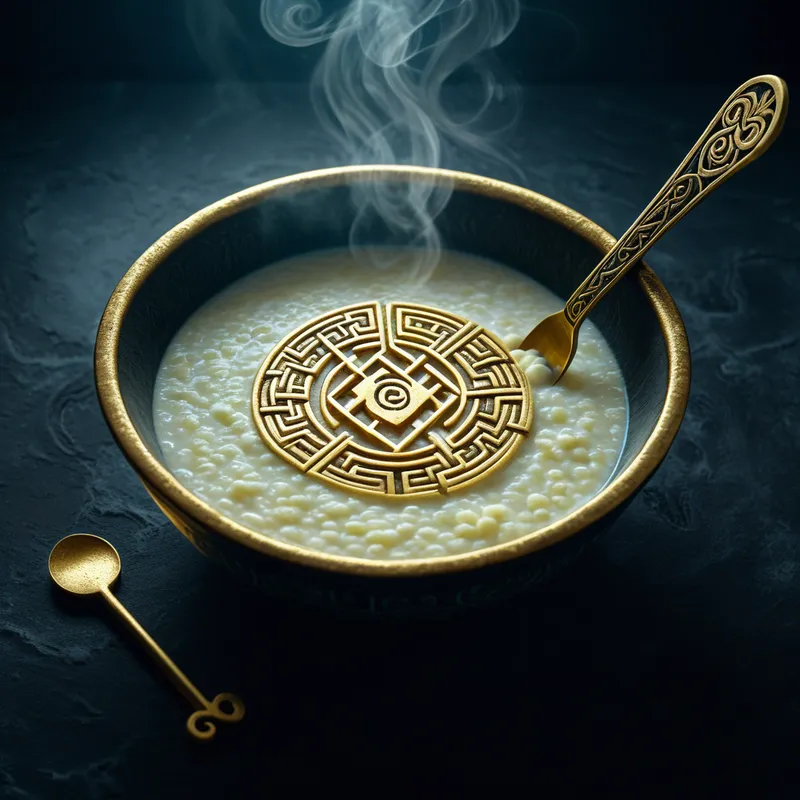
The porridge with [butter](/symbols/butter “Symbol: Butter symbolizes nourishment, transformation, and richness, often representing comfort, indulgence, or the churning of emotions into something valuable.”/) is rich in [symbolism](/symbols/symbolism “Symbol: The use of symbols to represent ideas or qualities, often conveying deeper meanings beyond literal interpretation. In dreams, it’s the language of the unconscious.”/). Porridge, a humble, staple [food](/symbols/food “Symbol: Food in dreams often symbolizes nourishment, both physical and emotional, representing the fulfillment of basic needs as well as deeper desires for connection or growth.”/), represents the basic sustenance of [life](/symbols/life “Symbol: The symbol of ‘Life’ represents a journey of growth, interconnectedness, and existential meaning, encompassing both the joys and challenges that define human experience.”/), the daily grind. The [butter](/symbols/butter “Symbol: Butter symbolizes nourishment, transformation, and richness, often representing comfort, indulgence, or the churning of emotions into something valuable.”/) is the luxury, the richness, the extra that makes [life](/symbols/life “Symbol: The symbol of ‘Life’ represents a journey of growth, interconnectedness, and existential meaning, encompassing both the joys and challenges that define human experience.”/) not merely survivable but good. To offer the butter is to offer the best of our produce, our creativity, and our gratitude. The Tomte’s dual [nature](/symbols/nature “Symbol: Nature symbolizes growth, connectivity, and the primal forces of existence.”/)—benevolent guardian and vengeful [trickster](/symbols/trickster “Symbol: A boundary-crossing archetype representing chaos, transformation, and the subversion of norms through cunning and humor.”/)—mirrors the psyche’s [response](/symbols/response “Symbol: Response in dreams symbolizes how one reacts to situations, often reflecting the subconscious mind’s processing of events.”/) to neglect. When we ignore the foundational, sustaining parts of ourselves (our [health](/symbols/health “Symbol: Health embodies well-being, vitality, and the balance between physical, mental, and spiritual states.”/), our roots, our quiet duties), the very structures that support us begin to sabotage us. The caring complex turns hostile. What was once a silent, organizing force becomes a [source](/symbols/source “Symbol: The origin point of something, often representing beginnings, nourishment, or the fundamental cause behind phenomena.”/) of inexplicable misfortune and unease.
The Dreamer’s Resonance
To dream of a Tomte-like figure in a modern context is to encounter the psyche’s signal of neglect toward one’s foundational “home.” This is not necessarily a physical house, but the internal structures of routine, self-care, ancestral memory, or respect for one’s own limits and resources.
The dream image may be a small, old figure repairing something in a basement or attic (the unconscious), or it may be a feeling of being watched in one’s own home. Perhaps the dreamer is frantically searching for a lost key (solution) that a small figure has hidden. The somatic experience is often one of creeping anxiety, a sense that something fundamental is “off” or being undermined. The psychological process is one of recalling. The unconscious is presenting the guardian who feels slighted, demanding that the dreamer stop, take stock, and remember what they have forgotten to honor in their relentless forward motion. It is a call to ritualize care for the basics of one’s existence.

Alchemical Translation
The myth of the Tomte models the alchemical process of coagulatio—the grounding of spirit into matter, and the necessity of tending that matter with conscious respect. The individuation journey is not only about soaring into transpersonal realms; it is equally about rooting deeply into the personal and the ancestral, honoring the “small spirits” of our daily reality.
The modern individual, often uprooted and focused on progress and [persona](/myths/persona “Myth from Greek culture.”/), is tasked with finding their own “farmstead”—their core values, their body, their history—and appointing a Tomte to guard it. This means establishing conscious rituals of self-care (the porridge) and gratitude (the butter). The struggle in the myth is the struggle against psychic inflation and neglect. The [triumph](/myths/triumph “Myth from Roman culture.”/) is the restoration of a reciprocal relationship with [the Self](/myths/the-self “Myth from Jungian culture.”/).
Individuation requires making a pact with the Tomte of the soul: to accept the guardianship of the ancient, autonomous psyche in exchange for the daily, humble offerings of conscious attention.
To integrate the Tomte is to understand that wholeness comes not from conquering the unconscious, but from entering into a respectful, ongoing dialogue with it. The farm prospers not when the farmer believes he acts alone, but when he knows he is in partnership with the spirit of the land itself. Our psychological well-being flourishes when we acknowledge and nourish the small, ancient, steadfast guardian who works in the shadows of our being, asking only for remembrance in return.
Associated Symbols
Explore related symbols from the CaleaDream lexicon: