The Chiton Myth Meaning & Symbolism
A profound exploration of the sacred garment in Greek myth, symbolizing divine identity, mortal vulnerability, and the soul's woven destiny.
The Tale of The Chiton
Hear now, not of a hero with a thunderous name, nor of a monster with a hundred heads, but of the silent witness to them all. Hear of the garment that touched the skin of the divine and the mortal, the second skin that held the scent of olive groves and the cold sweat of battle, of sacred smoke and mortal fear.
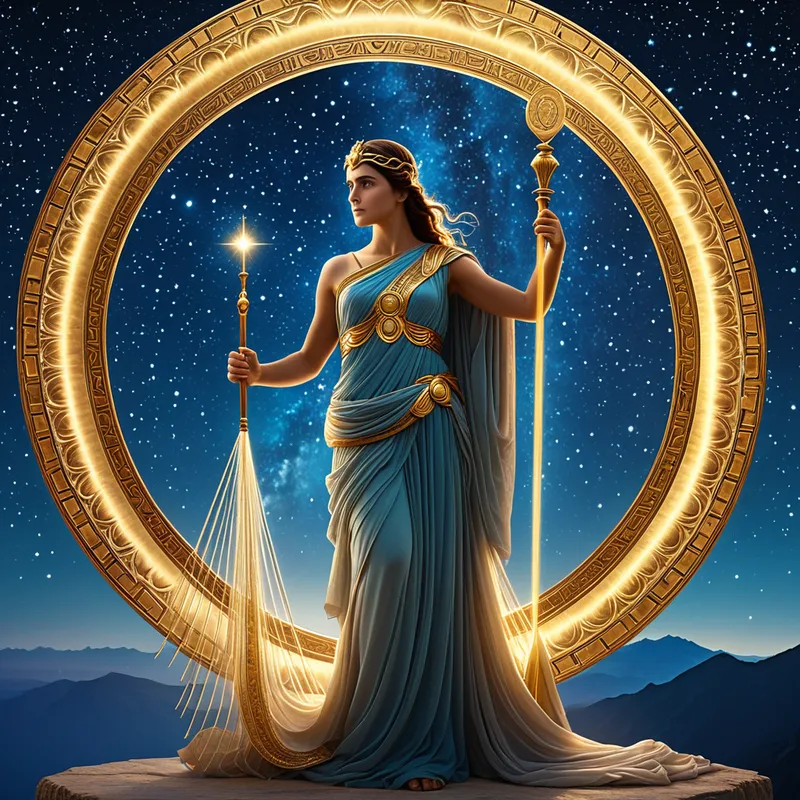
In the high halls of Olympus, where the air is music and light is a substance, the divine ones did not merely appear—they were composed. Before the flash of lightning or the crash of the sea, there was the whisper of cloth. The Athena, whose mind was a loom, would weave. Not from common flax, but from the beams of the rising sun caught in dewdrops, from the disciplined order of thought given form. Her shuttle flew, and a chiton emerged—a peplos of cloud-stuff, fastened with a brooch that held a constellation captive. It was not clothing; it was an assertion. When she donned it, she was not dressed, but declared: the Strategist, the Unshaken.
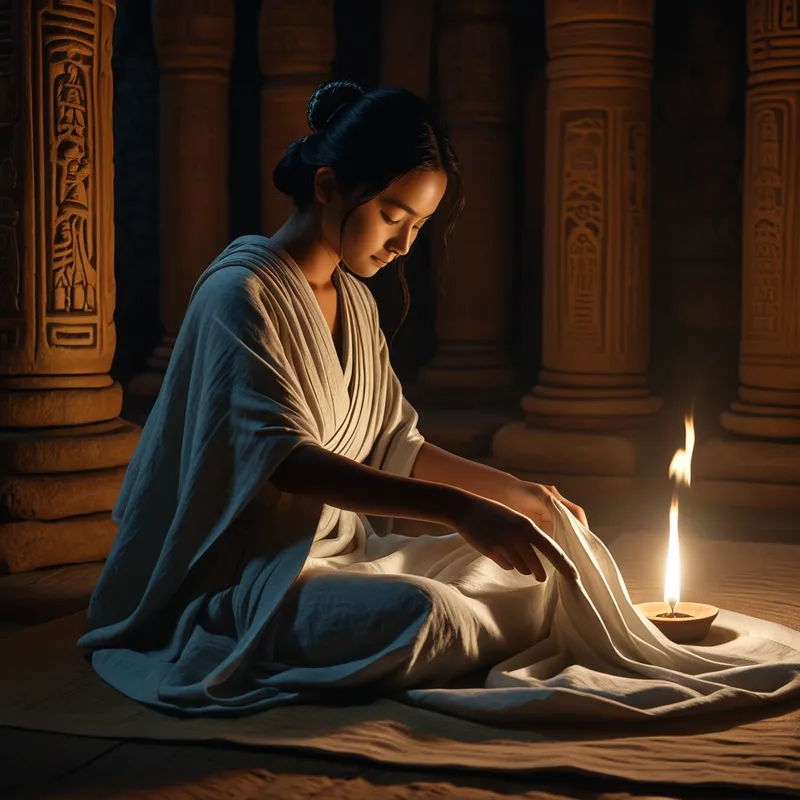
Below, in the world of dust and tears, the process was the same, though the materials spoke of earth. A mother, her hands calloused and gentle, would card the wool from her own flock. Her daughter would spin, the spindle a whirling prayer for health, for safety. The loom in the corner of the home was an altar of necessity. The chiton that grew there was humble, undyed, smelling of lanolin and hearth-smoke. Yet, in its weaving was encoded a story: the rhythm of daily life, the patience of seasons, the love that seeks to protect soft skin from a hard world.
Then came the hero to the temple, his heart a drum of dread and destiny. He had been told to come unarmed, wearing only what the goddess provided. The priestess, her eyes pools of ancient knowledge, presented it: a simple linen chiton, pure white. As he shed his own tunic—the one his mother wove, smelling of home—a vulnerability colder than any wind gripped him. This new cloth was cool, impersonal. Tying it, he felt not like a man putting on a shirt, but like a vessel being prepared for a libation. The garment was a membrane between his mortal self and the divine will he was to channel. It would be stained with sweat, torn by thorns, perhaps soaked in blood. It would become the parchment of his trial.
And when the Furies themselves pursued a soul stained with guilt, they did not see a man—they saw the chiton, stretched taut over a heart pounding with the memory of blood. The cloth, once a symbol of civilized life, now became a prosecutor’s evidence, clinging to the form, outlining the very shape of the crime.
Cultural Origins & Context
The chiton was not mythic ornament; it was the fundamental fact of the clothed human form in the ancient Greek world. Its story is woven into the very warp and weft of daily existence, from the polis to the battlefield, the temple to the home. We find it not in one grand, singular epic, but in the countless threads of poetry, vase painting, ritual, and law.
Homer’s epics are meticulous in their sartorial detail. A hero’s prowess is often matched by the quality of his chiton, sometimes given as a prize of honor, a tangible token of arete. In ritual, donning a specific chiton—often a special, saffron-dyed one for festivals—was an act of transformation, marking the wearer as a participant in the sacred, separate from the profane. The weaving of garments was the quintessential domain of women, a socially sanctioned art form where myth itself was literally woven into tapestries, as with the story of Arachne.
The myth of the chiton, therefore, is a diffuse but profound cultural narrative about boundary and identity. It functioned as a societal reminder that identity is not born, but fashioned. The citizen’s chiton distinguished him from the barbarian; the priest’s from the layman’s; the living’s from the shroud of the dead. It was a primary technology of the self, making the internal external, and in the mythological imagination, this process was simply elevated to a divine principle.
Symbolic Architecture
At its core, the chiton symbolizes the fashioned self. It is the psychic skin between the raw, unformed essence of being and the specific role one plays in the drama of existence.
The loom is the world, the thread is fate, and the chiton is the life we must wear.
First, it represents Divine Identity & Intent. For the gods, their garments are not separate from their essence. Poseidon’s chiton is the shifting deep blue-green of the restless sea; Artemis’s is the practical, short tunic of the hunter, stitched with silver like moonlight on leaves. Their clothing is an iconographic statement, a direct manifestation of their domain. Psychologically, this speaks to the archetypal forces within us—the inner King, Queen, Warrior, or Sage—each requiring its own distinct “raiment” or attitude to be properly expressed.
Second, it is the Vessel of Mortal Fate. The hero’s ritual chiton is a container for destiny. It is given, not chosen. This mirrors the Jungian concept of the persona—the “mask” we wear that adapts our inner self to the outer world. Initially, this persona can feel alien, like the hero’s cold, temple-issued linen. But through action, through living, it becomes uniquely ours, stained and shaped by our experiences, our pathos.
Finally, it signifies Vulnerability and Exposure. To have one’s chiton torn or stained is to be rendered profoundly vulnerable. In tragedy, it is the moment of peripeteia. The fabric that once conferred identity and protection now reveals the fragile mortal beneath. This is the moment when the persona cracks, and the raw, unadorned self—the shadow, the wound, the primal fear—is exposed.
The Dreamer’s Resonance
When the symbol of the chiton weaves itself into the modern dreamscape, it signals a profound process of re-clothing the self. The dreamer is navigating a shift in identity.
To dream of weaving or sewing a chiton suggests active engagement in constructing a new persona. Perhaps after a career change, a new relationship, or a spiritual awakening, the psyche is diligently working to fashion a self that can meet this new reality. The hands are busy, the pattern is emerging.
A dream of wearing an ill-fitting, constricting, or impossibly grand chiton speaks to a persona that has become a prison. The “garment” of one’s current role—be it the perfect parent, the tireless professional, the always-strong friend—no longer fits the growing soul beneath. It chafes, it stifles. The grandeur of a divine chiton may point to inflation, an identification with an archetype so complete that one’s humanity is lost.
Most powerfully, to dream of one’s chiton being torn away, unraveling, or burning is a classic symbol of ego dissolution. This is not a nightmare, though it feels terrifying. It is the psyche’s drastic surgery. The old identity, worn thin and false, is being forcibly removed. The dreamer is in the alchemical stage of nigredo, left naked in the dark, awaiting the raw material from which a truer self can be woven.
Alchemical Translation
The myth of the chiton provides a precise model for the alchemy of individuation—the process of becoming the unique, integrated self. It is a threefold operation: Receiving the Raw Pattern, Wearing-in Through Ordeal, and Unweaving to Re-weave.
The journey begins with the Given Thread. We do not invent our deepest calling from nothing. It is given—by family, culture, trauma, talent, the unconscious itself. This is the “temple chiton.” The initial task is not to reject this pattern, but to accept it as the starting material of our life’s work, however ill-fitting it may initially feel.
The ordeal is the shuttle; suffering weaves the impersonal pattern into a personal garment.
Then comes the crucial, unavoidable stage: The Stain and the Tear. Individuation is not a clean, intellectual process. It happens through lived experience—through failure, heartbreak, effort, and joy. Each “stain” on the pristine garment—the sweat of labor, the tear of grief, the mending after a rupture—is what transforms the generic pattern into a biography. The hero’s chiton is only truly his after it has been tested. So too, our character is forged not in avoiding life, but in engaging with it fully, allowing it to mark us.
The final, eternal stage is Sacred Unraveling. No single garment can fit a soul for its entire journey. The completed, well-worn chiton of one life stage must eventually be respectfully taken apart. This is the conscious work of shadow integration, of letting go of outgrown identities. We take the threads of our past achievements and failures—the gold and the grey—and place them back on the loom. Informed by wisdom, we begin to weave again, creating a garment for the next phase of the journey, one that incorporates all that we were into what we are becoming.
Thus, the soul is not a static statue, but a living tapestry. We are forever the weaver and the woven, the wearer and the worn, engaged in the sacred, endless craft of becoming.
Associated Symbols
Explore related symbols from the CaleaDream lexicon: