The Chinese Zodiac Animals Myth Meaning & Symbolism
A celestial race to determine the order of twelve earthly branches, revealing the virtues, flaws, and cosmic roles of the animals who answered the Jade Emperor's call.
The Tale of The Chinese Zodiac Animals
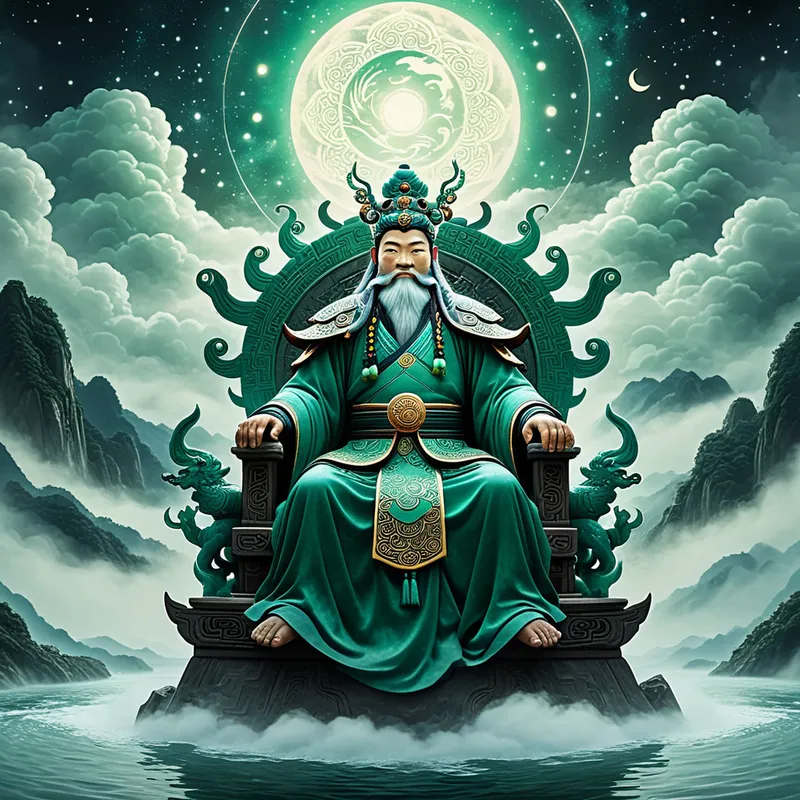
In the time before time was measured, when the heavens were a seamless tapestry of jade and [the earth](/myths/the-earth “Myth from Hindu culture.”/) a formless, fertile dark, the [Jade Emperor](/myths/jade-emperor “Myth from Chinese culture.”/) gazed down from his celestial palace. A profound stillness, beautiful yet vast and empty, filled the realms. He perceived a lack—a bridge between the eternal cycles of [the sky](/myths/the-sky “Myth from Persian culture.”/) and the bustling, burgeoning life of [the world](/myths/the-world “Myth from Tarot culture.”/) below. The years flowed, but they flowed nameless, without a face, a spirit, a guide for the human heart to know its place in the great turning.
So, he sent forth a decree, carried on the breath of the east wind and the rumble of distant thunder. A Great Race was to be held. The first twelve creatures to arrive at his heavenly gate would be granted a monumental honor: each would lend its name and essence to one of the twelve earthly branches, becoming a guardian of a year, a cycle within the cycle, forever imprinting their character upon the flow of time.
The news rippled through the world. In the deep forests, the Tiger roared with ambition, muscles coiling like springs. The clever Rat, hearing the whisper in the rafters, twitched its whiskers, its mind already a whirlwind of schemes. The loyal Ox simply nodded, ready to begin its steady, unwavering plod. From the burrow, the warren, the riverbank, and the mountain peak, they gathered—each driven by a unique fire of desire.
The course was set: a rushing, silver river to cross, then a final, soaring climb to the celestial gate. On the appointed dawn, as the first peach-blossom light touched the [water](/myths/water “Myth from Chinese culture.”/), the signal was given.
The Ox, with its immense, gentle strength, forged into the current, creating a wake of calm. Unseen, the tiny Rat, having judged the distance and its own limitations, leapt from the shore and landed softly, securely, upon the Ox’s broad back. As the Ox reached the far bank, the Rat, with a final burst of cunning energy, sprang from its head and dashed across the finish line, becoming the first. The Ox, never breaking its steadfast pace, arrived a moment later, the second.
Then came the chaos of striving. The Tiger, magnificent and powerful, fought the current’s pull to arrive third, its fur glistening. The Rabbit, hopping from stone to floating log, arrived fourth, barely dry. The Dragon, who could have flown directly, delayed to bring rain to a parched village, then blew a gust of wind to help the Rabbit ashore, earning the fifth place through benevolent power.
The Snake, hidden in the hoof of the Horse, startled it at the last moment to slip into sixth, while the Horse took seventh. A raft carried the Sheep, the Monkey, and the Rooster together, who worked in harmony to pole across; the Sheep was eighth, the Monkey ninth, the Rooster tenth. The Dog, though a strong swimmer, had tarried playing in [the river](/myths/the-river “Myth from Buddhist culture.”/)’s coolness, arriving eleventh with a happy shake.
As the Jade Emperor prepared to close the gate, a last, frantic splashing was heard. The Pig, having stopped to feast and then to nap, roused itself and lumbered across the line, claiming the twelfth and final place.
And so, [the pantheon](/myths/the-pantheon “Myth from Greek culture.”/) was set. The Jade Emperor looked upon the twelve, breathless and bedraggled, each a perfect embodiment of a strand of existence. He saw not just animals, but principles—ambition and patience, cunning and strength, benevolence and self-interest, cooperation and individual glory. He bestowed upon them their eternal stations, and the wheel of the Shengxiao began to turn, giving time a face, a story, and a soul.
Cultural Origins & Context
The myth of [the Zodiac](/myths/the-zodiac “Myth from Greek culture.”/) Animals, or Shengxiao, is a foundational folk narrative woven into the fabric of Han Chinese culture. Its origins are ancient and syncretic, likely arising during the Han Dynasty (206 BCE – 220 CE) from a confluence of earlier animal symbolism, Earthly Branch cyclical chronology, and popular storytelling traditions. It was not the product of a single priestly class but flourished in the oral tradition—told by grandmothers at [the hearth](/myths/the-hearth “Myth from Norse culture.”/), by traveling storytellers in market squares, and enacted in seasonal festivals.
Its primary societal function was twofold: to explain and humanize the complex, abstract system of calendrical time, and to impart moral and practical wisdom. By attaching an animal’s attributes to a year, the myth provided a memorable, accessible framework for understanding one’s place in the familial and social order (through birth years) and the perceived character of time itself. It served as a tool for socialization, teaching lessons about the virtues rewarded (the Ox’s diligence, [the Dragon](/myths/the-dragon “Myth from Chinese culture.”/)’s kindness) and the flaws that hinder (the Pig’s indulgence, the Dog’s distraction), all within the overarching framework of a cosmic, celestial order decreed by heaven.
Symbolic Architecture
At its [heart](/symbols/heart “Symbol: The heart symbolizes love, emotion, and the core of one’s existence, representing deep connections with others and self.”/), the race is not merely a [contest](/symbols/contest “Symbol: A contest often symbolizes competition, personal challenges, and the desire for validation or achievement.”/) of speed, but a [revelation](/symbols/revelation “Symbol: A sudden, profound disclosure of truth or insight, often through artistic or musical means, that transforms understanding.”/) of essential natures under the pressure of a cosmic [opportunity](/symbols/opportunity “Symbol: The symbol ‘opportunity’ signifies potential for advancement, growth, and new beginnings in various life aspects.”/). Each animal embodies a specific complex of psychological traits, a [strategy](/symbols/strategy “Symbol: A plan of action designed to achieve a long-term or overall aim, often involving competition, resource management, and foresight.”/) for navigating existence.
The order of the zodiac is not a hierarchy of worth, but a celestial map of the soul’s potential configurations, a cycle of becoming where every strength implies a shadow, and every vice holds a latent virtue.
The Rat and Ox represent the primordial [dyad](/symbols/dyad “Symbol: A fundamental pair or duality representing unity, opposition, and the foundational structure of existence in spiritual and mythological traditions.”/) of mind and [body](/symbols/body “Symbol: The body in dreams often symbolizes the dreamer’s self-identity, personal health, and the relationship they have with their physical existence.”/), cunning and endurance. Their partnership-turned-[betrayal](/symbols/betrayal “Symbol: A profound violation of trust in artistic or musical contexts, often representing broken creative partnerships or artistic integrity compromised.”/) speaks to the necessary, often uneasy, [alliance](/symbols/alliance “Symbol: A formal or informal union between individuals or groups for mutual benefit, support, or protection.”/) between intellect and stamina required to achieve any great undertaking. The [Dragon](/symbols/dragon “Symbol: Dragons are potent symbols of power, wisdom, and transformation, often embodying the duality of creation and destruction.”/)’s [choice](/symbols/choice “Symbol: The concept of choice often embodies decision-making, freedom, and the multitude of paths available in life.”/) to help others at the cost of its own rank transforms raw power into civilized, benevolent [authority](/symbols/authority “Symbol: A symbol representing power structures, rules, and control, often reflecting one’s relationship with societal or personal governance.”/). The Snake’s hidden ride and sudden strike exemplify the wisdom of the unseen, the strategic use of secrecy and surprise. The final trio—the Dog’s joyful dilly-dallying and the Pig’s contented lateness—remind us that the [journey](/symbols/journey “Symbol: A journey in dreams typically signifies adventure, growth, or a significant life transition.”/) itself, with all its sensual pleasures and distractions, is as much a part of [life](/symbols/life “Symbol: The symbol of ‘Life’ represents a journey of growth, interconnectedness, and existential meaning, encompassing both the joys and challenges that define human experience.”/) as the finish line.
Collectively, the twelve form a complete psychological ecosystem. They encompass the full [spectrum](/symbols/spectrum “Symbol: A continuum of possibilities, representing diversity, transition, and the full range of existence from one extreme to another.”/) of drives: the [predator](/symbols/predator “Symbol: Represents primal fears, survival instincts, and internal threats. Often symbolizes aggressive impulses or external pressures.”/)’s ambition ([Tiger](/symbols/tiger “Symbol: The tiger symbolizes power, courage, and primal instincts, often representing untamed energy and aggression.”/)), the social [creature](/symbols/creature “Symbol: Creatures in dreams often symbolize instincts, primal urges, and the unknown aspects of the psyche.”/)’s cooperation ([Sheep](/symbols/sheep “Symbol: Sheep often symbolize innocence, vulnerability, and the idea of conforming to societal norms.”/), Monkey, Rooster), the solitary’s self-reliance (Snake), and the diligent provider’s focus (Ox, Pig). The myth asserts that all these modes of being have a place in the cosmic order; the [year](/symbols/year “Symbol: A unit of time measuring cycles, growth, and passage. Represents life stages, progress, and mortality.”/) you are born under does not seal your [fate](/symbols/fate “Symbol: Fate represents the belief in predetermined outcomes, suggesting that some aspects of life are beyond human control.”/), but offers a primary archetypal [lens](/symbols/lens “Symbol: A lens in dreams represents focus, perspective, clarity, or distortion in how one perceives reality, art, or self.”/) through which you engage with the world.
The Dreamer’s Resonance
When the Zodiac Animals appear in modern dreams, they rarely come as a polite, ordered parade. They manifest as the dreamer’s [psyche](/myths/psyche “Myth from Greek culture.”/) engages with questions of identity, timing, and innate strategy.
To dream of a specific animal, especially in conflict or alliance with another, often points to an activation of that archetype within the dreamer. A person grappling with feeling overlooked might dream of the clever Rat finding an unorthodox path. Someone burning out from relentless effort might encounter the serene, unhurried Pig, inviting them to question their relationship to time and reward. A dream of the race itself—especially if the dreamer is participating or watching anxiously—can signal a deep somatic awareness of being in a critical life phase, a “cosmic timing” where one’s inherent nature is being called to perform and be recognized.
The river in the dream is particularly potent. It is the unconscious itself, the emotional and instinctual current one must cross to reach a new state of consciousness (the celestial gate). How one crosses it—riding another, struggling alone, helping others, or being carried—is a direct reflection of the psychological process underway.

Alchemical Translation
The myth models the alchemical journey of individuation—the process of becoming a whole, integrated self—with stunning clarity. The Jade Emperor’s call represents the summons from [the Self](/myths/the-self “Myth from Jungian culture.”/), the central archetype of wholeness, to the disparate parts of our personality (the animals). [The ego](/myths/the-ego “Myth from Jungian culture.”/) must organize these inner forces toward a transcendent goal.
The race is the lifelong process of psychic integration, where we must successively recognize, employ, and ultimately harmonize the competing creatures within our own nature.
First, we must employ our innate Rat-like cunning and Ox-like endurance to cross the great river of the unconscious. We then encounter our inner Tiger’s raw ambition and must temper it with the Dragon’s social responsibility. We learn the Snake’s strategic patience and the Horse’s passionate forward drive. The collaborative spirit of the Sheep, Monkey, and Rooster shows us the value of inner dialogue and cooperation between different psychic functions.
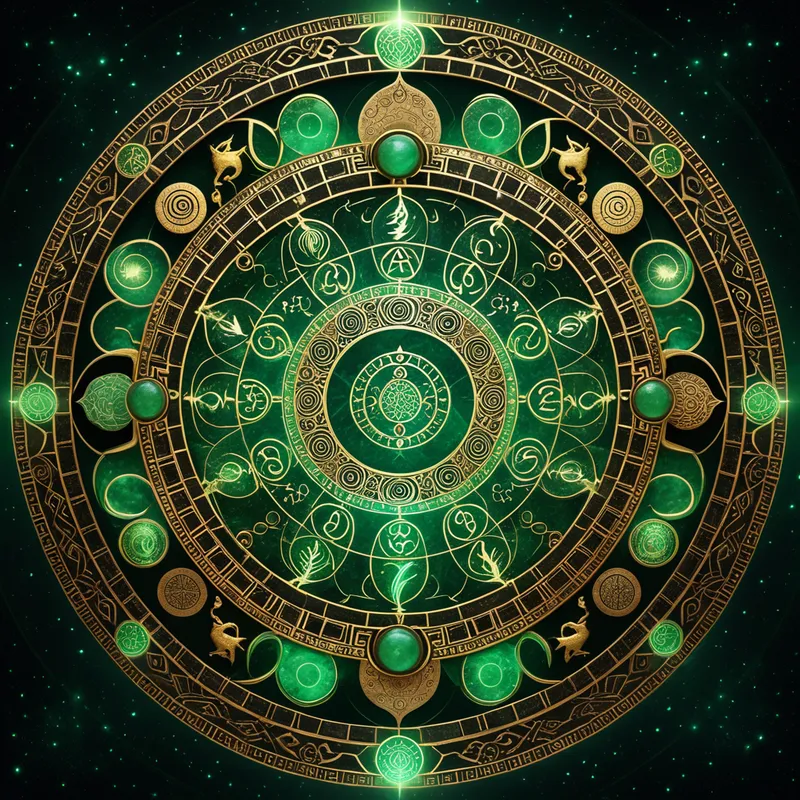
The final lesson is perhaps the most profound. The Dog’s playfulness and the Pig’s sensual enjoyment arrive last, not as failures, but as essential components. The alchemical work is not solely about striving and achieving; it is incomplete without integrating the parts of us that find joy in the journey itself, that value experience over mere achievement. To become whole, we must grant a place at the celestial table not only to our ambition and diligence but also to our capacity for delight, rest, and simple, embodied existence. The completed zodiac wheel is a symbol of the fully realized Self—a [mandala](/myths/mandala “Myth from Buddhist culture.”/) containing and balancing all twelve essential energies, turning in perfect, endless cycle within the human soul.
Associated Symbols
Explore related symbols from the CaleaDream lexicon: