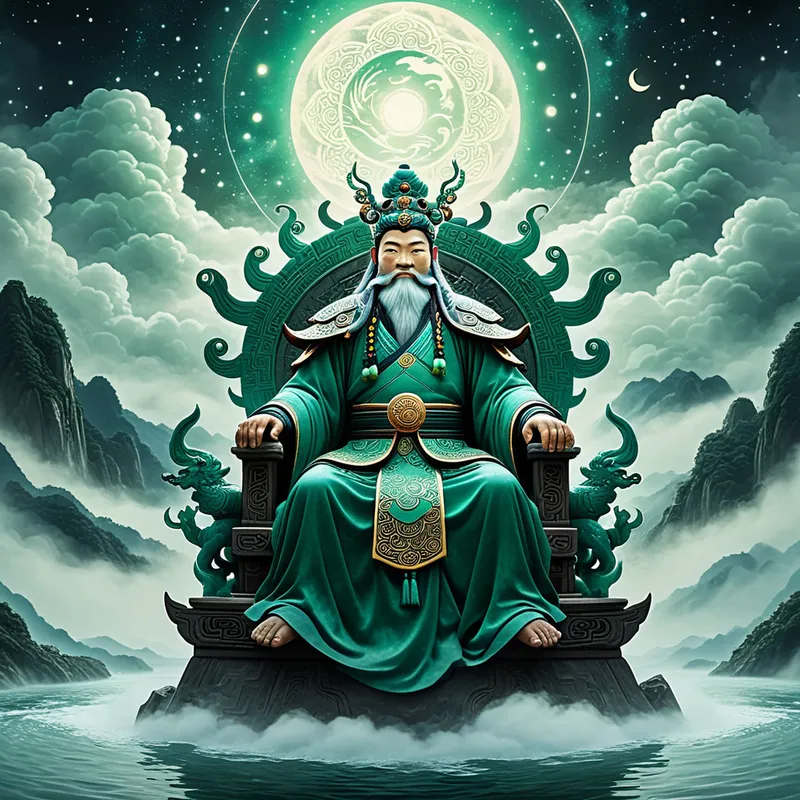
The Sacred Stranger: When a Character Enters Your Dream
The Somatic Echo
It begins not as a thought, but as a texture in the chest. A tightening, a quickening, a hollow pull behind the sternum—the body’s ancient radar detecting a foreign signature in its own sovereign airspace. It is the somatic echo of a presence. Before the face forms, before the voice speaks, the nervous system registers the arrival: a knot of unfamiliar energy, a ghost-limb of emotion you don’t consciously own. This is the prelude to encounter. The dream is not introducing you to someone new; it is reintroducing you to a part of yourself that has been living in exile, and your flesh remembers the exile first.
The Dreamer's Log
You are standing in a vast, empty hall of shifting, iridescent marble. A figure you’ve never seen, clad in worn leather and quiet intensity, walks toward you and without a word, presses a heavy, obsidian key into your palm. Their eyes hold a sorrow older than cities. You wake with your hand clenched, the phantom weight of the key still pressing against your skin.
This is not a message from the outside world, but the delivery of an internal authority you have yet to claim.

The False Lead
The most common and tempting misinterpretation is to literalize. To spend your waking hours searching for this face in a crowd, believing the dream to be precognition or a message about an external relationship. This is the false lead, a decoy of the psyche that keeps you looking outward, avoiding the more demanding, sacred confrontation within. The terror or allure of the character is not about them; it is the magnetic pull of a disowned part of your own psychological architecture, now personified and seeking audience. It is not a prophecy of meeting, but evidence of a meeting long overdue—inside you.
Psychological Architecture
To dream of a distinct character is to witness the psyche’s genius for personification. We are not monolithic beings, but parliaments of selves. In the language of Internal Family Systems, these are your Parts—exiles, managers, firefighters—taking on form to be seen. In the deeper waters of Jungian work, this is Shadow Integration. The character embodies qualities, memories, or potentials you have severed from your conscious identity. Perhaps it is your ferocity, gentled into submission. Your wild creativity, locked in a basement. Your grief, wearing a mask of stoicism. The dream stage allows this exiled self to step out of the darkness and into the limelight, not to haunt you, but to petition for recognition. The process of individuation is not about becoming a smooth, unified whole, but about becoming a conscious curator of this inner ensemble, learning the lines of each player in your soul’s complex drama.
Mythic Resonance
Consider the myth of Odysseus and the Underworld. To find his way home, the hero must descend and pour out libations to the shades. They cluster around him, famished for recognition—among them, the ghost of his own mother. He cannot embrace her; she is insubstantial. He can only listen. This is the precise dynamic of the character dream. The psyche’s underworld is populated by shades of our unlived lives, our unmourned losses, our untapped powers. They are insubstantial until we offer the libation of our attention. In the Aboriginal concept of the Dreamtime, the landscape is alive with ancestral beings whose stories form the very fabric of reality. Your dream characters are these ancestral beings—not of your bloodline, but of your soul’s lineage, singing the world of you into being.
Symbolic Nodes
- The Unknown Figure: The purest symbol of the disowned Self.
- The Guide/Mentor: A cluster of inner wisdom or needed knowledge personified.
- The Antagonist/Pursuer: Often a concentrated form of repressed fear, shame, or a power you refuse to wield.
- The Child: Vulnerability, innocence, a nascent aspect of the psyche, or a memory-self.
- The Lover: The embodiment of a deep yearning for union, often with a lost part of one’s own soul (anima/animus).
- The Authority Figure: Internalized rules, the critical parent, or the nascent voice of your own sovereignty.
Archetypal Resonance
The theme of the dream character resonates most profoundly with The Magician Archetype. The Magician’s domain is the liminal space where potential becomes form, where the unseen is made manifest. Every character that steps onto your dream stage is a feat of the inner Magician’s art—a thought, a feeling, a memory, conjured into a being with voice and will. The somatic echo is the crackle of this transmutative energy in your body’s field. The alchemical potential lies in moving from being bewitched by these apparitions (the Shadow Magician’s illusion) to learning the language of their conjuring—to recognize that you are both the audience and the archmage who cast the spell, and thus can dialogue with the creations of your own profound depth.
The Alchemical Process
The transmutation here is from spectral haunting to embodied council. The required heat is the courage to turn toward, not away from, the haunting. The pressure is the discomfort of suspending your known identity to listen to a voice that contradicts it. You must allow the character to speak its piece. In the crucible of your attention, the projected form begins to soften. The terrifying pursuer may reveal itself as a protector you misunderstood. The alluring stranger may dissolve into a quality you crave. This is the solve et coagula: you dissolve the rigid boundary between "me" and "not-me," and then re-coagulate your identity to include this reclaimed energy. The grief and terror are the energies of exile; the sovereignty gained is the authority of a self that has reclaimed its lost provinces.

The Integration Protocol
Question 1: If this character were a guardian of something I have forgotten or locked away, what treasure might they be protecting?
Question 2: What single, core emotion does this character seem to carry in their body—an emotion I rarely allow myself to fully feel?
Question 3: If I could offer this character one thing—not to make them go away, but to honor their presence—what would it be?
Action 1 (Somatic Re-entry): Upon waking, before the mind analyzes, return to the body’s echo. Place a hand where you felt the pull or tension. Breathe into that space, imagining you are creating a room there for that character’s energy to simply exist, without judgment or demand.
Action 2 (Unstructured Council): Set a timer for ten minutes. Write a dialogue with the character. Let your hand move without censorship. Ask the simple question: "What do you need me to know?" Do not force a resolution; allow the conversation to be awkward, strange, or unresolved.
Action 3 (Ritual of Embodiment): Choose one quality the character embodied (e.g., fierce stillness, playful mischief, deep sorrow). For one day, consciously "wear" that quality like a subtle garment. How does moving through your world with this energy change your perceptions, your interactions? You are not becoming them; you are integrating a note from their frequency into your own chord.
Final Validation
To be visited by these strangers from within is to feel the foundations of your known self tremble. It is deeply, inherently unsettling. Validate that tremor. It is the sign of a psyche that is alive, dynamic, and courageous enough to not settle for a small, well-lit room when a whole palace of selves awaits integration. The character does not come to dismantle you, but to introduce you to the next, more sovereign version of who you are becoming. The key they offer—often felt in the waking hand—fits a lock you have been walking past in the hallway of your own soul for a lifetime. It is time to turn it.