The Alchemy of Rivalry: When Your Dreams Demand You Compete
The Somatic Echo
Before the starting pistol fires, before the opponent takes shape, the body knows. It is a tightening in the solar plexus, a coiling of potential energy like a spring compressed to its limit. The breath becomes shallow, held in the upper chest, a readiness to sprint or to freeze. Muscles fiber themselves with a silent hum, a biological tuning to a frequency of confrontation. There is a metallic taste at the back of the tongue—the flavor of adrenaline, the precursor to fight. This is not the clean anxiety of a challenge accepted; it is the deeper, more ancient tremor of a system preparing for a threat to its very existence. The dream of competition begins here, in this visceral hum, long before the mind conjures a race, a game, or a rival. It is the somatic echo of a division within the self.
The Dreamer's Log (Case Vignette)
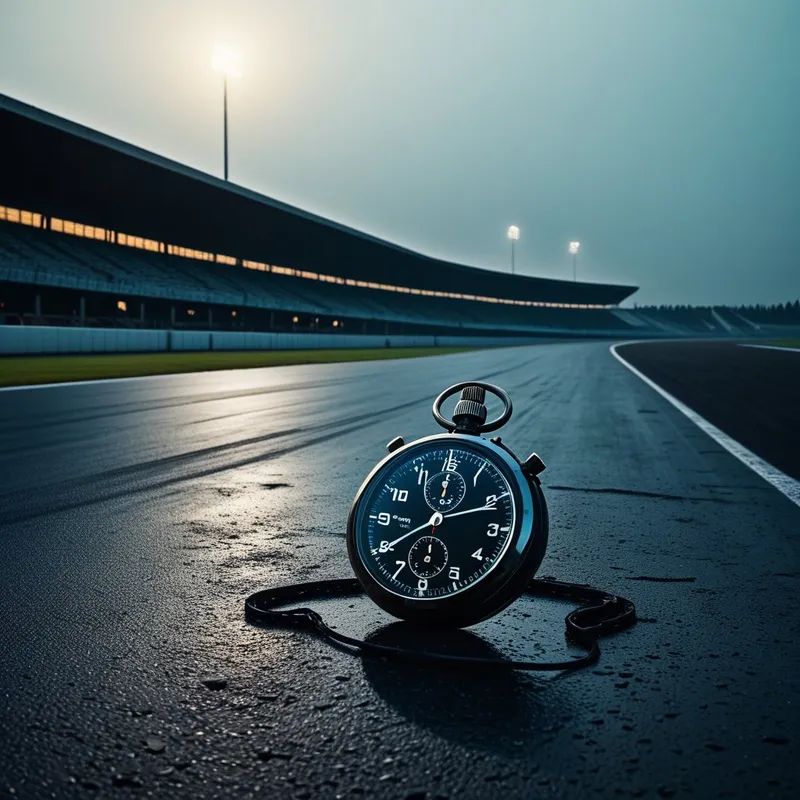
I am running a race on a track that stretches into a featureless horizon. There are no other runners, but I can feel a presence just behind my left shoulder, its breath hot on my neck. I push harder, my lungs burning, but the finish line recedes with every stride. The only sound is the frantic ticking of a stopwatch fused to my own wrist. This dream is the psyche’s stark report: you are in a race where the opponent is a disowned part of your own potential, and the true finish line is self-confrontation.
The False Lead
Do not mistake this theme for a simple rehearsal of daily stress or a reflection of workplace rivalry. The dream of competition is not about besting an external other. To interpret it as such is to follow a false lead, a decoy laid by the ego to keep you looking outward. The grief here is not about losing a prize; it is the grief of self-abandonment. The terror is not of an opponent’s victory, but of the realization that you have been pitted against yourself. The dream is not reporting on the world’s contests, but on the civil war within your own psychological architecture.
Psychological Architecture
Beneath the spectacle of the race lies the silent, shadowed work of Individuation. Here, competition reveals itself as the psyche’s brutal, necessary method of integration. You are not one thing, but a parliament of selves—the ambitious striver, the cautious protector, the joyful creator, the weary orphan. In waking life, we often exile the parts that seem weak or inconvenient, letting one dominant faction rule. But the exiled selves do not vanish; they gather in the shadowlands of the unconscious and form a rival faction. The dream of competition is the staged battle between the ruling inner regime and its shadow opposition.
The runner you cannot outpace is your own disciplined rigor, turned merciless. The opponent who knows all your moves is your intuitive self, now alienated and weaponized. The game you cannot win is rigged by your own inner critic, who holds both sides of the board. This is the deep Shadow work: to recognize that every rival is a mirror, every obstacle a part of yourself begging for acknowledgment. The goal is not to destroy the opposition, but to convene a truce, to listen to its grievances, and to negotiate a more unified inner sovereignty. The race ends only when you stop running from yourself.
Mythic Resonance
We see this eternal internal struggle reflected in the firmament of our oldest stories. Consider the myth of Osiris and Set. Osiris, the ruler of order and fertility, is dismembered and scattered by his brother Set, the god of chaos, storms, and the foreign desert. This is not merely a tale of fraternal envy. It is a map of the psyche. Osiris represents the integrated, functioning self. Set is the shadow—the disruptive, competitive, "not-self" force that shatters that wholeness. The subsequent quest of Isis and Horus to reassemble Osiris is the long, painful labor of Individuation: gathering the scattered fragments (our disowned qualities) and, through great effort, reconstituting a self that is even more resilient for having integrated its own chaotic potential. Set is not destroyed; his energy is contained within a renewed order. The competition was the necessary prelude to a higher synthesis.
Symbolic Nodes
- Unwinnable Races/Games: The structure of a contest with shifting rules or a receding goal, symbolizing the ego’s futile attempt to "solve" an internal conflict through sheer effort.
- The Unseen Opponent: A presence felt but not seen, often just behind you, representing the shadow self—close, persistent, and perceptible only through its effects.
- Malfunctioning Tools: A broken weapon, jammed starting pistol, or melting clock, indicating that the conscious strategies and tools for "winning" in the outer world are useless in this inner battle.
- The Mirror as Adversary: Facing an opponent who is your own reflection, the most direct symbol of the self-versus-self dynamic.
- The Crowd of Judges: A silent, watching audience whose approval you desperately seek, representing internalized expectations and the fragmented parts of the self waiting to see which faction will prevail.
Archetypal Resonance
The engine of this dream theme is most powerfully driven by The Shadow Hero. The Hero archetype in its essence seeks to overcome obstacles, to prove worth, and to achieve a decisive victory. In its shadow form, this noble drive curdles. The Shadow Hero does not fight dragons to save the village; it fights to prove the village needs saving. Its competition is performative, its battles are for validation, and its opponent is often a phantom of its own making—or a disowned part of the self cast as the villain. The somatic echo of the coiled spring is the Shadow Hero’s perpetual state of readiness for a battle that sustains its identity. Its alchemical potential, however, is immense: by turning its relentless drive inward, the Shadow Hero can become the champion of its own fragmented parts, not by slaying them, but by hearing their claims and integrating their strength. The battle is transformed from a war of annihilation into a campaign of unification.
The Alchemical Process
The transmutation of competition requires the heat of conscious suffering. You must willingly step into the nigredo, the blackening, of realizing you are your own adversary. This is the intense pressure: to hold the grief of self-betrayal and the terror of your own fragmented state without fleeing into the old story of blaming an external rival. The fire is applied when you ask, not "How do I win?" but "What part of me have I made into an enemy?"
The process is one of solutio—dissolution. You must let the rigid identity of "the competitor" dissolve. The rules of the external game melt away, revealing the raw, unmet needs of the inner factions. The alchemical gold that precipitates is sovereignty: not the tyranny of one part over the others, but the graceful, authoritative governance of a self that has acknowledged all its citizens. The race was the crucible. The finish line was always this moment of integration, where the energy once spent on internal rivalry is reclaimed as pure, undivided creative power.
The Integration Protocol
Question 1: In the dream, what did you stand to gain by winning, and what did you fear would happen if you lost? Translate these stakes into the language of your inner life—what quality or part of yourself feels like the "prize" or the "loss"?
Question 2: If your dream opponent could speak, what would it say it wants from you? Not to destroy you, but what recognition, what space, what acknowledgment does it crave?
Question 3: Where in your waking life do you feel this same somatic echo—that coiled-spring tension of competition—even when no obvious external rival is present? What situation or relationship activates this internal civil war?
Action 1 (The Inner Treaty): Sit in quiet meditation and visualize the two primary "sides" from your dream (e.g., the runner vs. the pursuing presence). Imagine a neutral ground. Let each side express its core desire and its core fear, without judgment. Your role is not to choose a side, but to witness and acknowledge both.
Action 2 (Unstructured Mapping): With a large sheet of paper and pens, draw the landscape of your dream competition not as a story, but as a system. Let shapes, lines, and colors represent the forces at play—the pressure, the goal, the obstacles, the entities. Do not aim for art; aim for an intuitive map of the internal conflict. Where are the blockages? Where is the flow?
Action 3 (Ritual of Reclamation): Find a small stone or object to represent the "opponent" from your dream. Hold it, and consciously state aloud: "The energy I have spent fighting you is my own energy. I reclaim it now." Then, place the object on your altar or a significant shelf, not as a trophy, but as an honored part of your now-integrated council.
Final Validation
It is profoundly difficult to discover that the rival you have been straining against wears your own face. It can feel like a betrayal by the very fabric of your being. Honor that disorientation. Yet within that vertigo lies your greatest liberation. For when you finally turn from the specter of external competition to face the internal one, you are no longer in a race with a single finish line. You are in the sacred process of becoming a universe—complex, varied, and held together by the gravity of your own acceptance. The competition was never about winning. It was an invitation to come home, to the only self you were ever meant to be: whole.