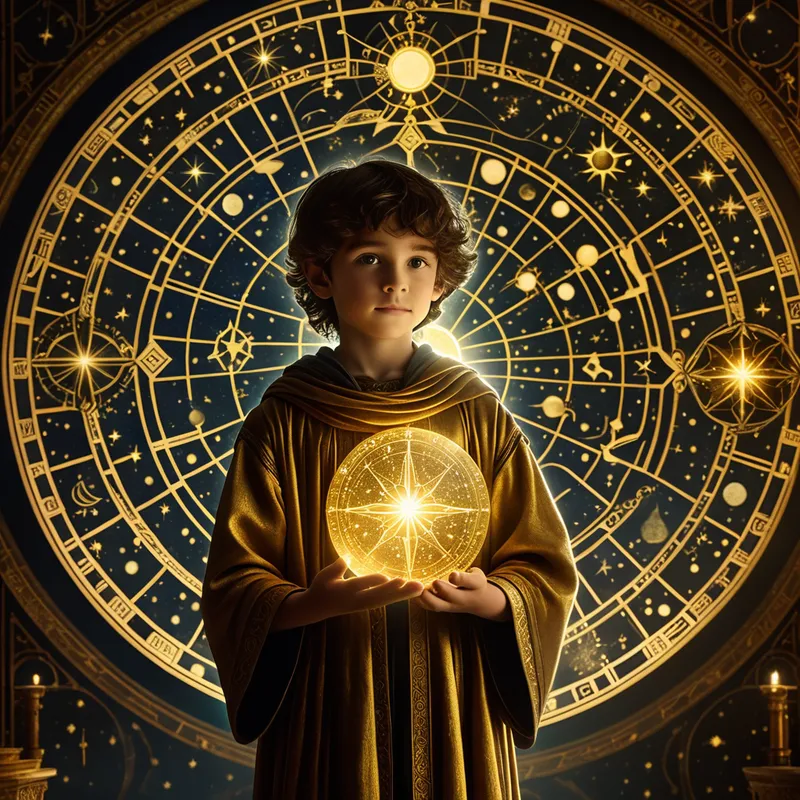
The Child Myth Meaning & Symbolism
A luminous being emerges from the crucible of chaos, embodying the perfected essence born from the union of opposites and the soul's ultimate goal.
The Tale of The Child
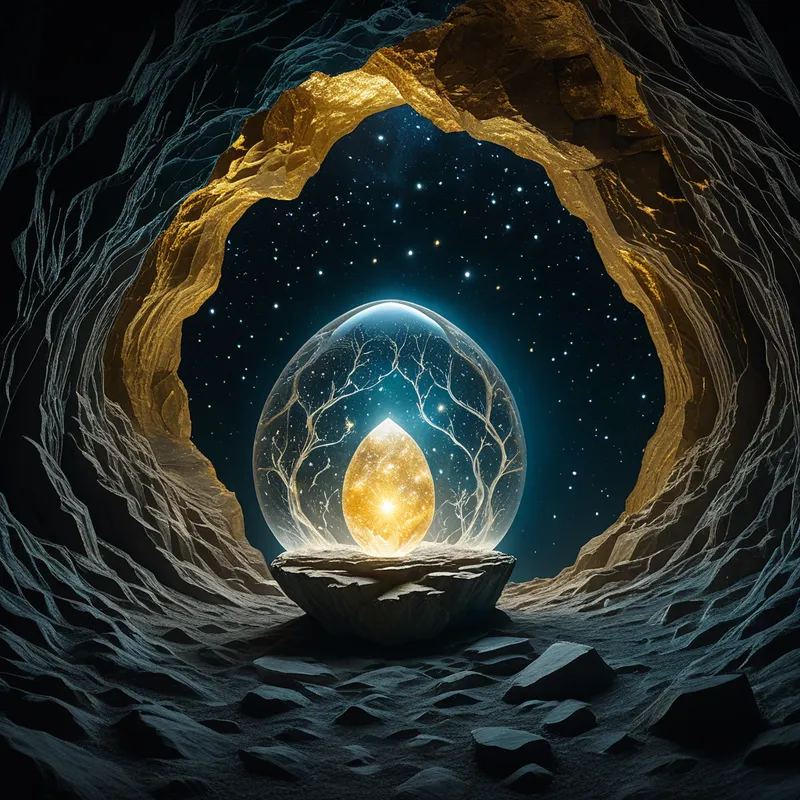
Listen, and hear the tale not of a birth, but of a becoming. In the beginning, there was only the Prima Materia—a formless, leaden darkness, a sea of potential groaning with unshaped dreams. From this abyss, the Alchemist, whose name is forgotten for it is every seeker, drew a portion. They placed it in the Vas Hermeticum, a vessel of egg-shaped glass, and sealed it with a sigh that held all their longing.
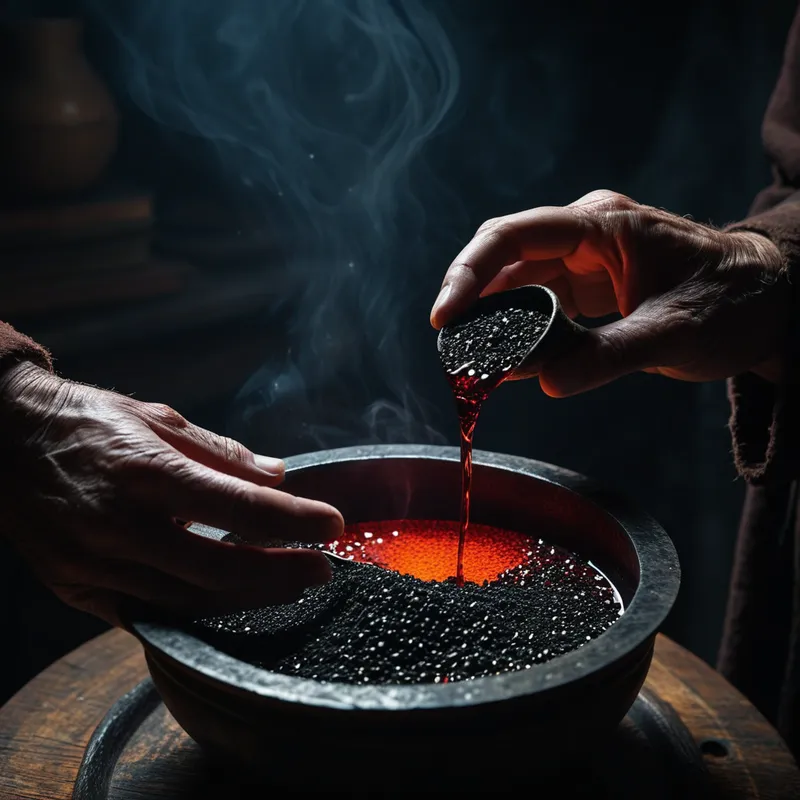
Then began the Great Work. First, the Nigredo. The Alchemist applied the heat of their focused will, and within the vessel, the matter writhed. It curdled, turned black as a starless midnight, and dissolved into a foul, chaotic soup. All order was lost; the Alchemist despaired, seeing only death where they hoped for life.
But the fire was not extinguished. From the blackness emerged the Albedo. A silvery light, faint as the first moonbeam on water, began to stir the murk. The matter clarified, rising like a luminous dawn, washing itself clean in its own tears. It was beautiful, but cold—a purified spirit, yet alone and incomplete.
The Alchemist, guided by an inner star, knew the work was only half-done. They introduced the principle of the Rubedo—the fiery, passionate, red king. This king descended into the silvery pool of the white queen. A great conflict erupted! Fire and water, spirit and soul, masculine and feminine clashed in a dazzling, terrifying dance within the glass womb. The vessel shook, glowing with inner lightning. For a long age, it seemed the two would destroy each other, reducing all back to dust.
Then, a stillness. A profound, listening silence. The opposing forces, exhausted by their struggle, began not to conquer, but to converse. They intertwined, their essences merging in a slow, cosmic spiral. The silver light warmed to rose, then to a deep, pulsing crimson. The vessel glowed like a captured sunset.
And in that moment of perfect, silent union, the impossible occurred. The crimson light coalesced, condensed, and took form. From the very center of the reconciled opposites, a figure emerged. It was The Child. Not an infant of flesh, but a being of solidified light and living gold, with eyes that held the calm of the moon and the fire of the sun. It held in its small hand a stone that was not a stone—the Lapis Philosophorum, radiating a soft, eternal warmth. The Child looked upon the weeping Alchemist, not with the gaze of a newborn, but with the ancient, knowing smile of a completed cycle. The work was done.
Cultural Origins & Context
The myth of The Child, or Filius Philosophorum, is the crowning narrative of the Western alchemical tradition, spanning from Hellenistic Egypt through the Islamic Golden Age to the Renaissance laboratories of Europe. It was never a single, standardized story but a core, recurring motif encrypted within dense symbolic texts like the Rosarium Philosophorum and the visions of figures such as Hermes Trismegistus. It was passed down not in public squares but in secret manuscripts, illustrated with enigmatic woodcuts, and discussed in hushed tones among initiates. Its societal function was dual: exoterically, it described a literal chemical process to create gold and an elixir of life; esoterically, and more importantly, it provided a coded map for the spiritual transformation of the practitioner. The myth served as a guiding star for the individual soul's journey toward divine knowledge, offering hope that from the base material of human suffering and contradiction, a state of grace and wholeness could be born.
Symbolic Architecture
The Child is not a literal offspring but the symbolic embodiment of the result of the alchemical process. It represents the emergent property of a system that has successfully integrated its own opposites.
The Child is the soul's surprise gift to itself, born from the marriage of all it thought was irreconcilable.
Psychologically, it is the Self, as defined by Carl Jung, manifesting after the arduous process of individuation. The black Nigredo is the confrontation with the shadow—the depression, confusion, and ego-death necessary for growth. The white Albedo is the purification, the emergence of consciousness and spiritual insight. The red Rubedo is the passionate engagement with life, the embodiment of spirit into the world. The Child is the culmination: a new, stable center of personality that is both transcendent (golden, divine) and immanent (born from the muck of human experience). It is the healed psyche, no longer at war with itself.
The Dreamer's Resonance
When this myth stirs in the modern unconscious, it often announces itself in dreams of profound transformation. One might dream of finding a mysterious, glowing child in a basement or attic (the hidden parts of the psyche), of giving birth to a child made of light or crystal, or of discovering a small, potent object—a gem, a seed, a key—that radiates immense significance. Somatic sensations often accompany these dreams: a feeling of warmth in the solar plexus, a sense of deep, cellular calm, or the release of a long-held tension.
These dreams signal that the dreamer is in the final stages of a major psychological integration. The labor of confronting contradictions (career vs. passion, logic vs. intuition, independence vs. connection) is nearing its end. The Child's appearance is the psyche's way of saying, "The synthesis is at hand. A new, more authentic way of being is being born from this struggle." It is an image of resolution, promising that the current state of tension is not meaningless suffering, but the necessary gestation for something entirely new.
Alchemical Translation
For the modern individual, the myth models the complete arc of psychic transmutation. We all begin with our Prima Materia: the raw, often painful material of our lives—our traumas, our conflicts, our unmet potentials. The Nigredo is the inevitable descent, the dark night of the soul where old identities and coping mechanisms break down. This is not failure, but the first, crucial dissolution.
The Albedo follows as we begin to sort through the pieces, gaining clarity, engaging in self-reflection and "washing" ourselves of old projections. We find our core values. Then comes the crucial Rubedo: we must take that purified understanding and live it passionately in the red-blooded world of relationships, work, and creation. We must let our spirit incarnate. This stage is often marked by conflict, as our new insights clash with old patterns and external expectations.
The crucible of the soul is sealed not to destroy its contents, but to protect the fragile miracle of recombination from premature exposure.
The birth of The Child is the moment this lived synthesis becomes a permanent, operational part of the personality. It is not the end of growth, but the establishment of a new, resilient center from which to live. You are no longer solely the conflicted seeker (the Alchemist); you have also become the embodied result (The Child). You hold your own Lapis Philosophorum—not a magic stone, but the hard-won, inner authority to transform your own leaden moments into golden wisdom, and to recognize that the goal of the journey was always the wholeness born from embracing the entirety of the self.
Associated Symbols
Explore related symbols from the CaleaDream lexicon: