The Cave of Hira Myth Meaning & Symbolism
A man retreats into a mountain cave seeking truth and is met with a terrifying, luminous command that shatters his world and births a new one.
The Tale of The Cave of Hira
Hear now a tale not of kings and conquests, but of a man and a mountain, of silence and a shattering word. In the land of the Jahiliyyah, where the desert sands whispered of forgotten gods and tribal pride was the highest law, there lived a man whose soul was a stranger to his world. His name was Muhammad, of the tribe of Quraysh, but in the bustling valley of Mecca, amidst the commerce and the clamor around the ancient Kaaba, he carried a quiet desolation.
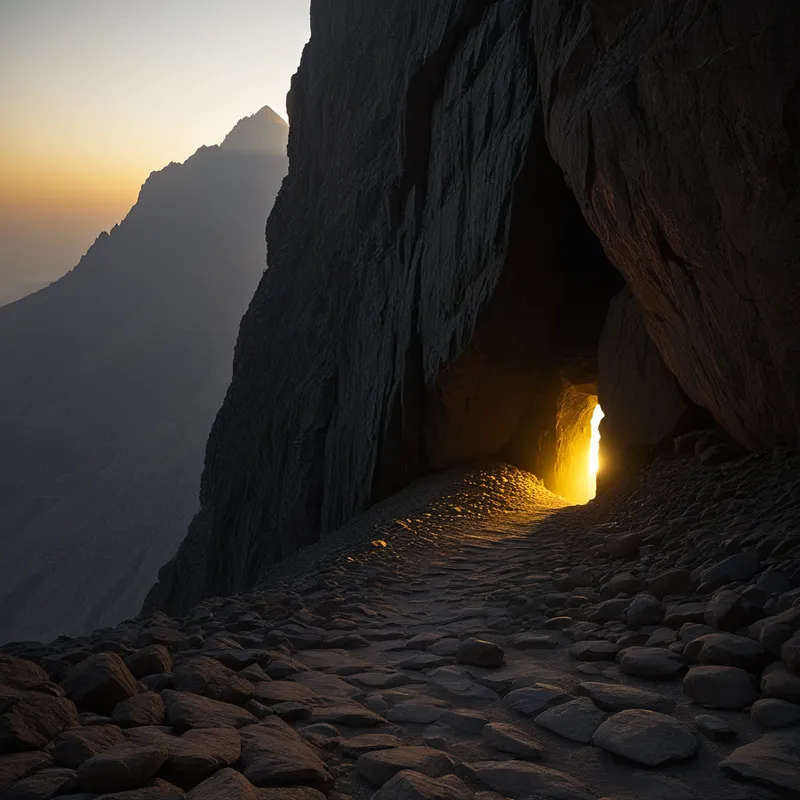
Driven by a hunger no feast could satisfy, by questions that echoed in the hollow places of ritual and tradition, he turned his back on the city. His feet found the path to Jabal al-Nour, the Mountain of Light. He climbed, not to conquer its peak, but to seek its secret heart: a small, rugged cave known as Hira. It was not a palace, but a womb of stone—cramped, dark, and utterly silent save for the sigh of the wind at its mouth.
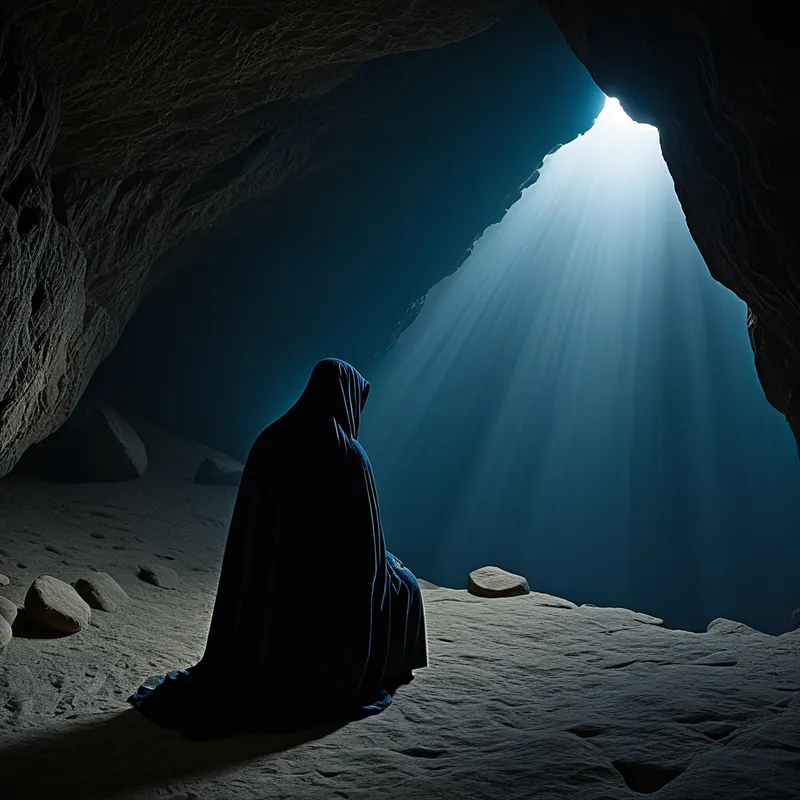
Here, in this mineral solitude, the man would retreat for days and nights. He took meager provisions: dates, a skin of water. He wrapped himself in a cloak, not against the chill of the cave, but against the chill of a world devoid of meaning. He engaged in Tahannuth, a deep, yearning meditation. He sought not visions, but truth. He listened to the silence until it became a roar in his ears, until his own identity began to dissolve into the pressing dark.
Then, in the deepest watch of the night, in the month of Ramadan, the solitude broke. It was not broken by a sound, but by a Presence that filled the cave like a crushing weight. A figure manifested, immense and awe-inspiring, blocking the very horizon of his perception. It was Jibril. The angel held forth a swath of silk, inscribed with glowing script. The command that echoed through the cave, through the mountain, and through the very bones of the man was not a whisper, but a seismic event: “Iqra!” — “Recite!”
Terror, pure and primal, seized him. “I am not a reciter!” he gasped, for he was an unlettered man. The command came again, a pressure upon his soul. Again, he refused, consumed by fear. The third time, the angel’s embrace became inescapable, and the words were pressed into his being, not heard with the ear but imprinted upon the heart: “Recite in the name of your Lord who created—Created man from a clinging clot. Recite, and your Lord is the most Generous—Who taught by the pen—Taught man that which he knew not.”
The words erupted within him, a volcano of meaning. The cave, once a refuge of quiet seeking, was now the epicenter of a cosmic quake. He fled, his soul trembling, the divine words burning in his breast, descending the mountain back to a world that could never again be the same.
Cultural Origins & Context
This account is the foundational narrative of Islam, drawn directly from the Qur’an (specifically Surah al-`Alaq) and the authenticated prophetic traditions (Hadith). It is not a myth in the sense of a fictional allegory, but in the deeper sense of a sacred, culture-forming story that carries ultimate meaning. For over 1,400 years, it has been transmitted with meticulous care by scholars and recited by billions, serving as the absolute pivot point of history: the moment the divine speech entered the human realm anew.
Its societal function is multifaceted. It establishes the prophethood of Muhammad, validating his mission as a direct, transcendent communication, not a product of his own mind. It sanctifies the act of seeking knowledge (“Read!”) as the first command of God. It also models a profound spiritual methodology: the necessity of withdrawal (khalwa) from worldly distraction to achieve clarity and receptivity. The Cave is the primordial classroom, and solitude is the first teacher.
Symbolic Architecture
The Cave of Hira is not merely a geographical location; it is the archetypal vessel for the meeting of the human and the infinite.
The cave is the crucible of the self, where the noise of the world is stripped away, and one is left alone with the echo of one’s own being, awaiting the voice that speaks from beyond it.
The Cave represents the unconscious itself—the dark, containing space of potential where the unformed self resides. The Mountain is the arduous ascent toward consciousness, the difficult path one must climb to reach the threshold of transformation. Jibril is not a mere messenger but the personification of the revelatory function of the psyche, the terrifying and majestic agent that delivers the contents of the collective unconscious (the divine command) to the individual ego.
The command “Iqra!” (Recite/Read) is the imperative of consciousness. It is the demand to give form to the formless, to articulate the inarticulate truth pressing from within. Muhammad’s protest, “I am not a reciter,” is the ego’s resistance to its own expansion, the terror of the humble human vessel asked to carry a cosmic burden. The final, irresistible transmission symbolizes the irrevocable moment of individuation—when the call of the Self can no longer be denied, and one’s personal identity is forever re-contextualized by a greater reality.
The Dreamer’s Resonance
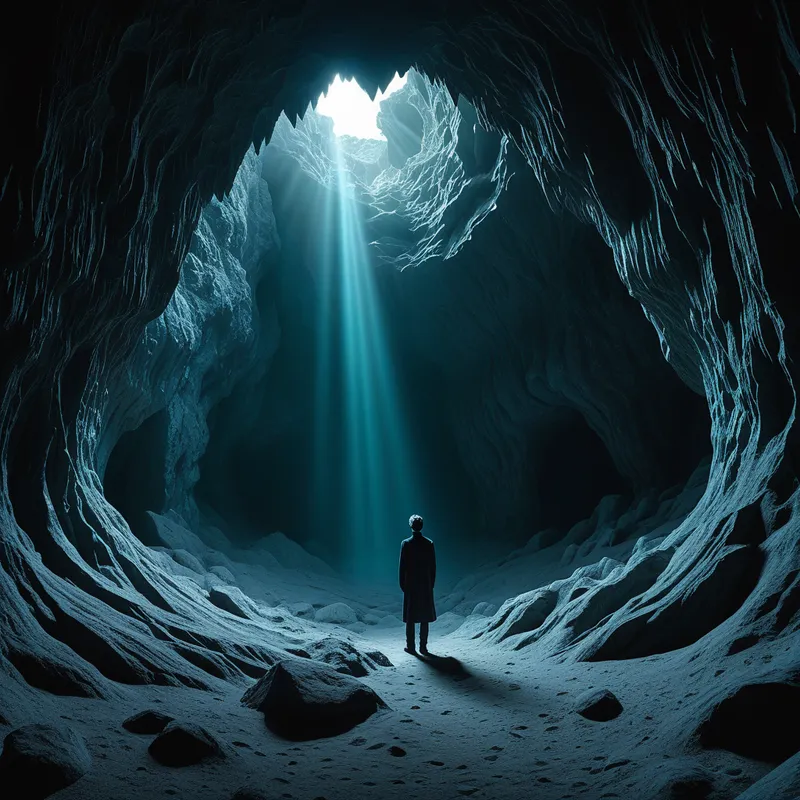
When this mythic pattern surfaces in modern dreams, it signals a profound psychic initiation. To dream of being in a tight, dark cave is to experience the somatic pressure of the unconscious gathering itself. It is a claustrophobic, yet strangely potent, solitude. The dreamer may feel both trapped and protected.
The appearance of an overwhelming, awe-inspiring figure (which may not be an angel, but a luminous being, a terrifying animal, or even a booming, disembodied voice) represents the eruption of a new complex or archetypal content into awareness. This is often preceded by a period of waking-life “Tahannuth”—a feeling of alienation from conventional values, a deep, restless questioning, or a voluntary withdrawal from social engagements to “figure things out.”
The psychological process is one of terrifying empowerment. The dream-ego, like Muhammad, is being asked to “recite”—to own and articulate a truth it feels utterly unprepared to handle. This could relate to a creative gift, a psychological insight, or a life direction that feels divinely mandated yet humanly frightening. The dream marks the crisis point where one’s old identity must break to accommodate a new, more authentic calling.
Alchemical Translation
The alchemy of Hira is the transmutation of isolated seeking into embodied revelation. It maps the individuation journey with stark clarity.
The Nigredo (Blackening): This is the voluntary retreat into the cave—the descent into the prima materia of the soul. It is the stage of Jahiliyyah, the inner “age of ignorance,” where one confronts the shadowy, confused, and fragmented parts of the self. It is a necessary dissolution.
The Albedo (Whitening) & Rubedo (Reddening): The appearance of Jibril with the command of light is the blinding albedo, the illuminating shock. The struggle and final acceptance are the rubedo—the passionate, often painful, integration. The divine word is the Philosopher’s Stone, the incorruptible, transformative truth that, once integrated, turns the base metal of a seeking life into the gold of a purposeful one.
The revelation in the cave does not remove the hero from the world; it throws him back into it with a fire in his heart that he must now learn to speak.
For the modern individual, this myth instructs that profound change is not born in committee or in comfort. It is forged in the chosen solitude where we dare to ask the deepest questions. The “cave” can be a period of meditation, therapy, artistic retreat, or any profound introversion. The terrifying “angel” is the inner voice of destiny, which initially feels alien and overwhelming. The alchemical work is to endure the embrace, to let the terrifying, luminous command shatter the old vessel of the personality, and to courageously “recite”—to live out—the unique text of one’s own discovered meaning in the marketplace of the world.
Associated Symbols
Explore related symbols from the CaleaDream lexicon:
- Cave — The primal womb of the unconscious and the sacred space of voluntary isolation where the ego dissolves to make room for a revelation from the deeper Self.
- Mountain — The arduous ascent toward consciousness and transcendence; the difficult, elevating journey one must undertake to reach the threshold of transformation.
- Light — The sudden, overwhelming illumination of divine knowledge or conscious awareness that pierces the darkness of ignorance and inner confusion.
- Journey — The essential movement from the familiar world into the wilderness of the self and back again, fundamentally changed and carrying a new truth.
- Fear — The primal, somatic terror of the ego confronted by the numinous power of the unconscious, a necessary crucible in the process of expansion.
- Dream — The internal, nightly cave where revelations often first appear in symbolic form, rehearsing the soul for a waking-life encounter with destiny.
- Echoing Cavern — The amplifying chamber of the soul where one’s deepest questions resonate until they attract an answer from a dimension beyond the personal.
- Underground Cave — The deeply buried chamber of the psyche where foundational, archaic truths and the seeds of new consciousness are stored.
- Islamic Crescent — A symbol of receptivity and reflection, echoing the cave’s mouth as a vessel waiting to be filled with the light of a revelatory dawn.
- Cave Wisdom — The profound, non-intellectual knowledge that arises only in the deep silence of solitude, born from direct encounter rather than learned doctrine.
- Door — The narrow entrance to the cave, representing the critical threshold between the profane world and the sacred space of transformation, which one must choose to pass through.
- Vision — The transformative content delivered in the cave, which reorganizes perception and provides a new map of reality for the one who receives it.