The Cauldron of Dagda Myth Meaning & Symbolism
The myth of the Dagda's magical cauldron, which never empties, offering a feast of wisdom and life from the depths of the Otherworld.
The Tale of The Cauldron of Dagda
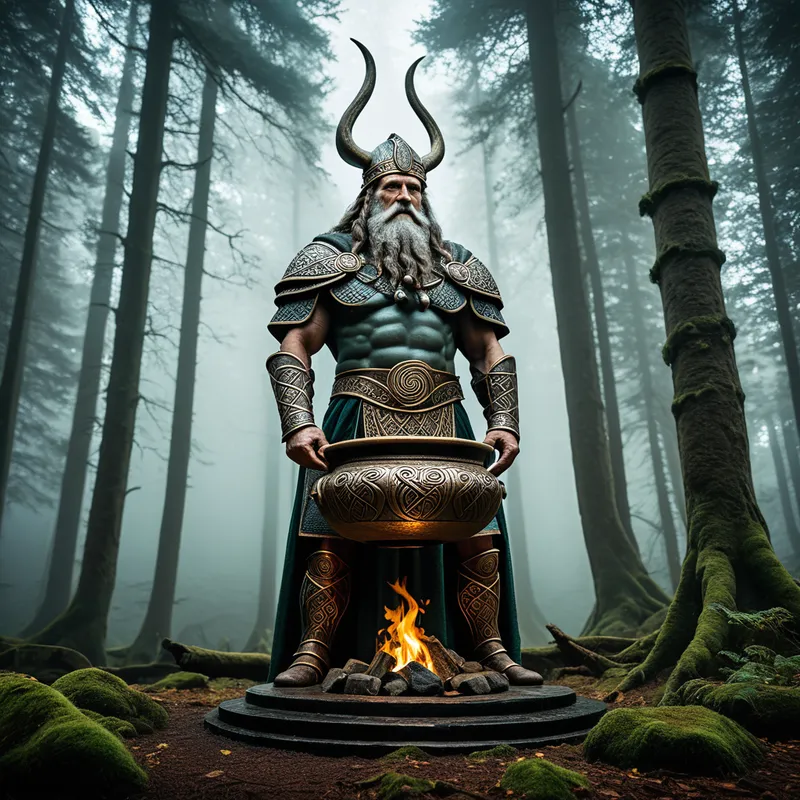
Listen, and let the firelight cast the shadows of the old world. In the time before memory solidified into history, when the land of Éire was a tapestry of magic and might, the people of the Tuatha Dé Danann walked among the misty hills. And among them, a giant of a being moved with the slow, sure rhythm of the turning earth. This was the Dagda. His cloak was the night sky, his club could slay nine men with one end and restore them to life with the other, and his heart was as vast as the plain.
But his greatest treasure was not a weapon. It was a vessel. The Cauldron of the Dagda.
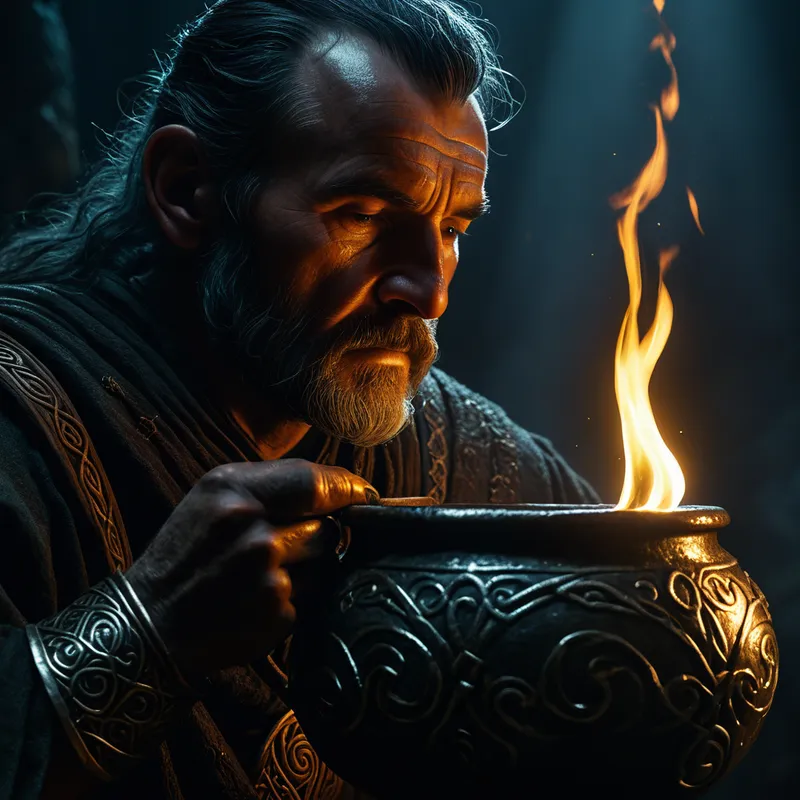
It was said this cauldron was born from the smith-fire of the Otherworld, its bronze sides etched with the spirals of destiny. It rested not in a fortress, but in the open, a humble, monumental promise. For its magic was not in defense, but in boundless giving. No company, however vast—be it a host of heroes or a tribe in flight—could ever empty it. It provided a feast that satisfied not just the belly, but the spirit. From its depths came a stew of such richness that it conferred wisdom and poetic inspiration upon those who partook. It was the hearth of the world made divine.
When the great battle against the Fomorians loomed, a shadow over the land, it was to this cauldron the Tuatha Dé Danann came. Not for strategy or weapons, but for sustenance. The Dagda, in his role as father and provider, presided. One by one, the warriors, the poets, the wounded, and the fearful approached. They dipped their bowls into the seemingly modest pot. And each found their portion—a portion that tasted of home, of courage, of forgotten strength. The cauldron did not discriminate; the coward and the champion received the same measure of its deep, dark bounty. It filled them, body and soul, for the trials to come.
And when the battle was done, and the land was won, the cauldron remained. It was a silent witness to peace, a testament that true power lies not in taking, but in an endless capacity to restore. It promised that from the deep, dark well of the world, there is always enough.
Cultural Origins & Context
This myth survives in the medieval Irish textual tradition, primarily within the Lebor Gabála Érenn and associated tales. It is crucial to remember that these were written down by Christian monks centuries after the oral traditions flourished, meaning the myths are preserved through a particular lens. The Cauldron of the Dagda is classified as one of the Four Treasures of the Tuatha Dé Danann, each from a legendary city of learning.
The societal function of this myth was multifaceted. In a culture where hospitality (félm), generosity, and the feast were paramount social and sacred duties, the cauldron embodied the ideal of the perfect host and the prosperous king. The Dagda, often portrayed as a somewhat rustic, potent figure of immense appetite and virility, represents the archetypal tribal father-chieftain whose primary responsibility is the physical and spiritual nourishment of his people. The myth reinforced the value of communal welfare over individual hoarding and presented abundance as a divine, renewable resource, deeply connected to the sovereignty of the land itself.
Symbolic Architecture
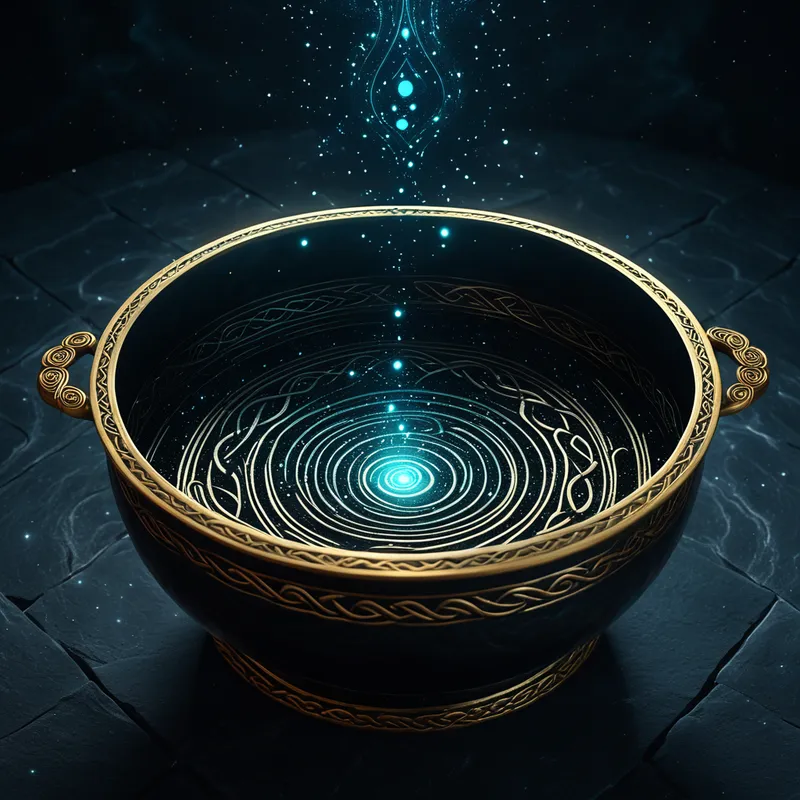
The cauldron is one of humanity’s most primal and potent symbols. It is the womb, the container, the crucible of transformation. The Cauldron of the Dagda specifically symbolizes the inexhaustible source.
It is the deep, unconscious psyche itself—a wellspring of latent life, wisdom, and creative potential that can never be depleted, only approached.
Its magic operates outside the economy of scarcity. It does not create gold or weapons; it creates sustenance and inspiration. This positions true abundance as a quality of essence, not of possession. The cauldron’s location—often described as being in the open—suggests this source is not hidden in a vault but is available to the community, to those who approach with need. The Dagda as its guardian represents the mediating ego, or the conscious aspect of the Self, that tends to this deep source and facilitates its distribution. He is the “caretaker of the depths,” the one who knows how to draw from the well without poisoning it.
The Dreamer’s Resonance
When this myth stirs in the modern psyche, it often manifests in dreams of profound nourishment or its agonizing lack. To dream of an endless pot of food, a bottomless cup, or a kitchen that magically replenishes itself is to touch the Cauldron of the Dagda. Conversely, dreams of starving at a full table, or of a feast that turns to ash in the mouth, signal a disconnect from this inner source.
The somatic process here is one of receiving. The dream-ego is being invited, or forced, to confront its capacity to be filled. This can be deeply uncomfortable for a psyche conditioned by striving and scarcity. The psychological process is the integration of the anima (in men) or the recognition of the Self (in all individuals) as a nourishing, rather than a demanding, force. The dream asks: Can you stop, dip your bowl, and trust that what you need will be there? The exhaustion that often accompanies these dreams is the ego’s fatigue from trying to manufacture its own sustenance, unaware of the cauldron waiting in the clearing of the unconscious.

Alchemical Translation
The individuation process modeled by this myth is not one of heroic conquest, but of humble return and receptivity. The alchemical vas or vessel is paramount; the work happens within the container of the Self. The modern individual’s “Fomorian battle” is often the internal war of burnout, depletion, and meaninglessness—the feeling of an empty larder in the soul.
The alchemical instruction is to identify and tend to your personal cauldron. What in your life is the inexhaustible source? What practice, relationship, or inner space, when approached, consistently yields a sense of being refueled and inspired?
The “transmutation” is the shift from a psychology of scarcity to one of sourced abundance. It requires the ego to take on the role of the Dagda: to become the good steward, not the frantic producer. This means creating rituals of receptivity—moments of silence, engagement with art or nature, authentic community—where one can “dip the bowl” into the unconscious. The wisdom and sustenance received are not always sweet; the cauldron’s brew is dark and deep, containing shadow material as well as light. But it is always enough. To integrate this myth is to realize that your fundamental task is not to seize the treasure, but to learn the posture of receiving from the treasure that is already, and always, yours.
Associated Symbols
Explore related symbols from the CaleaDream lexicon: