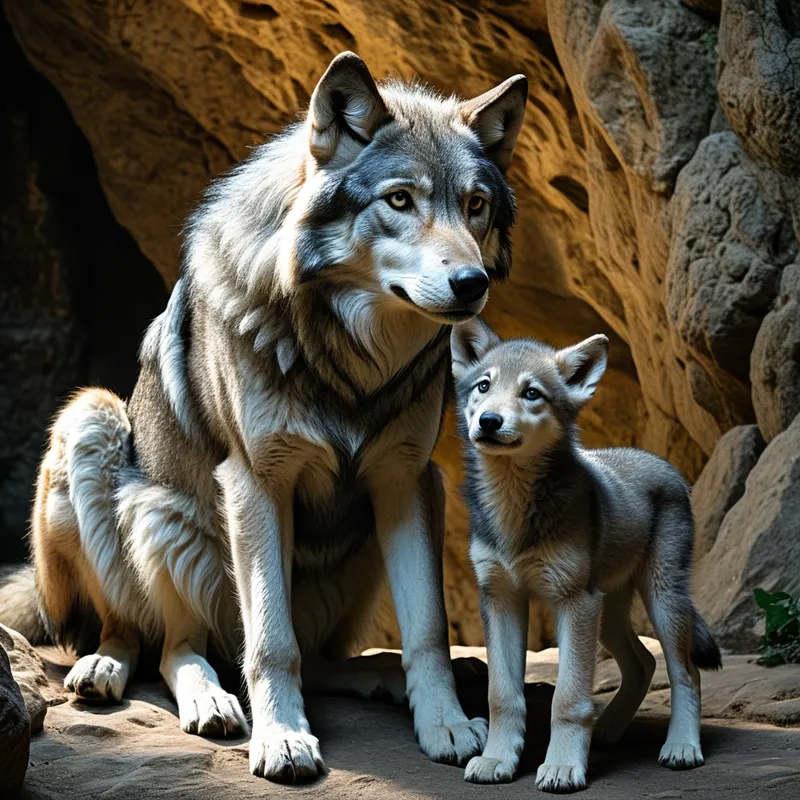
The Capitoline Wolf Myth Meaning & Symbolism
A sacred she-wolf saves the abandoned twins Romulus and Remus, an act of feral grace that leads to the violent founding of Rome.
The Tale of The Capitoline Wolf
Hear now a tale not of polished marble first, but of mud, blood, and a mother’s fierce milk. It begins in the shadow of a throne stolen by fear. In the city of Alba Longa, King Amulius, his heart a clenched fist of paranoia, feared the prophecy that his brother’s line would birth his downfall. So, he cast the rightful king, Numitor, into darkness and made his daughter, Rhea Silvia, a priestess of Vesta, bound to eternal chastity.
But the gods weave fate with threads mortals cannot see. The war god Mars himself came to the sacred grove. From that divine violation, twin boys were born: Romulus and Remus. Enraged, Amulius ordered the infants drowned in the great, muddy Tiber. The servant tasked with the deed could not bear it; he placed the squalling babes in a basket and set them upon the swollen currents, a fragile ark entrusted to the river’s mercy.
The river, however, was in a gentle mood. As the waters receded, the basket came to rest in the soft muck of the Palatine shore, caught by the roots of a wild fig tree, the Ficus Ruminalis. Their cries pierced the twilight—thin, human wails in a world of beast-sounds. And then, she came.
Not with a hunter’s stealth, but with a curious, padding grace. A she-wolf, Lupa, her coat the color of winter ash, her flanks lean from the hunt. She lowered her great head, sniffed the strange, hairless creatures, and was moved not by hunger, but by a deeper, divine instinct. She nudged them gently, then lay down, offering her teats. The twins, driven by primordial need, latched on. She warmed them with her body, licked them clean with her rough tongue, and guarded them as her own. A woodpecker, sacred to Mars, brought them scraps of food. In this wild crèche, under the protection of beast and bird, the founders of an empire were nourished.
They were found by Faustulus, a shepherd of the king, who saw the divine miracle and, with his wife Acca Larentia, raised the boys as his own. They grew strong, leaders among the rough herdsmen, unaware of the royal blood and divine wrath that coursed in their veins—until the day their destiny called them back to Alba Longa, to overthrow the usurper and restore their grandfather. But a city founded on such a wild, miraculous birth could not be shared. The twins quarreled over where to build, over signs from the gods. In the end, Romulus slew Remus, and on the Palatine Hill, where the wolf’s milk had sustained him, he plowed a sacred boundary and Rome was born. The first act of the city was fratricide; its first mother was a wolf.

Cultural Origins & Context
This is Rome’s foundational myth, its sacred pre-history. It is not a single, canonical text but a story woven from many threads: the histories of Livy, the poetry of Ovid, and older, local Italic folklore. The Romans themselves were keenly aware of the myth’s paradoxes. Here was a people who saw themselves as the pinnacle of law, order, and civilization (humanitas), yet proudly claimed descent from an act of feral, divine-bestowed survival and a foundational murder.
The myth functioned as a powerful piece of national identity. It explained the Romans’ perceived martial prowess (sons of Mars), their connection to the land (nursed by its wild spirit), and their often-ruthless pragmatism (the Remus story). The bronze statue of the Lupa Capitolina became a potent symbol of the state, displayed in the heart of the city. The story was told not just as history, but as a sacred charter, justifying Rome’s unique destiny and its sometimes brutal methods. It answered a profound psychological need: to reconcile the civilized self with the wild, instinctual forces that underpin all creation and survival.
Symbolic Architecture
The myth is a dense tapestry of opposing forces held in a tense, creative unity. The Lupa is the central, transformative symbol. She is not merely an animal but a liminal being, a bridge between worlds.
The wolf is the wildness that nourishes civilization, the instinct that precedes law, the untamed feminine that births the structured masculine world.
She represents the anima mundi—the world soul—in its raw, nurturing, and fiercely protective aspect. Her milk is pneuma, the spirit-substance that transmits not just life, but divine favor and wild strength.
The twins embody the archetype of duality: Romulus and Remus, city and wilderness, order and chaos, the survivor and the sacrificed. Their conflict is the inevitable splitting of a unified origin into competing possibilities. The fratricide is the tragic cost of choosing one path, one identity, over another. It signifies that the foundation of any conscious structure (a self, a city, a belief) requires the “killing off” of its shadow twin, its alternative possibility.
The river and the fig tree are symbols of fate and sustenance. The river carries them to their destiny; the fig tree, a symbol of fertility and shelter, holds them fast. Together with the wolf and woodpecker, they create a sacred ecosystem where the human is entirely dependent on the non-human, a reminder of our fundamental embeddedness in nature.
The Dreamer’s Resonance
To dream of the Capitoline Wolf is to dream of a foundational moment in one’s own psyche. It often appears during life transitions that feel like a return to a primal state: after a great loss, at the start of a daunting new venture, or when feeling abandoned by familiar structures.
The somatic sensation is often one of being exposed yet strangely held—the cold of abandonment coupled with the visceral, warming comfort of being fed by an unexpected source. The wolf in the dream may not be literal; it could be a fierce mentor, an unexpected opportunity, or a surge of instinctual energy that feels both alien and deeply familiar. This is the psyche’s own Lupa, the instinctual Self rising to nourish the nascent, vulnerable aspects of the personality that have been cast out by the “king” (the ruling conscious attitude).
Dreaming of the twins often highlights an internal conflict between two nascent identities or life paths. The dream may be urging a reconciliation, or it may be presenting the painful necessity of choosing one, with full awareness of the loss (the “Remus”) that must be integrated.
Alchemical Translation
The myth models the alchemical process of individuation—the forging of a coherent Self from the raw materials of the unconscious. The prima materia, the base substance, is the abandoned twins: our latent potential, our true nature, rejected by the conscious ego (King Amulius) which fears being overthrown.
The journey down the river is the necessary descent into the unconscious, the nigredo or dark night of the soul, where all conscious identity is dissolved.
The she-wolf represents the transformative function of the unconscious itself. In alchemical terms, she is the vas (the vessel) and the mercurial spirit—the agent that dissolves and nourishes simultaneously. Her milk is the aqua vitae, the divine water of life that sustains the psychic embryo through its darkest phase.
The raising by Faustulus and Acca Larentia symbolizes the integration of this wild, divinely-nourished potential into the human, social world—the albedo, or whitening. But the process is not complete. The final, crucial stage is the confrontation and integration of the shadow, represented by the fratricide.
Romulus does not simply forget Remus; he builds his city upon the memory of the slain brother. The integrated Self is not a perfect unity, but a conscious structure built with full acknowledgment of the cost of its own existence, the twin that was sacrificed at its foundation.
For the modern individual, the myth instructs: your strength, your foundational identity, is not born solely from conscious will or social training. It is first fed by a wild, instinctual, and often unexpected grace from the depths of your own being. To build your “city”—your conscious life—you must acknowledge this wild nurse, and you must make peace with the choices that required leaving other versions of yourself behind. The goal is not to become the wolf, nor to deny her, but to build with the strength her milk provided, forever honoring the wild source of your walls.
Associated Symbols
Explore related symbols from the CaleaDream lexicon: