The Call of the Untamed: Decoding Dreams of Wildness
The Somatic Echo
It begins not as a thought, but as a tremor in the soil of the self. A quickening in the blood that feels like a forgotten frequency being tuned. It is the prickle on the neck when you stand at the edge of a silent forest, the involuntary catch in your breath before a storm breaks. This is the somatic echo of Wildness—a deep, cellular memory of a state before the map was drawn, before the name was given. It is the body’s ancient knowledge of chaos as a creative force, a primordial soup from which all form is born and to which it may return. You feel it as a simultaneous pull and push: a magnetic draw toward the unbounded, paired with a visceral recoil from the dissolution of all you’ve built. Your heartbeat becomes a drum in a ritual you don’t remember starting.
The Dreamer's Log
The city grid is empty, a perfect geometric ghost. My phone is a frantic, pulsing heart in my hand, its screen a maze of notifications I cannot read. From the cracked pavement at my feet, thick, dark vines erupt, silent and swift. They do not crush the concrete; they absorb it, turning grey stone into deep, forest-green moss. The red dot on my map blinks once more, then dissolves into the spreading green.
Alchemical Interpretation: The system of external validation (the map) is being consumed and transmuted by the innate, organic intelligence of the soul (the vines), initiating a navigation by feeling rather than signal.

The False Lead
This is not a dream of mere rebellion or irresponsible abandon. To mistake Wildness for simple chaos is to confuse the earthquake with the tectonic shift. It is not the Shadow Jester’s cynical deconstruction for its own sake, nor the Shadow Rebel’s destructive rage against a cage it refuses to understand. The call of Wildness is not an invitation to burn your life down; it is a summons to stop building on borrowed, unstable ground. It is the psyche’s profound correction, not its petty sabotage. This theme speaks of a foundational restructuring, not a superficial riot.
Psychological Architecture
To engage with Wildness is to enter the chamber of Shadow Work where your most civilized agreements are renegotiated. You sit across from the internal parliament you’ve assembled—the Manager who keeps the schedule, the Diplomat who smooths every conflict, the Sentinel who guards the perimeter. Wildness does not dismiss them; it asks for their credentials. It asks: Who spoke for the river of instinct? Who voted for the star-navigator? Who gave the contract to the tamer of storms? This is the Individuation process in its raw, geological phase. The persona, that well-constructed city of the self, is not attacked but is discovered to be built upon a living, shifting biome. The work is to feel the roots move beneath the floorboards, to allow the wild substrate to inform the architecture above. It is the terrifying, liberating realization that your center is not a fixed point, but a dynamic equilibrium between form and flow.
Mythic Resonance
We see this eternal process in the story of Psyche and Eros. Psyche’s journey begins in a gilded, invisible cage—a palace of provided wonders where every need is met, but on the condition she never seeks the source, never beholds the wild truth of her lover’s face. Her act of disobedience, lighting the lamp to see Eros, is not a betrayal of love, but the necessary wild impulse that shatters the beautiful illusion. It catapults her into a harrowing, solo journey of impossible tasks, a descent into the raw, untamed realms of life, death, and the underworld. She does not return to the cage, but forges a self capable of standing, sovereign, beside the divine. The myth tells us: true union is only possible after one has faced the wildness within and without.
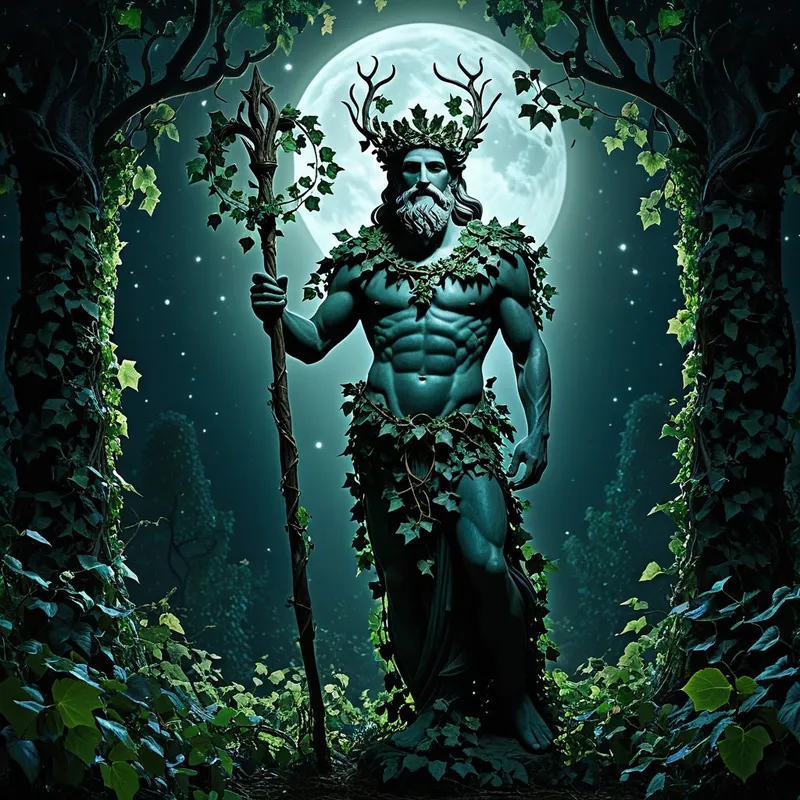
Another resonance is the Green Man, the ancient face woven from leaves, speaking through stone in cathedrals and forests. He is not the god of the cultivated field, but the spirit of the untamed edge, the fecund, consuming, ever-renewing life force that exists before and beyond the harvest. He represents the Wildness that patiently, inevitably, reclaims all cleared spaces, reminding us that our order is a temporary arrangement with a boundless, creative force.
Symbolic Nodes
- Untamed Animals (wolves, horses, bears, birds of prey) appearing as guides, threats, or untethered aspects of the self.
- Overgrown Ruins: Cities, houses, or familiar structures being reclaimed by nature.
- Unmappable Landscapes: Dense forests, trackless deserts, deep caves, or stormy seas.
- Loss of Technology/Communication: Failing devices, silent cities, lost maps, languages dissolving.
- Elemental Surges: Uncontrolled fire, flooding waters, cracking earth, howling wind within domestic spaces.
- Body Transformations: Hair growing wild, feet becoming roots or paws, voice turning to a roar or song.
Archetypal Resonance
The Explorer Archetype is the primary vessel for this theme. Not its shadow, aimless version, but the core, essential Seeker. The Wildness dream is the Explorer’s deepest call—the map has ended, and the true territory begins. This archetype resonates perfectly with the somatic echo of magnetic pull and the quickening pulse, for the Explorer’s fuel is curiosity, not comfort. Its alchemical potential lies in its willingness to trade the known world for an authentic one. The Wildness theme activates the Explorer’s fundamental task: to leave the collective “village” of prescribed identity and venture into the psychic frontier, not to conquer it, but to be reshaped by it, and to return with the news of what is truly real.
The Alchemical Process
The transmutation of Wildness is the Nigredo of the soul—the blackening, the dissolution into prima materia. The intense heat and pressure required is the conscious surrender of interpretive control. It is the agony of letting the dream-images be utterly strange, of allowing the vine to consume the phone without rushing to name the vine “freedom” and the phone “oppression.” The grief is for the loss of the known self, the tidy story. The terror is the free-fall into the unscripted. The alchemical fire is sustained attention to this chaos without fleeing into analysis. You must let the wild animals roam the rooms of your inner world without immediately trying to cage or befriend them. In this liminal, pressurized state, the raw, undifferentiated energy of Wildness begins to differentiate. Chaos reveals its patterns; the roar resolves into a language. The sovereign Self is not the one who tames the wild, but the one who emerges from it, forged in its fires, speaking its truths with a human tongue.
The Integration Protocol
Question 1: Where in my waking life do I feel the most rigid, polished, or “in control”? If that structure were gently dissolved by an organic, silent force, what raw sensation or impulse might first emerge from beneath it?
Question 2: What “wild” animal, element, or landscape in my dream felt most terrifying or alluring? If I were to speak from its perspective for one minute, what would it say about the confines of my current life?
Question 3: What is one small, “uncivilized” agreement I have with myself (e.g., “I must always be productive,” “I cannot show anger”) that my dream’s wildness might be inviting me to tear up?
Action 1 (Somatic Grounding): For five minutes at day’s end, sit in silence and track the “weather” inside your body—not emotions, but raw sensations: pressures, temperatures, densities, flows. Imagine these sensations as landscapes. Do not change them; be the wilderness guide who simply notes, “There is a tight ridge here,” “A slow river runs here.”
Action 2 (Creative Expression): Using any medium (charcoal, mud, digital scribbles), create an image of a “tamed” object from your life being gently reclaimed or transformed by a wild element. Do not aim for beauty or meaning. Focus solely on the process of the wild thing’s action—the wrapping, the growing, the cracking, the merging.
Action 3 (Outward Ritual): Go to a natural edge—a park, a shoreline, a field. Find one small, “wild” artifact (a stone, a leaf, a seed pod). Perform a simple, silent exchange: leave behind a small token that represents an over-civilized rule you carry (a business card, a to-do list scrap, a coin). Do not take the wild artifact home. Simply hold it, acknowledge its existence outside your systems, and place it back where you found it.
Final Validation
This is not easy work. To feel the foundations stir is profoundly disorienting; the ego’s first and rightful response is alarm. Honor that fear—it is the sign of something real happening, not something going wrong. The call to Wildness is not a punishment for a life well-built, but a testament to the life force that built it, now asking for a wider, truer expression. You are not being dismantled. You are being invited to exchange the architecture of containment for the discipline of the frontier, to become the sovereign who rules not by walling out the unknown, but by having the courage to make a home within it.