The Campfire Myth Meaning & Symbolism
A myth of a world plunged into cold silence, where humanity's first act of defiance—kindling a spark against the dark—forged the soul of community.
The Tale of The Campfire
In the time before memory, when the world was young and raw, there was no division between earth and sky, only a perpetual, damp twilight. The sun was a distant, cold coin, and the moon had not yet learned to reflect. In this gloaming lived the First People, not as we are now, but as creatures of shadow and chill. They did not speak, for sound had not been invented; they communicated through the shudder of cold and the slow blink of weary eyes. Their world was governed by The Great Silence, a presence that lived in the deep places and the long nights. It was not evil, but it was complete. It was the way of things.
The Great Silence cherished the cold. It breathed out the frost that settled on the stone, and it drew the warmth from any living thing that dared to generate it. For warmth was the one disturbance, the one note of discord in its perfect, frozen symphony. The First People huddled in shallow caves, their bodies leaching heat into the hungry dark. They watched the world die a little each day, feeling the life seep from their own bones into the grasping earth.
But in one of these huddles, there was a different kind of shudder. It was not from cold, but from a gathering tension. A being we might call The One Who Trembled felt not just the cold, but the injustice of it. This feeling was a new, terrible heat in its chest. One night, as The Great Silence pressed down like a weight of stone, The One Who Trembled did a forbidden thing. It scraped two pieces of flint together, not to shape a tool, but out of a pure, ragged frustration—a scream without sound.
A spark leapt forth.
It was a tiny, stuttering star, born for a heartbeat. It died on the damp ground, but its afterimage burned in the eyes of all who saw it. The Great Silence recoiled. For the first time, there was a crack in its dominion. The spark had made a sound: a sharp, bright crack that echoed in the new hollow of their awareness.
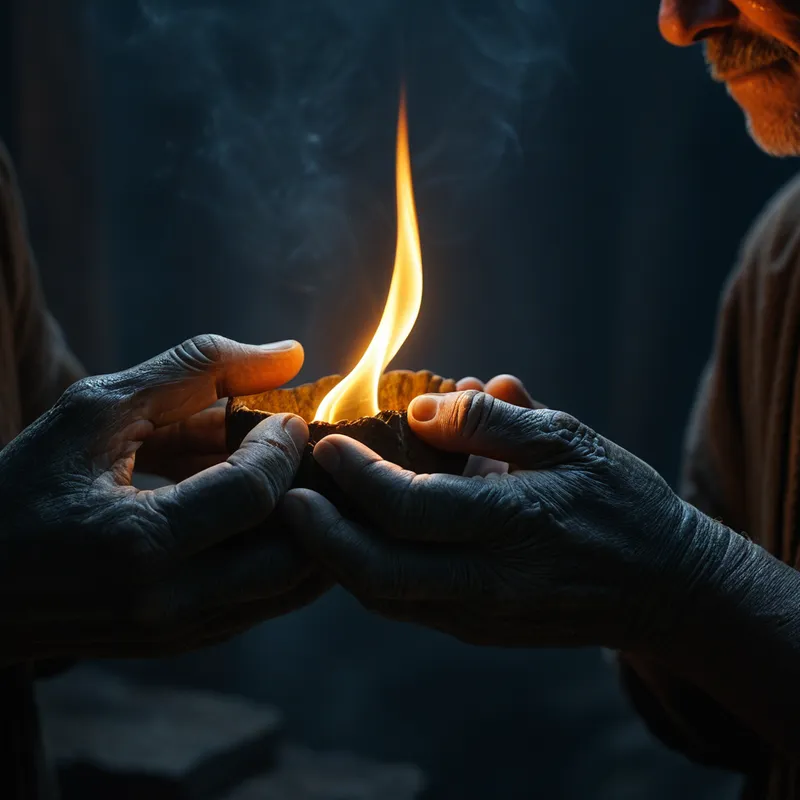
The One Who Trembled was seized not by fear, but by a furious need. It scraped again, and again, its hands raw. Sparks fell on dry moss stolen from a sun-bleached rock. One spark clung. A wisp of smoke, thin as a ghost, curled upward. Then, a glow. A feeble, red eye opening in the darkness. The others watched, not understanding, but feeling the strange new heat on their faces. The One Who Trembled bent low, its own breath—warm, living, defiant—nursed the glow. And then, it caught.
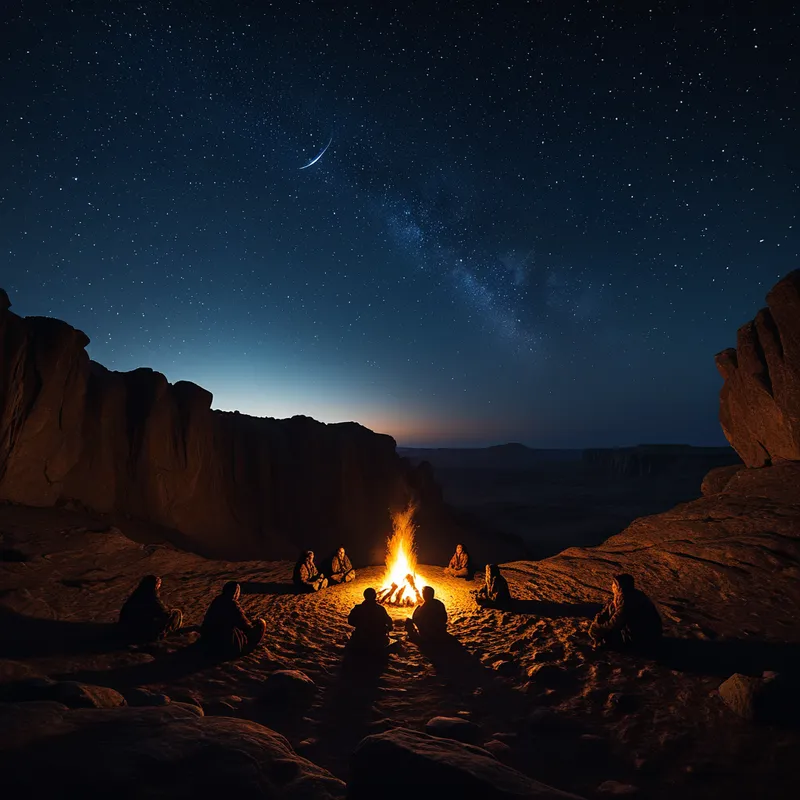
Flame. True, living flame. It was a beast of light and hunger. It consumed the moss, sought the twigs offered by trembling hands, and grew. It crackled, it popped, it sang a song of consumption and light. The Great Silence shrieked in a wind that tore at the cave mouth, trying to smother this blasphemy. The people formed a circle, their backs to the dark, their faces to the fire. They gave it fuel—their gathered wood, their attention, their fear. They sacrificed their comfort to its need, and in return, it gave them not just warmth, but a center. A reason to face outward, together.
The flame did not drive The Great Silence away forever. Nothing could. But it carved out a sphere of exception. Within the circle of its light, new things were born: the first story, told with hands casting shadows on the wall; the first song, a hum harmonizing with the fire's own voice; the first promise, sealed in a shared gaze across the flames. The One Who Trembled did not become a ruler, but a keeper. Its sacrifice was perpetual vigilance, the endless feeding of the spark it had stolen from the void. And so, the first campfire was lit, not as a tool, but as a pact—a declaration that where people gather and dare to feed a shared light, a world can be made.
Cultural Origins & Context
This is not a myth owned by any single tribe or recorded on any specific tablet. It is the ur-myth, the story that emerges independently in the ashes of a thousand first fires, from the steppes of Siberia to the plains of Africa to the islands of the Pacific. Anthropologists find its echoes in the foundational stories of fire-bringers—Prometheus, Maui, the Firebird—but the myth of The Campfire itself is more primal. It predates the hero. It is the story of the circle itself.
It was passed down not by professional bards, but by grandparents to grandchildren in the very act of tending the hearth. Its telling was the ritual. The lesson was in the gathering, the feeding of the flames, the sharing of food cooked in its embers. Its societal function was foundational: it was the original social contract. The fire demanded cooperation (gathering fuel), assigned roles (tending, guarding), and created the first sacred space (the circle of light and safety). It taught that warmth—physical, social, spiritual—is not a given, but a collective creation, born from friction and sustained by shared sacrifice.
Symbolic Architecture
The myth’s power lies in its stark, elemental symbolism. The Great Silence represents the unconscious in its cold, impersonal state—the inner void, depression, or the un-lived life where potential remains frozen. It is not malevolent, but indifferent, and its rule is the law of psychological dissipation.
The spark is not found, but forged in the friction between the soul and its circumstances.
The One Who Trembled symbolizes the nascent ego-consciousness. Its tremor is the first somatic recognition of a separate self, one that can feel opposition and generate a will. The flint and stone are the friction of conflict, trauma, or deep need—the necessary clash that produces the psychic spark.
The Campfire is the crowning symbol. It is not the spark, but what the spark becomes when tended. It represents the complex—the stable structure of consciousness, culture, the psyche itself. It is transformative (cooking raw into cooked), illuminating (making the unseen seen), and communal. It requires constant fuel—the sacrifice of unconsciousness (wood) to feed consciousness (flame). Its light creates a boundary: inside is the known, the shared, the human; outside is the unknown, the wild, the Other.

The Dreamer's Resonance
When this myth stirs in the modern dreamscape, it rarely appears as a literal campfire. It manifests as profound somatic and psychological processes. You may dream of desperately trying to light a match in a downpour, symbolizing a creative or emotional impulse struggling against inner dampness—depression or cynicism. Dreaming of a fire dying out while others sleep speaks to the burden of being the sole keeper of warmth in a relationship or family, facing burnout.
A dream of finding a single, warm ember in a vast, cold landscape signals the discovery of a core passion or truth amidst inner desolation. The act of cupping it, breathing life into it, is the dreamwork of nurturing a fragile new aspect of the self. Conversely, dreaming of a raging, uncontrolled wildfire reflects the spark of anger or desire, untended by consciousness, threatening to consume the very structures of one’s life. These dreams are the psyche’s way of asking: What is your fuel? Who is in your circle? Is your fire a beacon or a pyre?
Alchemical Translation
The alchemical journey mirrored in this myth is the opus contra naturam—the work against nature, or more precisely, against the prima materia of undifferentiated, cold existence. The initial state is the nigredo, the blackening: the rule of The Great Silence, the cold, leaden feeling of meaninglessness.
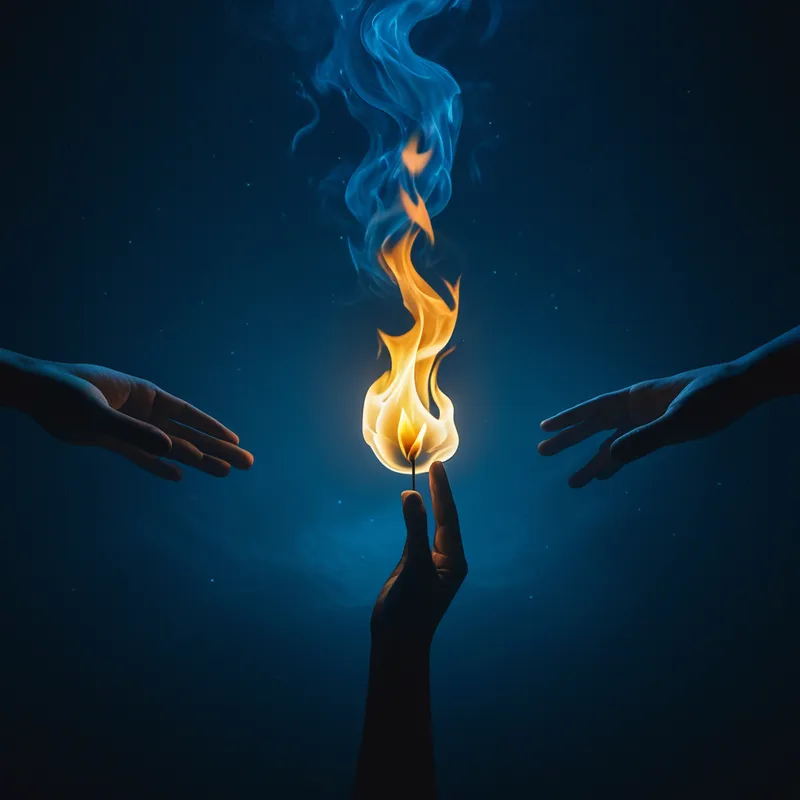
The striking of flint is the separatio, the crucial first differentiation where the conscious will (The One Who Trembled) distinguishes itself from the unconscious mass. The spark is the moment of illuminatio, a sudden, blinding insight or emotional truth that ignites the process.
Individuation is not the discovery of a pre-existing self, but the perpetual kindling of a self through the fuel of experience.
The sustained tending of the Campfire is the long labor of albedo and rubedo—the whitening and reddening. It is the daily, often tedious work of integration. Feeding the fire is the act of taking raw, unconscious content (memories, emotions, instincts) and sacrificing them to the flame of awareness, where they are cooked, transformed, and made digestible for the psyche. The circle of faces represents the internal community of archetypes—the inner child, the anima/animus, the sage—all gathered and given light by the central, ruling consciousness.
The ultimate goal is not to defeat The Great Silence, which is impossible, as the unconscious is eternal. It is to establish a stable, warm, and illuminated temenos—a sacred inner space—from which one can relate to the outer and inner darkness without being consumed by it. The perfected Campfire is the Lapis Philosophorum, the philosopher’s stone of the soul: a centered, creative, and resilient self, capable of generating its own light and warmth, and inviting others to share in its glow. We do not own the fire. We are its keepers, and in keeping it, we are forever remade.
Associated Symbols
Explore related symbols from the CaleaDream lexicon: