The Bridge of the Dead Siberian Myth Meaning & Symbolism
A soul's journey across a perilous bridge, judged by ancestral spirits, to reach the land of the dead—a myth of moral reckoning and transformation.
The Tale of The Bridge of the Dead Siberian
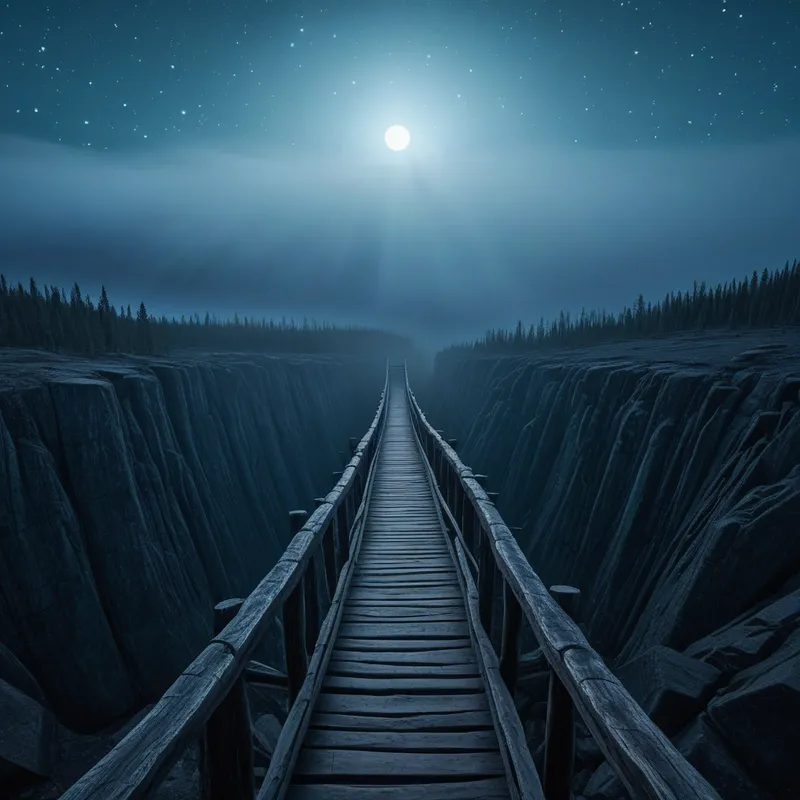
Listen. In the time when the world was younger and the cold breathed with the voice of a god, there was a place where the living could not walk. It was a place of whispers, of frozen sighs, where the great taiga gave way not to a river or a mountain, but to an absence—a yawning chasm where light fell and did not return. This was the edge of the world of breath and blood. And across this nothingness stretched a bridge.
It was not built by human hands. It was a bridge of a single, colossal larch, petrified by time and sorrow, its bark like iron, its surface worn smooth by countless silent footsteps. They called it Khotgoriin Guur. The air around it hung heavy, thick with the cold scent of pine and forgotten things.
When a person’s breath stilled and their fire went out, their sünesün would awaken, cold and confused, drawn to this place by a pull deeper than memory. The soul would find itself standing before the bridgehead, the vast gulf at its feet humming with a wind that carried voices. And the bridge was not empty.
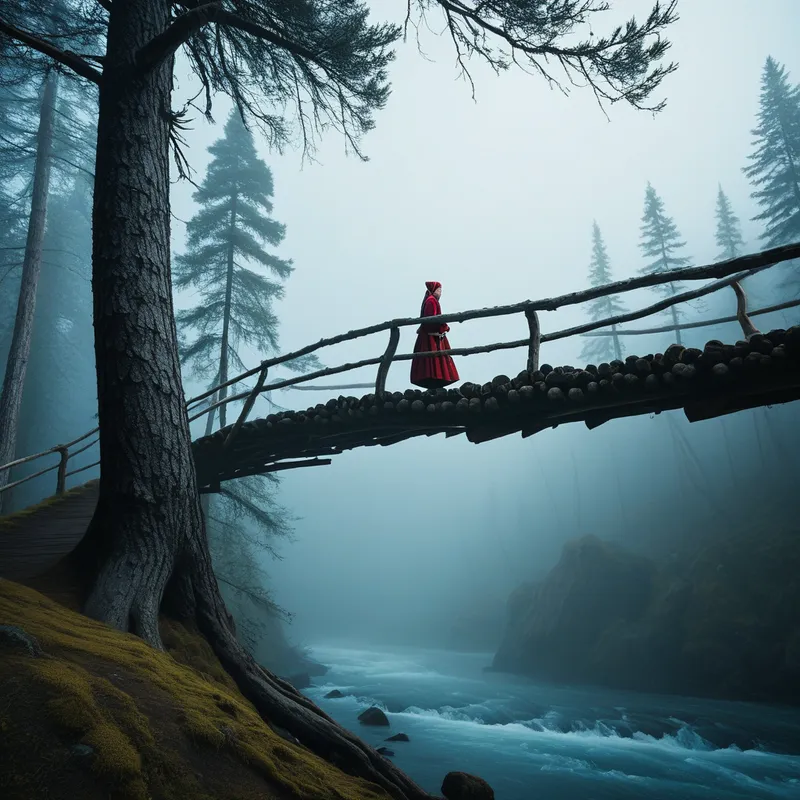
Upon its rails and along its impossible length stood the Ugtei Uhaan, the Ancestral Shades. They were not monsters, but watchers. Their forms were woven from mist and memory, their eyes like chips of glacial ice, holding the wisdom and the verdict of all who had come before. They were the living record of the clan.
The soul’s journey began with a step onto the wood. With each footfall, the bridge would speak. For a life lived with honor, in balance with the clan and the fierce spirits of the Bayan Ayalguu, the bridge remained firm, wide as a steppe path. The Ancestral Shades would bow their heads, a silent chorus of approval.
But for a soul heavy with falsehood, with cruelty left unatoned, or sacred bonds broken, the bridge would change. It would narrow, becoming a trembling thread. The smooth wood would sprout splinters like accusations. The wind from the chasm would rise into a shriek, and the Shades would lean close, their gaze a weight of frozen disappointment. The soul would see its deeds reflected in their eyes—not as stories, but as raw, felt consequences. The sting of a betrayal given, the ache of a kindness withheld, the cold void of a responsibility abandoned.
Here was the trial: no battle with beasts, but a confrontation with the truth of one’s own story. A soul that could not bear this gaze, that could not find the courage to walk its truth, would falter. The bridge would become like glass, and they would fall, not into fire, but into the whispering chasm—a place of becoming lost, of endless wandering, separated from the ancestors forever.
But the soul that walked, bearing the weight of its truth, however painful, would reach the far side. There, the mists would part, not onto a paradise of ease, but onto the Buga Uhaany Oroi, the Silent Hunting Grounds. The Ancestral Shades there would not smile, for their faces were beyond such things. But they would reach out, their touch like the first thaw of spring, and welcome the soul home. The journey was over. The story was complete.
Cultural Origins & Context
This myth finds its roots not in a single Siberian tribe, but resonates across the shamanic worldview of many Indigenous peoples of the region, including the Buryat, Yakut, and various Altai groups. It is a cornerstone of the animist and ancestral veneration practices that define these cultures. The story was not mere entertainment; it was a vital ontological map.
It was transmitted orally, most powerfully by the Böö, the shaman. During rituals of divination or soul-guiding, the shaman, in a state of ecstatic trance, would describe this very journey, serving as a psychopomp for the community’s understanding of death. The myth’s primary function was societal and psychological: it was the ultimate ethical framework. In cultures where survival depended on absolute cooperation, reciprocity, and respect for the delicate balance of nature, the idea of a post-mortem judgment based on one’s relational integrity was a powerful force for social cohesion. It taught that one’s actions were eternally recorded in the memory of the community, embodied by the ancestors. Your life was not your own; it was a thread in the clan’s enduring story, and you would answer for how you wove it.
Symbolic Architecture
The bridge is the ultimate [symbol](/symbols/symbol “Symbol: A symbol can represent an idea, concept, or belief, serving as a powerful tool for communication and understanding.”/) of the liminal threshold. It is not a place of residence, but of [passage](/symbols/passage “Symbol: A passage symbolizes transition, movement from one phase of life to another, or a journey towards personal growth.”/). Its [condition](/symbols/condition “Symbol: Condition reflects the state of being, often focusing on physical, emotional, or situational aspects of life.”/)—firm or treacherous—is not predetermined but responsive, a direct manifestation of the [soul](/symbols/soul “Symbol: The soul represents the essence of a person, encompassing their spirit, identity, and connection to the universe.”/)’s inner state. This reflects a profound psychological [truth](/symbols/truth “Symbol: Truth represents authenticity, honesty, and the quest for knowledge beyond mere appearances.”/): the obstacles we face in critical transitions are often shaped by the integrity (or lack thereof) of our past choices.
The bridge does not judge; it reveals. The soul walks upon the mirrored surface of its own life.
The Ugtei Uhaan represent the internalized Other—the collective conscience, the psychic [presence](/symbols/presence “Symbol: Presence in dreams often signifies awareness or acknowledgment of something significant in one’s life.”/) of all those impacted by our lives. They are the embodiment of what Jung termed the collective [consciousness](/symbols/consciousness “Symbol: Consciousness represents the state of awareness and perception, encompassing thoughts, feelings, and experiences.”/), now made manifest. Their judgment is the unavoidable [moment](/symbols/moment “Symbol: The symbol of a ‘moment’ embodies the significance of transient experiences that encapsulate emotional depth or pivotal transformations in life.”/) of self-[awareness](/symbols/awareness “Symbol: Conscious perception of self, surroundings, or internal states. Often signifies awakening, insight, or heightened sensitivity.”/), where we are seen not by our own narrative, but by the network of consequences we have created. The [chasm](/symbols/chasm “Symbol: A deep fissure in the earth representing a profound division, transition, or psychological gap between states of being.”/) below is not hell, but [dissolution](/symbols/dissolution “Symbol: The process of breaking down, dispersing, or losing form, often representing transformation, release, or the end of a state of being.”/)—the [terror](/symbols/terror “Symbol: An overwhelming, primal fear that paralyzes and signals extreme threat, often linked to survival instincts or deep psychological trauma.”/) of losing one’s [connection](/symbols/connection “Symbol: Connection symbolizes relationships, communication, and bonds among individuals.”/) to meaning, [lineage](/symbols/lineage “Symbol: Represents ancestral heritage, family connections, and the transmission of traits, values, and responsibilities across generations.”/), and the structured world of the psyche, becoming a disconnected fragment in the unconscious.

The Dreamer’s Resonance
When this myth pattern erupts in the modern dreamscape, it signals a profound psychic crossroads. Dreaming of a perilous bridge, of being watched while crossing, or of falling from one, often coincides with life phases of moral reckoning, career change, the end of a relationship, or a crisis of identity. The somatic feeling is one of visceral anxiety, vertigo, and profound exposure.
Psychologically, the dreamer is undergoing a process of shadow integration. The “Ancestral Shades” in the dream may appear as former partners, parents, authority figures, or even anonymous crowds—all representing aspects of the dreamer’s own psyche that hold judgments or unmet expectations. The dream is forcing a confrontation: Can you walk the narrow path of your own authentic truth, bearing the weight of your past mistakes and acknowledging your impact on others? The fear of falling is the fear of psychic disintegration, of failing this crucial test of self-honesty and falling back into a state of unconscious, unintegrated being.
Alchemical Translation
The myth of the Bridge is a perfect allegory for the Jungian process of individuation. The journey from the known world (the conscious ego) to the ancestral lands (the integrated Self) requires crossing the perilous bridge of the unconscious.
The first alchemical stage, nigredo, is the soul’s arrival at the bridgehead—the moment of crisis, depression, or confusion that initiates the journey. The confrontation with the Shades is the albedo, a brutal purification by the light of self-awareness. Every splinter on the bridge, every accusing gaze, is a piece of the persona being stripped away, an illusion shattered.
To cross the bridge is to perform the ultimate alchemy: turning the leaden weight of guilt and shame into the gold of conscious responsibility.
Walking the bridge, step by step, is the citrinitas—the slow, painful integration of these shadow elements. The soul does not become perfect; it becomes whole. It accepts its story. The final arrival, the welcome of the ancestors, symbolizes rubedo—the attainment of the integrated Self. The soul is not judged “good” by an external standard, but is recognized as “complete” by the totality of its own psyche. It has earned its place in the eternal internal community. For the modern individual, this translates to the hard-won ability to look at one’s entire life—the triumphs and failures, the kindnesses and cruelties—without flinching, and to say, “This is mine. I carry it.” From that place of full ownership, authentic life can finally begin.
Associated Symbols
Explore related symbols from the CaleaDream lexicon:
- Bridge — The central liminal threshold between states of being, representing the perilous, self-revealing journey of transition and judgment that every soul must undertake.
- Death — Not merely an end, but the essential catalyst for the ultimate journey of reckoning and the transition to a different order of existence within the psyche.
- Ancestor — The internalized collective of past influences and moral structures, serving as the living judges who reflect the soul’s impact on its relational world.
- Shadow — The repressed, unseen aspects of the self that are brought to light and must be integrated during the crossing, embodied by the accusing gaze of the Shades.
- Journey — The core narrative structure of the myth, representing the soul’s mandatory progression from a state of unconsciousness to one of conscious integration.
- Judgment — The moment of profound self-awareness and moral accounting, where the soul’s life is weighed not by external law but by the felt truth of its connections.
- Mist — The veil of uncertainty, mystery, and the unknown that shrouds the transition, representing the unconscious terrain the soul must navigate.
- Forest — The symbolic World Tree and the origin of the bridge itself, representing the deep, ancient, and untamed psyche from which the path to transformation grows.
- Soul — The essential self that undergoes the trial, stripped of its earthly persona and forced to confront its own naked essence.
- Threshold — The critical point of no return at the bridgehead, marking the irrevocable commitment to the process of profound inner change.
- Chasm — The abyss of non-integration, psychic dissolution, and eternal wandering that awaits those who cannot face their own truth.
- Silence — The quality of the ancestral lands, representing the peace that comes not from absence of conflict, but from the full acceptance and integration of one’s story.