The Bridge of Judgment Chinvat Myth Meaning & Symbolism
In Zoroastrian eschatology, the soul must cross the razor-thin Chinvat Bridge, which widens for the righteous and narrows for the wicked, guided by its own conscience.
The Tale of The Bridge of Judgment Chinvat
Listen, and hear the tale of the crossing that awaits all. For three days and three nights after the breath leaves the body, the soul sits at the head of its former shell, beholding the life it has lived. Then, a wind rises, a wind not of this world. It carries a scent—for the righteous, a fragrance sweeter than all the blossoms of spring; for the wicked, a stench fouler than a charnel pit. This is the wind of Asha, and it heralds the journey’s start.
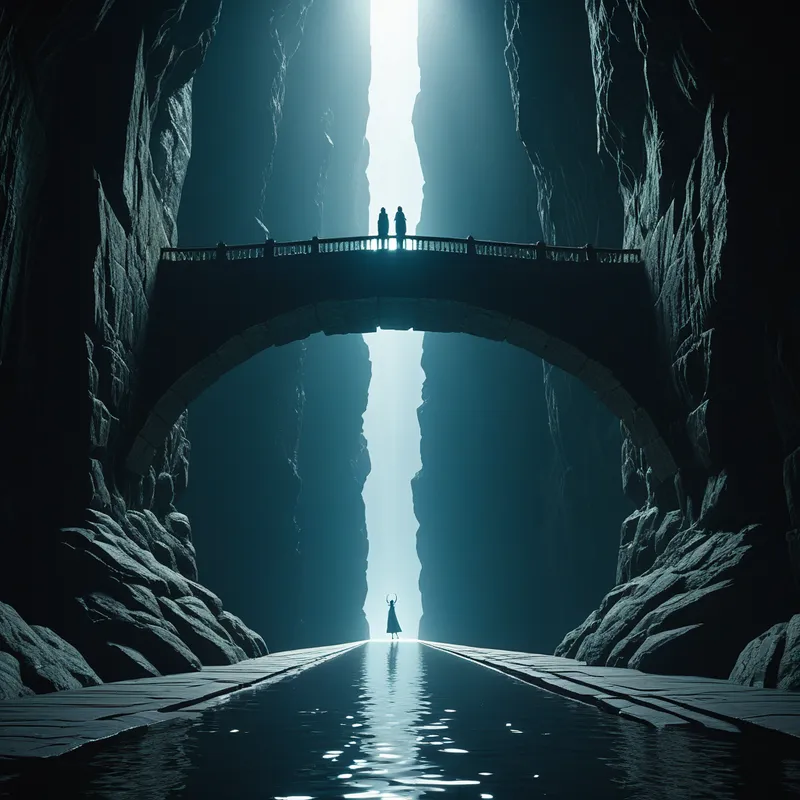
The soul is drawn forth, toward the peaks of the Chinvat. The way is steep, the path unseen. It arrives not at a gate, but at a precipice. And there, spanning a chasm so deep its bottom is the heart of darkness itself, is the Bridge. It is called Chinvat Peretu. To the eye of the just, it appears broad as a king’s highway, nine spears across, leading to a paradise of sweet-smelling trees and eternal light. To the eye of the deceitful, it is sharper than a razor’s edge, narrower than a hair’s breadth, twisting and treacherous.
Upon the bridge stand the Amesha Spentas, but two figures are foremost. Here is Daena. She is the embodiment of the soul’s own inner faith, its conscience made manifest. To the righteous, she appears as a maiden of breathtaking beauty, radiant and kind, holding a mirror that reflects only purity. To the wicked, she is a hideous, wretched hag, and her mirror shows every corruption, every lie. With her stands Rashnu, the impartial judge, holding scales that weigh not deeds, but the very weight of the soul’s thoughts, words, and actions against the feather of Asha.
The crossing begins. For the soul aligned with truth, the bridge becomes a firm and welcoming path. Daena leads them by the hand. A sweet dog—the spirit of loyalty and protection—may accompany them. They cross into the Garothman, the realm of endless light and song, to stand in the presence of [Ahura Mazda](/myths/ahura-mazda “Myth from Persian culture.”/).
But for the soul heavy with the lie of Druj, the bridge contracts. It becomes a blade. Each step is agony, each memory a weight that drags them down. Daena shrieks their failings. The scales of Rashnu tip, and the soul falls. Not into fire, but into a place of its own making: the Drujo Demana, a realm of darkness, stench, and regret, where the soul endures a second death, a dissolution in the presence of Angra Mainyu. This is the resolution: not eternal torment, but a final, terrible reckoning with the self one has created.

Cultural Origins & Context
This myth is the heart of Zoroastrian eschatology, one of the oldest surviving revealed religions, originating in ancient Persia (modern-day Iran) with the prophet Zarathustra (Greek: Zoroaster). It is meticulously detailed in the Avesta, particularly in the later Hadhokht Nask and the Arda Wiraz Namag. It was not merely a priestly doctrine but a foundational societal narrative, told by Mobeds and woven into the fabric of daily ethical life.
Its function was profound: it externalized the cosmic battle between good (Asha) and evil (Druj) into the most intimate of personal journeys. The myth served as the ultimate moral compass, teaching that every thought, word, and deed actively constructed the very bridge one would one day have to cross. It was a narrative of radical personal responsibility, where the divine court was, in essence, the soul’s own accumulated character. This provided a powerful framework for social order, justice, and the pursuit of an ethical life, promising that cosmic justice was intrinsic and inescapable.
Symbolic Architecture
The Chinvat Bridge is not a physical [location](/symbols/location “Symbol: The symbol of ‘Location’ signifies a sense of place, context, and the environment in which experiences unfold.”/) but a psychic [structure](/symbols/structure “Symbol: Structure in dreams often symbolizes stability, organization, and the framework of one’s life, reflecting how one perceives their environment and personal life.”/), a living [metaphor](/symbols/metaphor “Symbol: A figure of speech where one thing represents another, often revealing hidden connections and deeper truths through symbolic comparison.”/) for the [moment](/symbols/moment “Symbol: The symbol of a ‘moment’ embodies the significance of transient experiences that encapsulate emotional depth or pivotal transformations in life.”/) of ultimate self-confrontation.
The bridge you must cross is built from the stones of your own choices; its width is determined by the integrity of your inner alignment.
- The Bridge Itself is the liminal [space](/symbols/space “Symbol: Dreaming of ‘Space’ often symbolizes the vastness of potential, personal freedom, or feelings of isolation and exploration in one’s life.”/) between states of being—[life](/symbols/life “Symbol: The symbol of ‘Life’ represents a journey of growth, interconnectedness, and existential meaning, encompassing both the joys and challenges that define human experience.”/) and [afterlife](/symbols/afterlife “Symbol: A symbolic journey beyond death, representing transition, the unknown, and ultimate questions about existence, purpose, and what follows life.”/), [consciousness](/symbols/consciousness “Symbol: Consciousness represents the state of awareness and perception, encompassing thoughts, feelings, and experiences.”/) and unconsciousness, [persona](/symbols/persona “Symbol: The social mask or outward identity one presents to the world, often concealing the true self.”/) and [shadow](/symbols/shadow “Symbol: The ‘shadow’ embodies the unconscious, repressed aspects of the self and often represents fears or hidden emotions.”/). Its changing [nature](/symbols/nature “Symbol: Nature symbolizes growth, connectivity, and the primal forces of existence.”/) reveals that [reality](/symbols/reality “Symbol: Reality signifies the state of existence and perception, often reflecting one’s understanding of truth and life experiences.”/) is not fixed but is a [reflection](/symbols/reflection “Symbol: Reflection signifies self-examination, awareness, and the search for truth within oneself.”/) of the perceiver’s inner state. The “razor’s edge” is the precise, demanding [path](/symbols/path “Symbol: The ‘path’ symbolizes a journey, choices, and the direction one’s life is taking, often representing individual growth and exploration.”/) of ethical consciousness.
- Daena is perhaps the most profound [symbol](/symbols/symbol “Symbol: A symbol can represent an idea, concept, or belief, serving as a powerful tool for communication and understanding.”/). She is not an external judge but the [soul](/symbols/soul “Symbol: The soul represents the essence of a person, encompassing their spirit, identity, and connection to the universe.”/)’s own spiritual double, the accumulated record of its moral and existential choices. Her dual [appearance](/symbols/appearance “Symbol: Appearance in dreams relates to self-image, perception, and how you present yourself to the world.”/)—maiden or hag—is the ultimate mirror. She represents the Self in its totality, beautiful when integrated, monstrous when denied.
- The [Chasm](/symbols/chasm “Symbol: A deep fissure in the earth representing a profound division, transition, or psychological gap between states of being.”/) symbolizes the [abyss](/symbols/abyss “Symbol: A profound void representing the unconscious, the unknown, or a spiritual threshold between existence and non-existence.”/) of non-being, [chaos](/symbols/chaos “Symbol: In Arts & Music, chaos represents raw creative potential, uncontrolled expression, and the breakdown of order to forge new artistic forms.”/), and the unintegrated shadow. Falling is not a [punishment](/symbols/punishment “Symbol: A dream symbol representing consequences for actions, often tied to guilt, societal rules, or internal moral conflicts.”/) inflicted but the natural consequence of a life built on a [foundation](/symbols/foundation “Symbol: A foundation symbolizes the underlying support systems, values, and beliefs that shape one’s life, serving as the bedrock for growth and development.”/) of Druj—a [disintegration](/symbols/disintegration “Symbol: A symbol of breakdown, loss of form, or fragmentation, often reflecting anxiety about personal identity, control, or stability.”/) of the coherent self.
- The Weighing of Deeds by Rashnu moves beyond simple [ledger](/symbols/ledger “Symbol: A symbolic record of accounts, debts, and balances, representing life’s moral, emotional, and transactional reckonings.”/)-keeping. It signifies that our actions have intrinsic spiritual [weight](/symbols/weight “Symbol: Weight symbolizes burdens, responsibilities, and emotional loads one carries in life.”/) and substance, shaping the very [density](/symbols/density “Symbol: Represents the concentration of matter, energy, or meaning in a given space, often symbolizing complexity, weight, or substance.”/) of the soul.
The Dreamer’s Resonance
When this myth pattern stirs in the modern dreamer, it seldom appears as a literal Persian bridge. Instead, it manifests as a profound psychological process of self-assessment and transition. The dreamer may find themselves on a Swinging Bridge over a dark canyon, a Invisible Bridge they must trust exists, or a Mist-Covered Bridge where the other side is unknown.
Somatically, this can feel like vertigo, a tightening in the chest, or a profound hesitation in the legs. Psychologically, this is the ego facing a critical life transition—a career change, the end of a relationship, a moral dilemma, or an inner call to authenticity—where the outcome feels perilously dependent on one’s own integrity. The “judgment” is not from an external god but from the emerging Self, which demands alignment. The dream is an enactment of the soul’s own Daena, showing the dreamer the true state of their inner foundation as they attempt to cross from one stage of life to the next.

Alchemical Translation
In the alchemy of individuation, the Chinvat myth models the critical, non-negotiable stage of self-judgment that precedes psychic integration. It is the “night sea journey” where the ego must submit its account to the totality of the psyche.
The alchemical fire that transmutes lead into gold is the searing, honest light of self-awareness shone upon the shadow.
The modern individual’s “crossing” occurs in moments of deep introspection, therapy, or crisis. The Chinvat Bridge becomes the process of holding two contradictory truths: who we believed ourselves to be (our persona) and who we have actually been (our shadow). To cross successfully is to integrate these, to widen the bridge. This requires brutally honest self-assessment—facing our personal Druj of avoidance, deceit, or pride.
The guiding Daena is the voice of the Self, the inner sage. Listening to her, even when she appears as a critical “hag” (the negative mother complex, the harsh inner critic), is essential. She holds the mirror. The “fall” into the chasm, psychologically, is not damnation but a necessary dissolution of a false ego-structure—a painful but potentially regenerative descent into the shadow for the purpose of recollection and eventual Rebirth. The triumph is not reaching a paradise “out there,” but achieving an inner Garothman—a state of psychic wholeness where one’s outer life is finally a true reflection of one’s inner reality.
Associated Symbols
Explore related symbols from the CaleaDream lexicon:
- Bridge — The central archetype of transition and judgment, representing the perilous path from one state of consciousness to another, shaped by the integrity of the traveler.
- Mirror — Embodied by Daena, it represents unflinching self-reflection and the revelation of the true self, whether in beauty or in shadow.
- Judgmental Voice — The internalization of the myth’s cosmic court, manifesting as the conscience or the critical superego that weighs every thought and action.
- Soul — The essential entity undergoing the journey, whose accumulated substance and alignment determine the nature of its passage across the liminal bridge.
- Shadow — The totality of the denied and unconscious aspects of the self, which, if left unintegrated, makes the bridge narrow and the chasm below a terrifying reality.
- Light — The principle of Asha (truth) and the radiant destination of Garothman, representing consciousness, clarity, and integrated wholeness.
- Darkness — The realm of Druj (the lie) and the Drujo Demana, symbolizing the unconscious, chaos, and the psychic disintegration that follows self-deception.
- Journey — The essential narrative structure of the soul’s post-mortem passage, mirroring the lifelong psychological journey toward individuation and self-realization.
- Ridge — A synonym for the bridge’s razor-thin edge for the wicked, emphasizing the precariousness of an inauthentic life and the narrow path of ethical rigor.
- Destiny — The ultimate outcome shaped by free will and choice, as the myth posits that one’s destiny in the afterlife is the direct fruit of one’s earthly actions and inner state.