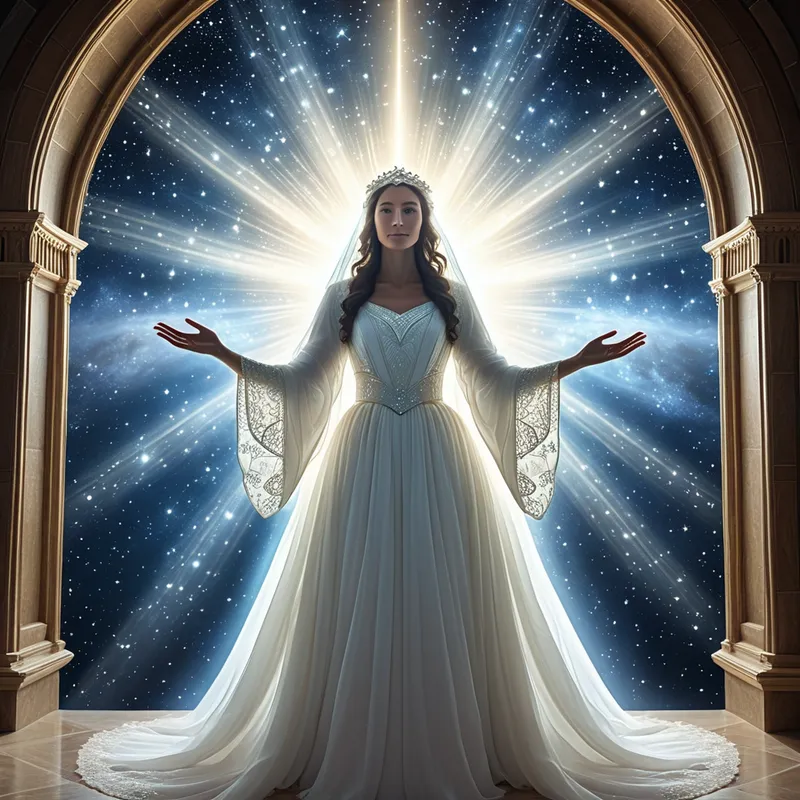
The Bride of Christ Myth Meaning & Symbolism
A mystical allegory of the soul's sacred longing for divine union, moving through purification, betrothal, and ultimate, transformative spiritual marriage.
The Tale of The Bride of Christ
Listen, and let the silence between the words speak. This is not a story of flesh, but of fire; not of a kingdom on earth, but of a longing written in the very marrow of the soul.
In the beginning of this tale, there is a Cry. It echoes not in the ears, but in the hollow chambers of the heart. It is the sound of a spirit, a human soul—the Anima—awakening to a profound and terrible loneliness. She wanders in the marketplace of the world, adorned with the trinkets of ambition, pleasure, and knowledge, yet her inner chambers remain cold and echoing. She is a princess in exile, her royal lineage forgotten, her true name a whisper on the wind she cannot quite catch.
Then, a Voice. It comes not as thunder, but as the memory of a song she once knew in a life before life. It is the voice of the Beloved. In the parables of the vineyard, in the poetry of the prophets, in the breaking of bread and the sharing of wine, she hears His call. It is a call to remembrance. "You are not orphaned," the Voice murmurs. "You are chosen. You are meant for a union that will make the stars themselves seem like distant candles."
The courtship is one of terrifying intimacy. He does not send golden chariots, but dark nights. He sends not roses, but thorns that prick the ego and draw out the nectar of humility. The soul is led into the wilderness of her own being, into the desert where every mirage of self-sufficiency evaporates. Here, in the aching void, the dialogue begins—a dialogue of longing and lament, of accusation and adoration, recorded in the secret journals of saints and the ecstatic verses of mystics like Hadewijch and John of the Cross.
The conflict is the soul's own resistance. Her old garments—pride, fear, attachment—are clung to with desperate hands. The purifying fire of divine love feels like annihilation. "To be consumed," she weeps, "is to cease to be!" Yet the Beloved persists, a gentle, relentless pressure at the core of her being. The rising action is the gradual surrender, the fiat—"let it be done." As the soul consents to be stripped, she finds not emptiness, but a capacity she never knew she had: a vessel being cleansed to hold an ocean.
The resolution is the Sacred Marriage. It is not a ceremony witnessed by angels, but a silent, cataclysmic event in the ground of being. The veil—the last illusion of separation—dissolves. The soul does not lose herself; she finds herself in Him. She becomes what she has always been: the Bride. The union is consummated not in passion, but in perfect peace; not in taking, but in a boundless, reciprocal gift of self. The two become one, yet remain distinct—a mystery sung in the eternal present, where the wedding feast has no end.
Cultural Origins & Context
This myth did not spring from a single scripture, but bloomed in the fertile, shadowed gardens of early Christian contemplation. Its roots tap into the ancient allegorical tradition, where the Song of Songs—an earthy poem of human love—was transposed into a divine key. By the 3rd century, Origen of Alexandria was already expounding on the soul as the bride of the Logos, the Word.
It found its most potent expression in the medieval period, within the cloisters and beguinages. Here, often barred from clerical authority, women mystics like Hildegard of Bingen, Hadewijch, and Catherine of Siena became the primary vessels and poets of this myth. For them, it was not mere theology; it was the lived, somatic reality of their spiritual journey. Their ecstatic, often erotically charged visions provided a legitimate language for divine intimacy, framing their profound experiences within a culturally sanctioned narrative of holy union.
The myth functioned as a master template for the mystical path. It provided a map—from awakening (the hearing of the call), through purification (the dark night), to union (the spiritual marriage). It democratized sainthood, suggesting that this ultimate union was not just for apostles but for every soul that dared to love God with a singular, spousal passion. It was passed down through theological treatises, yes, but more powerfully through hymns, illuminated manuscripts, and the oral traditions of spiritual direction.
Symbolic Architecture
At its core, the myth is a grand metaphor for the individuation process, where the soul achieves its fullest integrity by marrying its deepest nature to the transcendent.
The Bride is the human anima or psyche itself—not the ego, but the total, essential Self in its potential state. She represents consciousness that is incomplete, yearning, and destined for wholeness.
The Christ/Beloved symbolizes the Self archetype in its transcendent aspect. He is the image of ultimate meaning, completeness, and integrative power that calls from beyond the ego's horizon.
The engagement ring is the wound that makes room for the infinite.
The Betrothal and Marriage are the central symbols of coniunctio, the alchemical union of opposites. This is not a subsumption of the individual into the collective, but the sacred marriage of the personal with the transpersonal, the finite with the infinite. The soul retains its "I" but now knows it is utterly held within a greater "Thou."
The Dark Night of the Soul, a crucial stage in the narrative, symbolizes the necessary dissolution of the ego's rigid structures. It is the painful but liberating process where the soul's false identifications—with achievements, roles, or even spiritual consolations—are burned away to make space for the authentic Self.
The Dreamer's Resonance
When this myth stirs in the modern dreamer, it rarely appears as biblical pageantry. Its patterns manifest in the psyche's own symbolic language.
You may dream of preparing for a wedding where the partner is unseen or unknown, feeling a mix of exhilarating anticipation and profound anxiety. This somatic state mirrors the soul's approach to a commitment to its own depth, a commitment the conscious mind cannot yet grasp. Or you may dream of being in a beautiful gown or suit that is somehow incomplete or stained, reflecting the ego's acute awareness of its own inadequacy before the call to wholeness.
Another common pattern is the dream of a lost wedding ring, symbolizing a felt rupture in the connection to meaning, a fear that the promise of inner union has been broken or forgotten. Conversely, finding a ring of immense, simple beauty can signal the ego's readiness to accept the betrothal.
These dreams point to an active process in the psyche: the central archetype of the Self is exerting its gravitational pull. The ego is being invited, or compelled, to enter into a new and more comprehensive relationship with the totality of who one is. The anxiety and longing in the dream are the birth pangs of a larger identity.
Alchemical Translation
The myth of the Bride provides a complete alchemical map for psychic transmutation in the modern quest for individuation.
The initial longing (Calcinatio) is the burning away of casual contentment. The soul's divine discontent is the fire that begins the work, forcing a separation from the leaden weight of unconscious living.
The courtship and dark night (Solutio and Nigredo) represent the dissolution. The ego's solid certainties are flooded by the waters of the unconscious and plunged into the blackness of confusion, depression, or meaninglessness. This is the crucial, painful stage of breaking down the old personality complex to its essential components.
The soul must become empty to become a vessel; it must be shattered to be remade as a cathedral.
The surrender and betrothal (Albedo) signify the washing clean, the whitening. As the ego relinquishes its frantic control, a new clarity emerges. A covenant is made with the deep Self—a commitment to follow its guidance, even without full understanding. This is the stage of inner peace and purified intention.
Finally, the Sacred Marriage (Coniunctio and Rubedo) is the reddening, the achievement of the philosopher's stone. It is the integration of the transcendent function. The conscious mind (the Bride) and the guiding, transpersonal Self (the Beloved) enter into a permanent, creative partnership. The individual no longer has a spiritual life; their life is spiritual, grounded in an unshakable, inner-connected wholeness. The gold produced is not worldly success, but the ability to live from a center of authentic love, purpose, and unassailable peace—a soul finally at home in itself and the cosmos.
Associated Symbols
Explore related symbols from the CaleaDream lexicon: