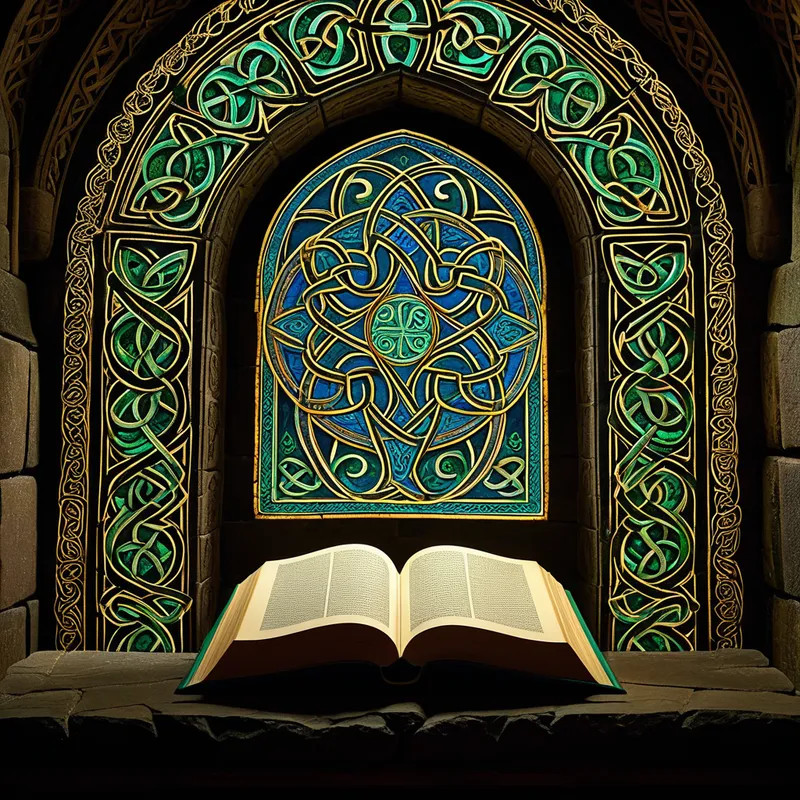
The Book of Kells Myth Meaning & Symbolism
A sacred manuscript, born in a storm of faith and violence, journeys through darkness to become a testament to divine order and illuminated consciousness.
The Tale of The Book of Kells
Listen, and hear the tale of the Book of Kells. It was not born in peace, but in the howling gale of faith and fire. Its cradle was the edge of [the world](/myths/the-world “Myth from Tarot culture.”/), on the Isle of Iona, where the salt spray kissed the stone and the prayers of monks rose like incense against the grey sky. These were the Perigrini, wanderers for Christ, who sought [the desert](/myths/the-desert “Myth from Biblical culture.”/) in the ocean’s heart.
Their hands, calloused from labor, became instruments of a divine madness. They stretched the skin of calves, scraping it until it was as smooth as a still lake at dawn—vellum. From crushed stones, berries, and precious metals, they conjured colors that had no name in the world of men: a green deeper than the forest mantle, a blue snatched from the twilight sky, a gold that held the sun captive.
And then, the [Vikings](/myths/vikings “Myth from Norse culture.”/) came. Their longships were black serpents on the [water](/myths/water “Myth from Chinese culture.”/), their coming announced by the scream of gulls and the thunder of oars. Fire and iron fell upon the holy island. The monks, their hearts pounding a psalm of terror and resolve, gathered their greatest treasure—the unfinished Gospel, the luminous book—and fled across the treacherous sea to Kells. The book journeyed in a chest, a holy ark tossed upon the waves, a seed of light carried through a storm of darkness.
In Kells, the work continued for generations. In the dim scriptorium, lit only by narrow windows and tallow dips, scribes and artists bent their backs. Their world contracted to the point of a quill, their universe a square of vellum. Here, they did not merely write; they wove. They wove [the Word of God](/myths/the-word-of-god “Myth from Abrahamic culture.”/) into labyrinths of [knotwork](/myths/knotwork “Myth from Celtic culture.”/) that had no beginning and no end. They trapped beasts—lions, eagles, otters, cats—in margins of foliage, making the natural world a witness to the supernatural. They drew the Chi-Rho page, where the name of Christ exploded in a cosmic riot of color and pattern, a visual Big Bang of sacred order.
The book was stolen, buried, recovered, its boards lost to time, its pages stained by rain. Yet, through every trial, the illumination within did not fade. It waited, a silent, radiant heart in the dark belly of a tumultuous age, a testament that from chaos, a breathtaking order can be born; that into history’s violence, a timeless beauty can be inscribed.
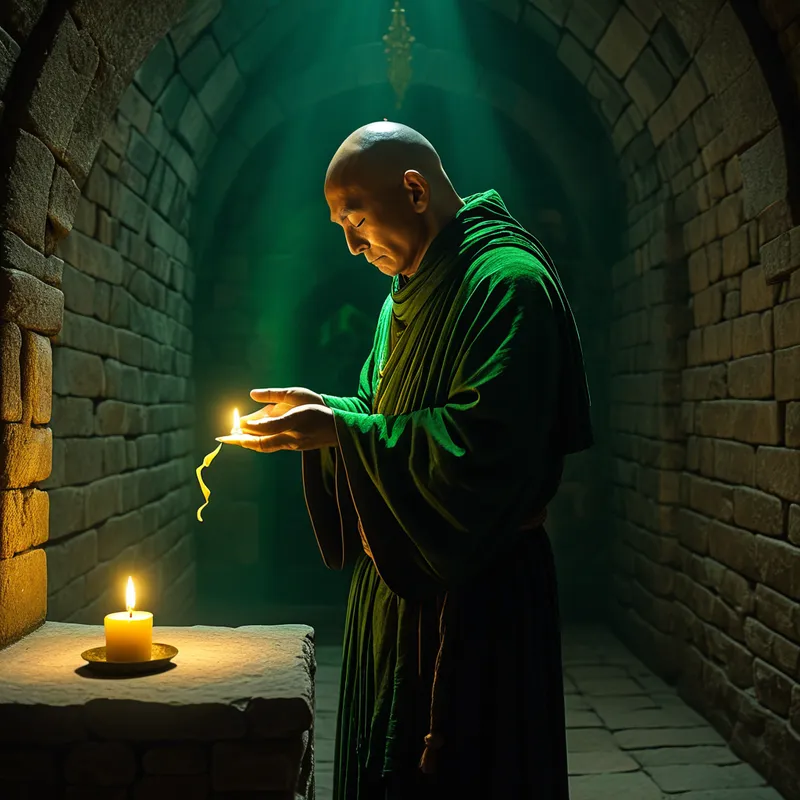
Cultural Origins & Context
The Book of Kells is not a myth in the classical sense of gods and heroes, but a living mythos born from a specific historical crucible: early medieval Insular Christianity. Created circa 800 AD, its origins are shrouded in the scholarly consensus of Iona and Kells. This was a culture suspended between worlds—between the native, pre-Christian Celtic reverence for spirals, knots, and animal interlace (the “Ultimate La Tène” style) and the new theology of the Gospel.
The “storytellers” were the anonymous monk-artists themselves. Their society functioned on the edge of known civilization, seeing itself as a new Israel in the Atlantic wilderness. The book’s primary function was liturgical and contemplative, likely used for altar display during Mass to inspire awe at the tangible glory of God. It was a “textual relic,” making the divine Word physically resplendent. In an illiterate society, its images preached. In a violent, uncertain age, its intricate, unassailable order was a psychic bulwark—a microcosm of the divine harmony they believed underpinned a chaotic cosmos.
Symbolic Architecture
Psychologically, the Book of Kells is a supreme [symbol](/symbols/symbol “Symbol: A symbol can represent an idea, concept, or belief, serving as a powerful tool for communication and understanding.”/) of the individuation process: the bringing of profound, often chaotic, inner content into a state of exquisite, conscious order.
The raw vellum represents the base [material](/symbols/material “Symbol: Material signifies the tangible aspects of life, often representing physical resources, desires, and the physical world’s influence on our existence.”/) of the [psyche](/myths/psyche “Myth from Greek culture.”/)—the animal [nature](/symbols/nature “Symbol: Nature symbolizes growth, connectivity, and the primal forces of existence.”/), the unconscious, untamed and blank. The punishing process of scraping and preparation is the necessary suffering and discipline required to make [the self](/myths/the-self “Myth from Jungian culture.”/) receptive to transformation.
The labyrinthine knotwork, with no true start or end, is the psyche’s own complex, interconnected architecture—the endless weaving of memory, thought, instinct, and spirit.
The terrifying Viking raids symbolize the eruptive, destructive forces of the unconscious—the sudden complexes and traumas that can shatter a fragile conscious order. The book’s [journey](/symbols/journey “Symbol: A journey in dreams typically signifies adventure, growth, or a significant life transition.”/) to Kells is [the ego](/myths/the-ego “Myth from Jungian culture.”/)‘s desperate, faithful [effort](/symbols/effort “Symbol: Effort signifies the physical, mental, and emotional energy invested toward achieving goals and personal growth.”/) to preserve a nascent center of meaning through psychic storms.
Most crucially, the act of [illumination](/symbols/illumination “Symbol: A sudden clarity or revelation, often representing spiritual awakening, intellectual breakthrough, or the dispelling of ignorance.”/) is the core symbol. It is not decoration, but [revelation](/symbols/revelation “Symbol: A sudden, profound disclosure of truth or insight, often through artistic or musical means, that transforms understanding.”/). The scribe, through immense concentration (the [opus](/symbols/opus “Symbol: A spiritual or alchemical term for a great work of creation, often representing the culmination of a life’s purpose or a transformative process.”/)), “lights up” the sacred text from within, making [the Logos](/myths/the-logos “Myth from Biblical culture.”/) visible. This is the ego serving a higher, transpersonal content, laboring to give beautiful, intricate form to the numinous patterns it intuits within the [chaos](/symbols/chaos “Symbol: In Arts & Music, chaos represents raw creative potential, uncontrolled expression, and the breakdown of order to forge new artistic forms.”/).
The Dreamer’s Resonance
To dream of the Book of Kells is to dream of one’s own nascent wholeness. The dreamer may find themselves in a dim library, unable to read the text but mesmerized by the glowing, moving patterns on a page. This signals a confrontation with deep, non-verbal psychic content—the “script” of the Self is present, but not yet intellectually understandable; its power is in its aesthetic, symbolic form.
A dream of creating such a page, perhaps with immense frustration at the complexity of the lines, points to an active, painstaking process of self-formation underway. The somatic sensation is often one of intense, focused pressure in the hands and eyes, a bodily memory of meticulous craft.
Conversely, a dream where the book is threatened—by water, fire, or shadowy figures trying to deface it—indicates a perceived threat to one’s hard-won inner coherence, often from old, disruptive patterns (the “Vikings” of the psyche) resurfacing. The dream serves as a reminder of the preciousness and vulnerability of the individual’s unique inner order.
Alchemical Translation
The alchemical process mirrored here is the opus contra naturam—the work against nature, which is really a work of elevating nature to its highest potential. The base animal skin (the [prima materia](/myths/prima-materia “Myth from Alchemical culture.”/), the unrefined self) undergoes a series of ordeals (dissolution in [the sea](/myths/the-sea “Myth from Greek culture.”/), burial) before being subjected to the artist’s labor and patience.
The gold leaf on the page is not mere wealth; it is the aurum non vulgi—the gold of the philosophers, the shining, incorruptible essence of the personality that emerges only through dedicated, devotional work on the raw material of one’s life.
The modern individual’s “Kells” is the unique, intricate tapestry of their lived experience, memory, and insight. The “[Viking raids](/myths/viking-raids “Myth from Norse culture.”/)” are life’s inevitable crises, losses, and chaos that seem to destroy order. The alchemical translation teaches that these raids are not final. The work must be gathered up, carried across turbulent inner seas, and resumed in a new “monastery”—a new inner container of discipline and meaning.
The ultimate [triumph](/myths/triumph “Myth from Roman culture.”/) is not a finished, perfect life, but a process of endless, faithful illumination. To become a scribe of one’s own soul is to engage in the lifelong task of taking the chaotic, often brutal text of one’s history and, through attention, love, and craft, illuminating it—finding the divine, interwoven pattern hidden within the storm, and making of one’s own life a manuscript worthy of awe.
Associated Symbols
Explore related symbols from the CaleaDream lexicon: