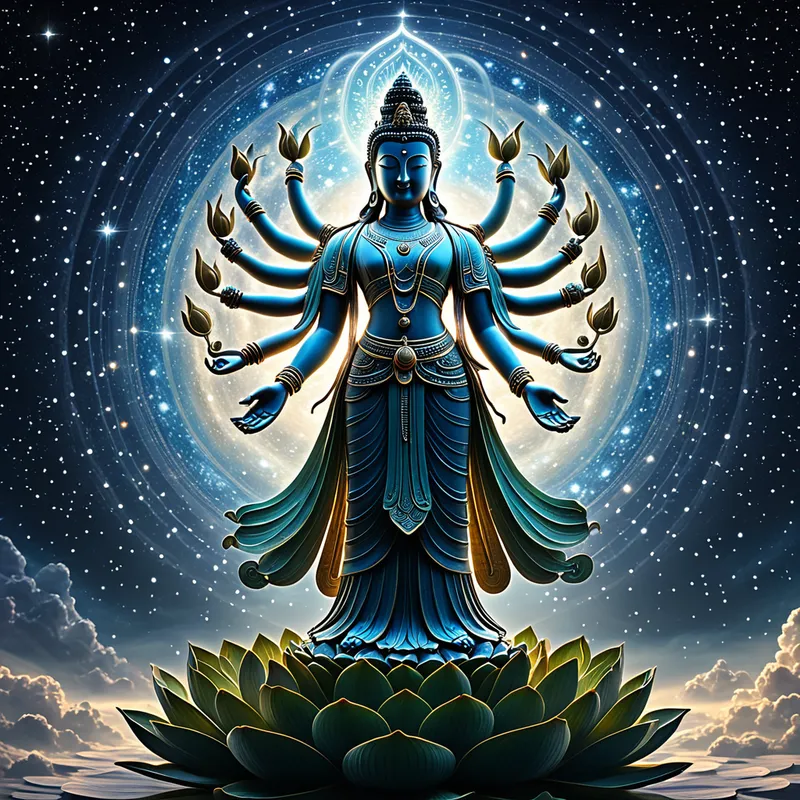
The Bodhisattva Path Myth Meaning & Symbolism
A being stands at the threshold of final peace, then turns back into the world of suffering, vowing to save all others before claiming their own freedom.
The Tale of The Bodhisattva Path
Listen, and hear a story not of a single life, but of a promise that echoes across lifetimes. It begins not in a palace or a battlefield, but in a moment of unbearable clarity.
Imagine a being who has walked the long road. They have sat in the deep silence, peeled back the layers of illusion, and felt the cool, liberating truth of Nirvana beckoning. It is a shore of perfect peace, an end to all suffering, a final release from the wheel of Samsara. The weight of a thousand lifetimes is about to slip from their shoulders. The door stands open. The light is blinding in its purity.
They take the final step. And then, they stop.
For in that ultimate moment, they turn their gaze backward. Not to the path they have walked, but to the world they would leave behind. They see the ocean of suffering—the cry of a newborn, the grief of the old, the confusion of the lost, the endless, hungry churn of beings caught in the net of their own desires and fears. They hear it not as noise, but as a single, vast, and piercing lament.
And in that hearing, something in the cosmos cracks. The serene destiny of personal escape shatters like a mirror. A vow, more profound than any mountain, rises from the depths of their being. It is not spoken to gods or recorded in books. It is etched into the fabric of their intention, a seismic shift in the axis of the soul.
“I shall not enter final Nirvana until every blade of grass has attained enlightenment. However innumerable sentient beings are, I vow to save them. However inexhaustible the defilements are, I vow to extinguish them. However immeasurable the Dharma is, I vow to master it. However unattainable the awakening is, I vow to attain it.”
With these words, the being turns around. They step back from the luminous threshold and walk, deliberately, into the swirling storm of Samsara. They are no longer a seeker of exit. They are a Bodhisattva—an “enlightenment-being.” Their path is no longer upward and out, but downward and in, into the very heart of the world’s agony. They will take the form of teachers, healers, beggars, kings, animals, and demons. They will accumulate not wealth, but the Paramitas—perfections of generosity, patience, and wisdom. Their journey is now endless, their compassion, a boundless engine. The story does not end with a coronation, but with a perpetual, loving return.

Cultural Origins & Context
This is not a myth of a singular, ancient event, but the living architecture of Mahayana Buddhism, which emerged around the 1st century BCE to 1st century CE. It represents a democratization and radical expansion of the spiritual ideal. While the earlier tradition revered the Arhat—the “worthy one” who achieves liberation for themselves—the Mahayana scriptures, like the Prajnaparamita Sutras and the Avatamsaka Sutra, placed the Bodhisattva at the center. This path was narrated by monks, philosophers, and storytellers, and embodied by figures like Avalokiteshvara and Manjushri.
Its societal function was profound. It transformed Buddhism from a monastic pursuit of personal salvation into a cosmology of universal responsibility. It provided a heroic model for all—layperson and monk alike—framing everyday acts of kindness and patience as steps on the supreme path. The myth served as a narrative container for the core Mahayana doctrine of Shunyata, for if no self truly exists, then the distinction between “my” liberation and “yours” is the final illusion to be surrendered.
Symbolic Architecture
Psychologically, the Bodhisattva represents the ultimate integration of the ego with the Self, where the individuated consciousness voluntarily takes on the suffering of the psyche’s unexplored depths—the collective shadow—as its own work. The moment of turning back is the critical pivot from withdrawal to engagement, from purification to participation.
The hero’s journey culminates not in seizing a prize, but in realizing the prize was never separate from the world it was sought to escape.
The Paramitas are not virtues but alchemical disciplines for dissolving the ego. Generosity (Dana) dismantles possessiveness. Patience (Kshanti) dissolves reactivity. Wisdom (Prajna) incinerates ignorance itself. The Samsara they re-enter is the psyche itself, with all its conflicts, complexes, and forgotten traumas. The vow is the commitment to conscious relationship with all inner contents, not just the luminous ones.

The Dreamer’s Resonance
When this myth stirs in the modern unconscious, it often manifests in dreams of profound, sometimes agonizing, responsibility. One may dream of being unable to leave a sinking ship because others are still aboard, of feeding a crowd with a loaf of bread that never diminishes, or of holding a fracturing world together with bare hands. The somatic sensation is often a deep, resonant tension in the heart center—a feeling of being stretched between the pull of a serene, private peace and the urgent call of a messy, collective need.
This is the psyche processing the emergence of what Jung called the “mana personality,” a stage where one’s own hard-won development creates a burden of responsibility toward others. The dreamer is confronting the shadow of the hermit or the perfected ego—the temptation to use spiritual or psychological insight as a fortress rather than a bridge. The dream is the soul’s insistence that individuation is incomplete if it does not ultimately serve the whole.
Alchemical Translation
The alchemy of the Bodhisattva Path is the transmutation of liberation from the world into liberation of the world, beginning with the inner world. For the modern individual, this models the final, most demanding phase of individuation: the return.
One does the hard work—therapy, introspection, shadow-work, healing old wounds. One glimpses a state of relative inner peace, a “personal Nirvana” of sorted-out complexes and managed triggers. The conventional spiritual temptation is to stay there, to protect that hard-won peace. The Bodhisattva’s vow, however, commands the opposite. It demands we turn back and re-engage—not from a place of egoic saviorhood, but from the grounded wisdom of Shunyata. We engage with our families, communities, and the world’s pain, not as unhealed victims or detached sages, but as conscious vessels.
The ultimate transformation is realizing that the gold you sought to possess is only realized in the act of giving it away.
This is the alchemical rubedo, the red stage of completion, where the philosopher’s stone—the integrated Self—is used not for personal immortality but to catalyze transformation in the lead of the world. Your healed trauma becomes a capacity to hold space for another’s. Your hard-won boundaries allow you to be present without being consumed. Your journey becomes a path you clear not just for yourself, but for all who walk behind you. The vow is made daily: to meet life not with an agenda of final escape, but with the boundless, patient, and wise compassion of one who has chosen to stay.
Associated Symbols
Explore related symbols from the CaleaDream lexicon: