The blood of the Grail in Arth Myth Meaning & Symbolism
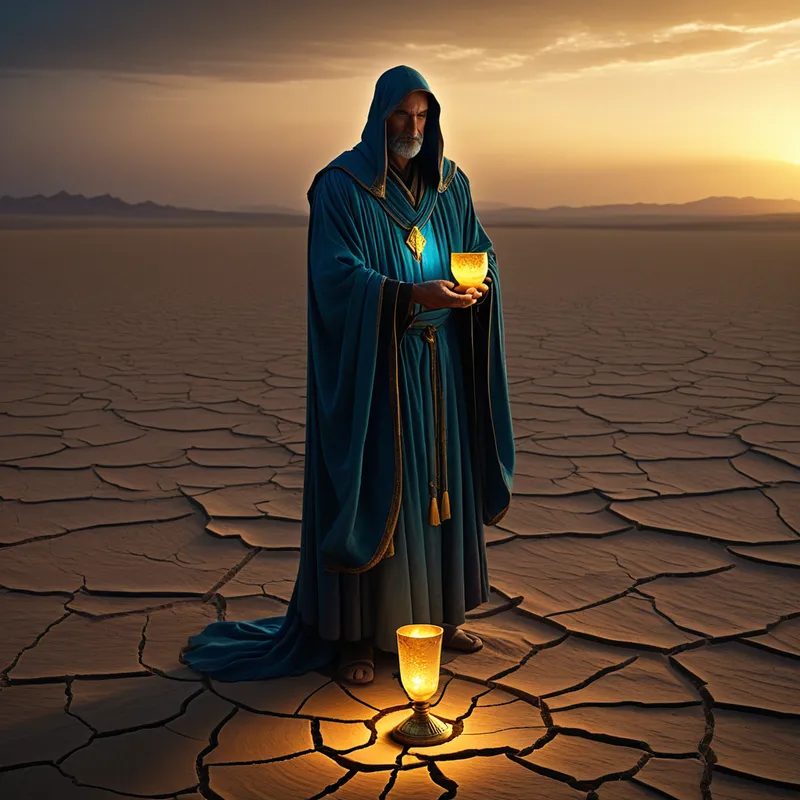
A sacred king spills his lifeblood into the land, merging with the divine vessel to awaken the sleeping world-soul from its slumber.
The Tale of The blood of the Grail in Arth
Listen, and let the silence between the stars carry the tale. There was a land named Arth, and it was not a kingdom of stone and border, but a living body—a vast, dreaming beast of mountain, forest, and plain. But its dream had turned to a deep, cold slumber. The rivers of Arth ran slow and silent, thick as cold syrup. The trees stood as gray sentinels, their leaves whispering only of forgotten rain. The heart of the world-beat was a faint, faltering thrum, heard only by those who pressed their ear to the deepest root or the highest, wind-scoured peak.
In this sleeping land, there was a king. He was not called by a name we would know, for his name was the sum of his duty: the Steward of the Root. He felt the ache of Arth in his own bones, the dryness in his own throat. He ruled from a hall not of timber, but woven from the living boughs of the World-Tree’s last, grieving descendant. His crown was not gold, but a circlet of withered hawthorn.
The sages and the bone-readers spoke of a remedy, a memory from the First Dreaming. There existed, they said, the Cup of the Uncarved, a vessel not made by hand, but formed from the first intention of containment. And there was the Blood of the Will, the vital essence that could wake the dreamer. But the Cup was empty, and the Blood was the king’s own—not the blood of battle, but the blood of his sovereign life, the pact-blood that tied his spirit to the soil.
The king walked out from his hall of sighing wood, past his people whose eyes held the same gray as the sky. He climbed to the Navel-Stone, a vast, flat altar of obsidian at the center of the plains, where the winds from all corners met and mourned. He held the simple, clay-gray Cup. No fanfare, no chant. The only sound was the wind’s low keen.
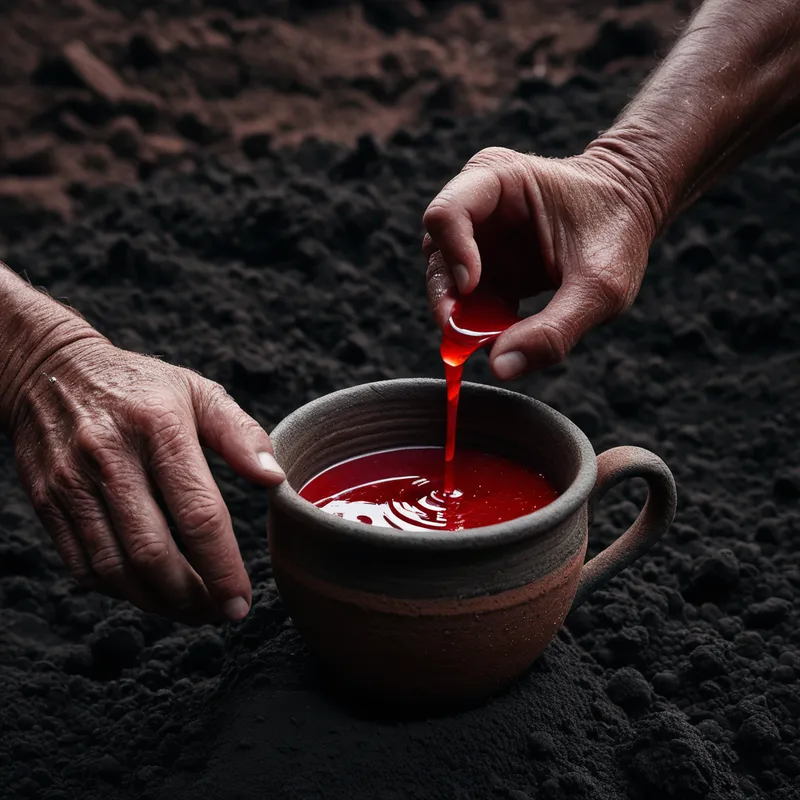
He drew a blade of flint, dark as the stone beneath him. He looked not at the sky for blessing, but down at the cracked earth of Arth. With a breath that was both surrender and command, he drew the blade across his palm. His blood did not drip—it flowed, a stream of profound crimson, into the waiting Cup. It did not fill it by volume, but by essence; the Cup drank his sacrifice, and its clay body began to glow with an inner hearth-light.
Then, he knelt. He poured the contents of the Cup—now a liquid of fused light and life—onto the Navel-Stone. It did not pool. It sank into the stone as if it were water into parched sand. A shockwave of silence, deeper than before, gripped the world.
Then, a tremor. A single, green shoot cracked the obsidian at his knees. A hum rose from the earth, a chord struck from the very core of Arth. The gray drained from the trees, replaced by the vibrant green of remembered spring. The rivers cleared and sang over stones. The land drew its first conscious breath in an age, and the king, his hand healed yet forever marked, felt the heartbeat of the world sync with his own. He was no longer just its steward. He and the land were one living system, awake.
Cultural Origins & Context
The myth of the Blood of the Grail in Arth does not belong to a single scroll or oral tradition, but emerges as a recurring pattern in the "Global/Universal" cultural stratum—a term denoting those deep, cross-cultural story-fields that surface in disparate lands, speaking the same symbolic language. It is the myth of the Hieros Gamos of king and kingdom, found in Celtic sovereignty goddess tales, in the Mesopotamian Dingir (divine) rituals linking ruler to city, and in the alchemical maxim "As above, so below" applied to the microcosm of man and macrocosm of world.
It was likely not a story told to children, but a sacred narrative performed during rites of coronation or seasonal renewal by priest-kings or shamans. Its function was ontological: to explain and enact the fundamental covenant between leadership and the health of the collective body—be it tribe, nation, or ecosystem. The king is not a dictator, but a sacrificial conduit; his power is legitimate only insofar as he is willing to bleed for the literal and spiritual fertility of his realm. The myth served as both a blueprint for sacred kingship and a warning against its corruption—rule without this sacrificial union leads to a Wasteland.
Symbolic Architecture
At its core, this myth maps the psyche’s journey from a state of dissociation to one of embodied, conscious unity.
Arth is the Self in a state of dormancy or depression—the psychic landscape that feels barren, disconnected, and lifeless. The slow rivers and gray trees symbolize stagnant energy, repressed emotions, and a loss of vitality and creativity.
The Steward King represents the conscious ego, tasked with management but ultimately powerless while it remains separate from the deeper, instinctual layers of the psyche. His hawthorn crown is the burden of duty without joy or connection.
The Grail is not a thing to be found, but a relationship to be forged. It is the vessel of the soul, empty until it receives the conscious sacrifice of the will.
The Cup of the Uncarved is the archetypal Vessel, the receptive unconscious itself, waiting to be filled with conscious intention. The Blood of the Will is the libido or life-energy of the conscious ego—its ambition, its vitality, its very attention. The king’s act is the ultimate act of psychological courage: the ego voluntarily surrendering its prized, isolating autonomy—its "blood"—to the service of the greater, unconscious Self.
The Navel-Stone is the psychic center, the point of connection between the personal and the transpersonal. The resulting awakening of the land symbolizes the enlivening of the entire personality when ego-consciousness aligns with and nourishes the deep Self. The healed hand with a mark signifies that the sacrifice transforms the ego; it is no longer separate, but indelibly part of a living, reciprocal whole.
The Dreamer's Resonance
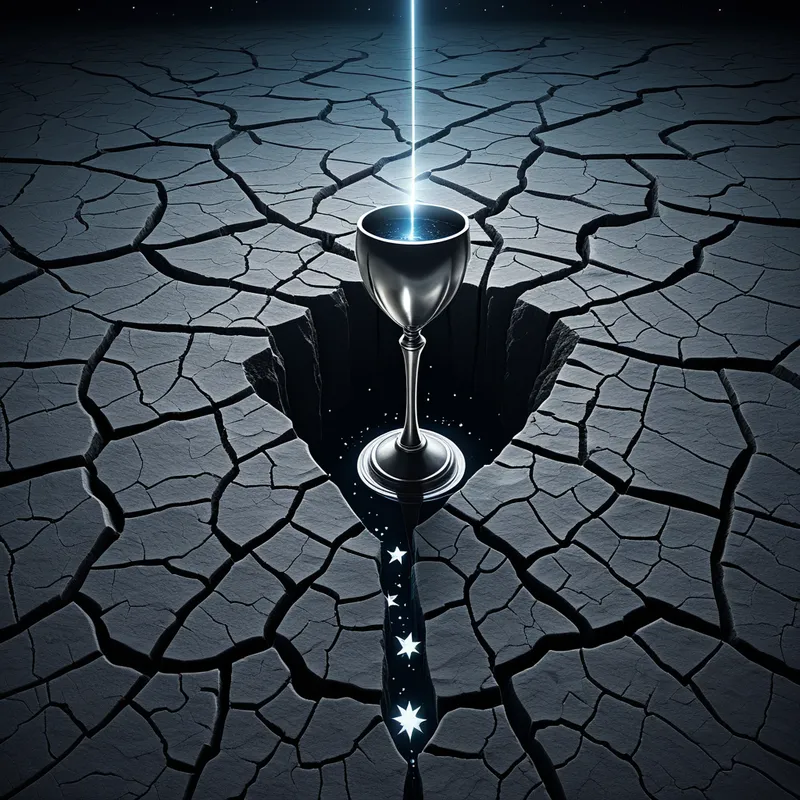
When this myth stirs in the modern dreamer, it often manifests not as a literal narrative, but as potent, somatic imagery. You may dream of a parched, endless garden you are tasked to water with only a thimble, feeling the despair of the task. You might encounter a crumbling building that is also your body, and know you must find a hidden cornerstone to stabilize it. There could be a ceremony where you must offer something profoundly precious—a voice, a memory, a token of identity—into a well or a fire, accompanied by immense dread and subsequent relief.
These dreams signal a critical phase in what Jung called the individuation process. The "barren land" is a life situation, a relationship, or an inner state that has become emotionally sterile. The psyche is demanding a sacrifice of the old attitude. The somatic feeling—the tight chest, the weight, the dryness in the dream—is the body echoing the soul's thirst. The dream is the unconscious presenting the Cup and the Knife. The conflict is the dreamer's resistance to the act of conscious surrender, to giving up a familiar identity or control for an unknown renewal.
Alchemical Translation
The myth is a perfect allegory for the alchemical Coniunctio and the psychological process of individuation. The King (Sulfur, the active, masculine principle) and the Land/Arth (Salt, the passive, feminine, bodily principle) are in a state of separatio—fatal division. The Grail (Mercury, the mediating spirit) is the transformative vessel.
The operation is solutio (dissolution) and coagulatio (coagulation) in one sacred act. The ego (King) must dissolve its rigid boundaries—its "blood"—into the solvent of the unconscious (the Cup). This is not annihilation, but a necessary death of the old, isolated self.
The goal is not to possess the Grail, but to become the Grail—a vessel where spirit and matter, consciousness and the unconscious, flow as one sustaining life.
The pouring of the mingled essence onto the *Navel-Stone (the Lapis Philosophorum, the Philosopher's Stone)* represents the coagulatio: the formation of the new, integrated personality. The awakened land is the albedo* followed by *rubedo—the whitening (purification) and reddening (vivification) of the psyche. The individual is no longer a ruler over their inner world, but a conscious participant within a dynamic, self-sustaining ecosystem. For the modern seeker, the "Blood of the Grail in Arth" is the call to stop seeking wholeness externally, and to perform the sacred, internal rite: to offer one's most cherished conscious attitudes—our will to control, our curated identity—into the vessel of the soul, thereby watering the roots of our own being and awakening the sleeping god within the landscape of our life.
Associated Symbols
Explore related symbols from the CaleaDream lexicon: