
The Bell of St. Patrick Myth Meaning & Symbolism
A myth of sacred sound, where a saint's bell banishes primal chaos, forging a sanctuary of order from the wild Irish landscape and the human psyche.
The Tale of The Bell of St. Patrick
Listen, and hear a tale not of swords, but of sound. In the mist-cloaked isle of Éire, where the green hills whispered with older gods and the bogs held memories darker than peat, a man walked. He was Patrick, his soul a vessel for a new fire, his feet sore upon the old, dreaming stones. The land itself was a living psalm of chaos—a symphony of shrieking winds in the mountain passes, the low moan of spirits in the hollow hills, the cacophonous shatter of waves on the northern cliffs.
Patrick carried few things: a staff of ash, faith like a knot in his gut, and a bell. Not a bell of gold for kings, but a humble thing of iron, forged in a monk’s quiet fire. Its voice was not sweet, but clear—a single, sharp note that cut like truth.
His journey brought him to a valley where the shadows did not wait for sunset. The local folk, their eyes hollow with a fear older than memory, spoke of a glen that swallowed light and sound. A demon</ab title>, they said, had made its throne there. It was not a beast with claws, but a presence—a coalescence of every doubt, every despair, every formless terror that writhes in the human heart given dominion over a place. It was Chaos, unbound. The very air in the glen was thick and silent, a suffocating blanket that killed birdsong and stilled the streams.
Patrick stood at the mouth of that dread place. He felt the silence push against him, a physical weight seeking to extinguish the inner flame of his purpose. The trees were twisted parodies of life. He did not draw a cross in the air. He did not shout a Latin curse. He reached into his simple sack, and his fingers closed around the cold iron of the bell.
He stepped into the glen.
The oppressive silence deepened, becoming a roar in the ears. Shadows pooled and swirled, forming shapeless suggestions of malice that pressed in from the gnarled oaks. Patrick’s breath came in short gasps, the void sucking at his spirit. He raised the bell. For a moment, nothing. His arm felt heavy as stone. Then, with a resolve pulled from the core of his being, he swung the clapper.
Clang.
The sound was a physical shockwave. It was not loud, but profound—a circle of pure, ordered vibration radiating from the iron. The swirling shadows flinched. The thick air shivered.
Clang.
A second strike. The note hung in the foul air, a sovereign declaration. Where the sound passed, the twisted light straightened. The suffocating pressure lessened by a hair’s breadth.
Clang. Clang. Clang.
Patrick began to walk, ringing the bell with each step—a slow, deliberate procession into the heart of the terror. Each strike was a word in a language older than Latin: Here is order. Here is boundary. Here is a point that is not you. The formless demon of the glen, that incarnation of primal chaos, had no defense against this. It could battle a sword, argue with a doctrine, but it could not exist within this relentless, defining frequency. The sound created a sanctuary around the saint, an expanding sphere of here against the endless nowhere of the demon’s realm.
He rang until his arm ached, until the clear note had filled every dark corner of the glen. And as the last vibration faded, a true silence returned—not a suffocating one, but a peaceful, empty silence. Sunlight, thin and pale, broke through the canopy and touched the forest floor for the first time in living memory. A trickle of water could be heard from a freed spring. The demon was not slain, for such things cannot die. It was banished, defined against the bell’s order, and thus forced to retreat to the outer wilds where chaos still ruled. The place was healed. Patrick hung the bell on the branch of a now-straightened oak, a sentinel of sound, and continued his walk.

Cultural Origins & Context
The myth of the Bell of St. Patrick finds its roots in the early medieval Irish church, a unique institution that blended deep Celtic sensibilities with Christianity. It is part of a rich hagiographical tradition surrounding the national apostle, stories compiled in texts like the 7th-century Vita Sancti Patricii (Life of St. Patrick). These tales were not dry history but "soul history," told by monks and bards to inspire, teach, and explain the spiritual transformation of Ireland itself.
The bell as a sacred object was immensely practical and symbolic in this context. Irish monasticism revered peregrinatio—exile or wandering for Christ—and early missionaries traveled with simple, portable altars. The bell was a crucial tool, calling the faithful to prayer in a land without churches, marking the canonical hours in the wilderness. But in the Celtic imagination, sound itself held magical properties. Druids were said to use incantations to control elements. The myth transposes this ancient belief into a Christian key: the ordered, sacred sound of the bell becomes the weapon against pre-Christian, chaotic spiritual forces. The story served a societal function, narratively mapping the transition from a pagan, animistic worldview to a Christian, ordered one, not as destruction, but as a sanctification of the landscape. It gave people a psychic model for understanding how the new faith "worked" in their world.
Symbolic Architecture
At its core, the myth is a profound drama of Cosmos versus Chaos. The demon in the glen is not merely a monster; it is the psychological embodiment of the undifferentiated, the unformed, the terrifying potentiality that precedes creation. It is the swamp of unresolved trauma, the fog of depression, the anarchic riot of unbounded impulse.
The sacred sound does not destroy chaos; it defines a space within it, creating a vessel where consciousness can dwell.
The bell, therefore, is the symbol of the logos—the word, the principle, the differentiating idea. Its iron construction speaks of strength and humility (not royal gold). Its sound is the act of consciousness itself: to name, to delineate, to call into being. Patrick, the peregrinus, represents the oriented ego or the conscious self, venturing into the untamed territories of the personal and collective unconscious (the wilds of Éire). His act of ringing the bell is the heroic, repetitive work of applying consciousness—through ritual, through therapy, through disciplined thought—to the formless anxieties within. The healing of the glen symbolizes the transformation of a psychic complex from a autonomous, terrifying "demon" into a integrated part of the inner landscape, now accessible to the light of awareness.

The Dreamer's Resonance
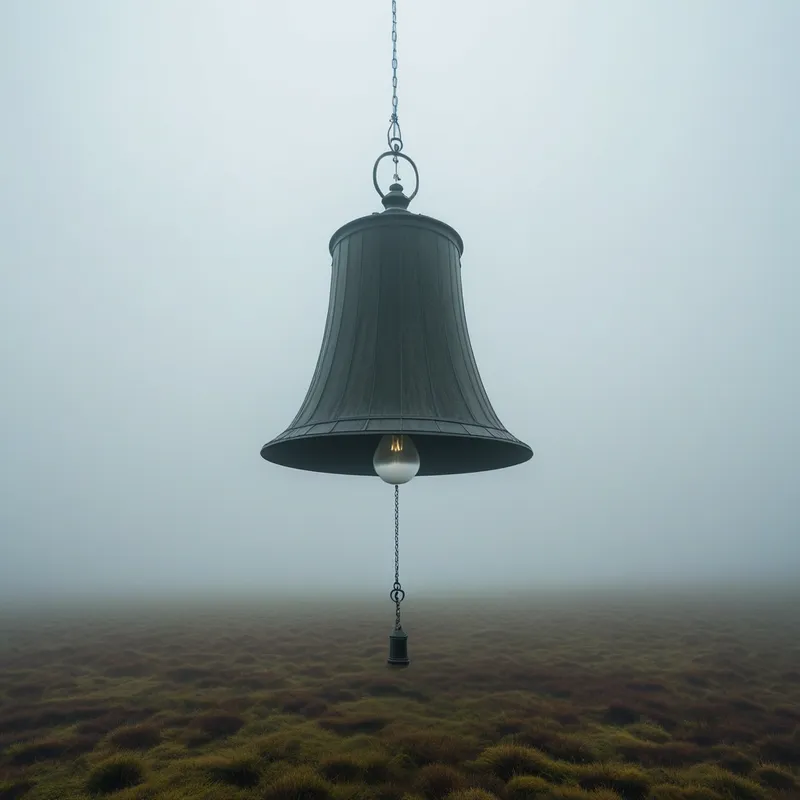
When this myth pattern stirs in the modern collective unconscious and surfaces in dreams, it often manifests during periods of overwhelming confusion or moral/emotional ambiguity. One might dream of being lost in a foggy, silent forest where directions are meaningless, or of a room in their house that is suddenly filled with a thick, dark substance that muffles all sound. The somatic feeling is one of suffocation, paralysis, and dread—the sheer weight of the undefined.
The appearance of a bell, a gong, a single clear chime, or even the dreamer finding their own voice to shout a word in this silence, marks the turning point. This is the psyche initiating its own ordering principle. The dream is not merely a replay of the myth; it is the individual's soul performing the same operation Patrick did. The psychological process is one of differentiation—beginning to separate "me" from the overwhelming "not-me" of the anxiety, to name the formless fear, and thus to begin to have a relationship with it rather than being consumed by it. The relief felt upon hearing the sound in the dream is the relief of nascent consciousness asserting itself against dissolution.
Alchemical Translation
The alchemical journey, or the path of individuation, is precisely the saint's journey into the chaotic glen. The prima materia—the base, confused state of the soul—is the suffocating silence and the formless demon. This is the nigredo, the blackening, the state of despair and confusion that often initiates the transformative work.
The bell's ring is the first operation of the opus: it is separatio. It distinguishes spirit from matter, conscious intention from unconscious content.
Patrick's repetitive ringing is the disciplined practice of the seeker: daily meditation, journaling, active imagination, or ethical reflection. Each act is a strike of the bell, creating a temporary, sacred space of awareness (vas philosophorum, the philosopher's vessel) within the chaos. This is not a one-time exorcism but a lifelong liturgy. The demon (a shadow complex, a deep-seated fear) is not obliterated; it is gradually transmuted. By consistently defining a space of consciousness around it, its energy is converted. The chaotic terror becomes a source of vitality for the now-ordered glen (the integrated psyche). The hanging of the bell on the tree signifies that this ordering principle must become a permanent fixture of the inner life, a touchstone to which one can return when the fog threatens to descend again. The ultimate triumph is not a world without wildness, but a self that can carry a circle of ordered meaning into the heart of the wild, and in doing so, sanctify both.
Associated Symbols
Explore related symbols from the CaleaDream lexicon: