
The Bard's Bothy Myth Meaning & Symbolism
A bard seeks a song in a sacred, silent hut, confronting the void to birth a new music that heals the land and the self.
The Tale of The Bard’s Bothy
Listen. The wind on the moor carries not a song, but a hunger. It was a time when the harp strings of the land had grown slack, when the chieftains’ boasts rang hollow and the laments of mothers had no melody. The old songs were worn thin as last year’s cloak, and a deep silence, colder than the winter loch, settled in the bones of the people.
Into this silence walked Fionn the Bard. His fingers, once nimble on the willow harp, now stumbled. His voice, which had once commanded battles and soothed fevers, was a rasp in his throat. He had sung all the songs he knew, and they were not enough. In despair, he sought the counsel of the Cailleach of the Grey Stones. She did not speak, but pointed a bony finger toward the most desolate part of the moor, where the mist clung like a shroud.
“There,” the wind seemed to whisper with her voice. “Where nothing grows, you must go. In the place of utter silence, you must listen.”
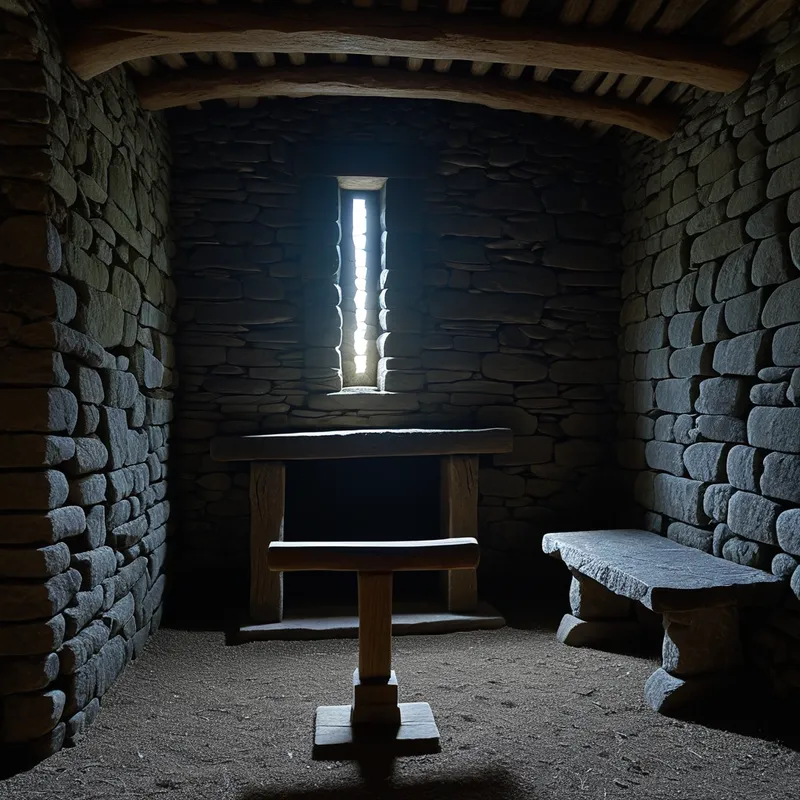
For three days and three nights, Fionn walked, his harp a dead weight on his back. He passed landmarks of forgotten battles and the graves of bards whose names were dust. Finally, in a shallow valley where even the heather dared not bloom, he saw it: a bothy. It was not grand. It was a low, round structure of fitted stone, older than the oldest oak, with a roof of sod and a single, dark doorway that seemed to swallow the weak daylight.
He crossed the threshold. Inside was not darkness, but a profound, palpable stillness. The air was thick with it. There was no hearth-fire, no bed, no carvings—only a smooth stone floor and, in the very center, a single, waist-high pillar of stone inscribed with ogham so ancient the grooves were filled with moss. This was the Bard’s Bothy, the Hollow Hall of Creation. The silence here was not an absence. It was a presence. It pressed against his ears, his chest, the very strings of his harp. It was the silence before the world was sung into being.
Fionn sat. He took his harp, but when he plucked a string, it made no sound. The silence drank it whole. He opened his mouth to sing a known verse, but his breath vanished before it could become tone. Panic, cold and sharp, rose in him. This was not a test of skill, but an annihilation of it. The Bothy demanded not a performance, but a sacrifice. It demanded he offer up his old voice, his known songs, his very identity as a bard.
Days bled into nights. He faced the void within the hut and, more terrifyingly, the void within himself. He saw the vanity of his past praises, the hollow echoes of his lamentations. He starved. He thirsted. He wept soundless tears. In the depth of this despair, as he lay his forehead against the cold ogham stone, he stopped trying to give. He began, helplessly, to receive.
And the Bothy spoke. Not with sound, but with sensation. He felt the slow heartbeat of the land beneath the stone floor. He tasted the memory of rain on the moor’s first dawn. He saw, in the dust motes caught in a stray moonbeam, the dance of the anam of all things. The silence became a vessel, filling with a raw, unformed potential—the music of what is, before it is named.
On the seventh night, with fingers numb and spirit raw, Fionn touched his harp again. He did not play a tune. He simply let his hand fall upon the strings. And a note, pure and clear as ice-melt, shivered into the stillness. It was a note that had never been heard before. Then another, woven from the sigh of the peat and the whisper of starlight. A melody unfolded, not from his memory, but from his marrow. It was the song of the silent moor, the hymn of the empty hut, the lament and joy of the void itself. He sang until the stone pillar glowed with a soft, inner light, and the ogham lines shone like silver.
When he stumbled back into the world, he was gaunt, eyes burning with a new fire. He went to the chieftain’s hall and played. He did not sing of old heroes, but of the heroism of the sprouting seed. He did not lament lost loves, but sang the love that binds root to earth. His music did not entertain; it reconsecrated. Where his notes fell, quarrels stilled, sickness eased, and the people remembered a wholeness they had forgotten. He had been to the Bothy. He had died there as the old bard, and was reborn as a vessel for the world’s own song.
Cultural Origins & Context
The motif of the Bard’s Bothy is not a single, standardized myth from a specific manuscript, but a powerful archetypal fragment woven through the broader tapestry of Celtic lore, particularly the Irish and Scottish Gaelic traditions concerning the fili and bards. These figures were not mere entertainers; they were the living memory, jurists, satirists, and magicians of their people. Their training was famously arduous, involving years of memorization in dark, isolated huts, where they learned the vast corpus of history, law, and genealogy.
The Bothy in this myth symbolizes the ultimate stage of that initiation—the point where learned knowledge ends and inspired wisdom begins. It represents the imbas forosnai, the “illumination that enlightens,” a state of poetic frenzy or vision sought through ritual isolation and sensory deprivation. This practice was a dangerous crossing from the human community into the Sídhe, the realm of the spirits, to retrieve not just a song, but a piece of the world’s truth. The story served a critical societal function: it sacralized the bard’s role, explaining their power as hard-won from the brink of madness and oblivion. It taught that true culture—true healing and order—springs not from repetition, but from a courageous encounter with the formless source.
Symbolic Architecture
At its core, the Bard’s Bothy is a myth of the creative crucible. The Bothy itself is the ultimate symbolic container: the womb, the alchemical vessel, the sealed chamber of the self. It is not a place of comfort, but of essential poverty.
The soul’s most profound music is not found in the noise of accomplishment, but in the terrifying fertility of its own emptiness.
The enforced silence represents the death of the persona—the socially constructed identity of “the bard.” Fionn must relinquish his old tricks, his reputation, his very craft. The silent harp is his ego, rendered useless. The ogham stone pillar is the axis mundi, the world-pillar connecting the human, natural, and divine realms; it is also the immutable, ancestral truth that one can only lean upon when all else is stripped away. The music that finally emerges is not “his” music, but the voice of the collective unconscious or the anima mundi (world soul) speaking through him. He becomes a conduit. The myth beautifully illustrates that authentic creation is always a transpersonal event, a dialogue between the individual consciousness and the great, silent ground of being.
The Dreamer’s Resonance
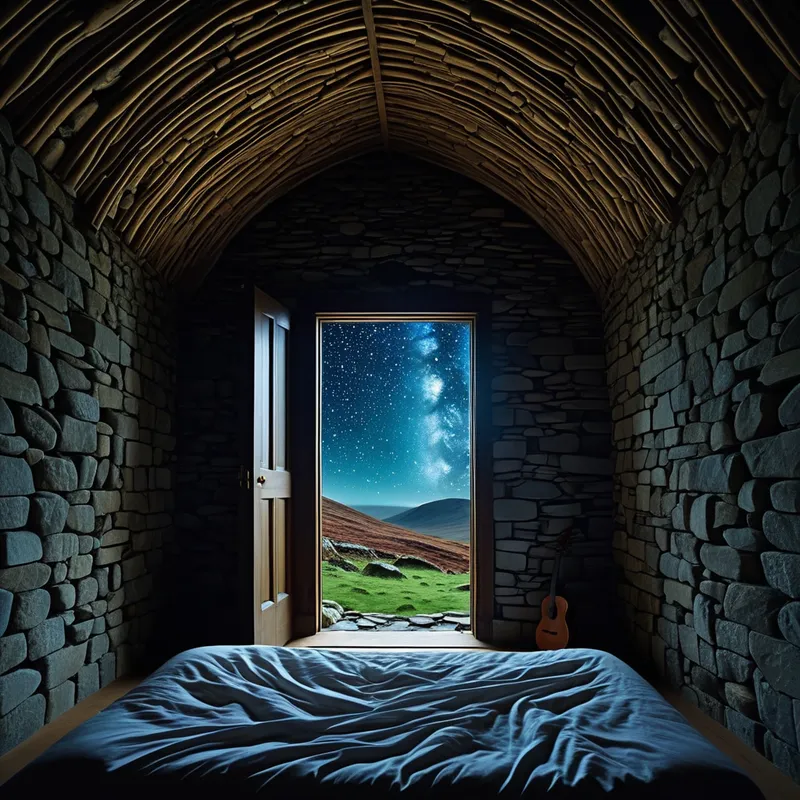
When this myth stirs in the modern psyche, it often manifests in dreams of profound isolation and creative paralysis. One may dream of being in a bare, stone room, unable to speak or make a sound. A crucial tool—a pen that won’t write, a keyboard with dead keys, a musical instrument with broken strings—fails utterly. There is a deep somatic feeling of pressure, of being compressed in a silent vacuum.
These dreams do not signify failure. They signal a necessary, if arduous, phase of psychic gestation. The ego’s familiar methods—our “old songs” of problem-solving, self-narrative, and professional identity—have reached their limit. The psyche is forcing a retreat into the temenos, the sacred enclosure of the Bothy, to dismantle the outdated structures. The dreamer is undergoing a numinous encounter with the void. The anxiety felt is the death-throes of an old adaptation. The dream invites a surrender, a cessation of striving, to allow a more authentic pattern, a “new music” from a deeper source, to coalesce. It is the psyche’s way of initiating a creative or spiritual rebirth by first insisting on the quietude of the grave.
Alchemical Translation
The journey of Fionn is a perfect map of the alchemical opus and the Jungian process of individuation. It begins with the nigredo, the blackening: the despair of the barren land and the bard’s own irrelevance. His journey to the desolate moor is the conscious decision to engage with the shadow, to enter the prima materia of his own unexplored psyche.
The Bothy itself is the alchemical vessel where the mortificatio occurs—the symbolic death. His old identity (the known songs) is dissolved in the acid of silence. This is not destruction for its own sake, but a stripping away to reach the incorruptible core, the lapis or philosopher’s stone represented by the ogham pillar. The long vigil is the albedo, the whitening, a purification through patience and suffering, where opposites (sound/silence, fullness/emptiness) are held in tension.
Individuation is not about becoming a more polished version of who you think you are; it is the terrifying and glorious process of becoming a humble instrument for who you truly are, beyond all thinking.
The emergence of the new song is the rubedo, the reddening, the birth of the conscious personality now aligned with the Self. Fionn returns not just as a better bard, but as a healed and healing force. His new music performs the alchemical goal: it conjuncts the opposites, marrying the deep, silent truth of the unconscious (the land) with the conscious world of community and action (the people). For us, the myth instructs that any genuine transformation—psychological, artistic, or spiritual—requires a voluntary descent into our own “Bothy,” a courageous facing of the inner silence where our borrowed identities fall away, so that the unique, essential melody of our own being can, at last, be heard.
Associated Symbols
Explore related symbols from the CaleaDream lexicon: