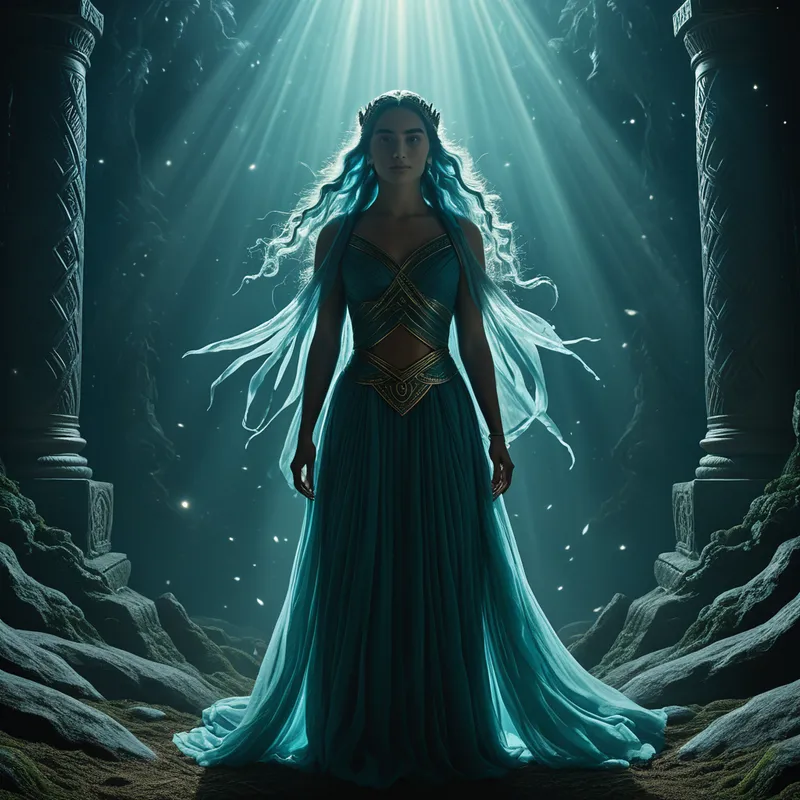
The Ballgame of the Hero Twins
The Hero Twins descend into the underworld to challenge the gods in a deadly ballgame, risking everything to restore cosmic order and achieve immortality.
The Tale of The Ballgame of the Hero Twins
In the deep, silent time before the first dawn, [the world](/myths/the-world “Myth from Tarot culture.”/) was out of joint. [The lords of Xibalba](/myths/the-lords-of-xibalba “Myth from Mesoamerican culture.”/), the Place of Fright, held sway, their laughter a cold echo in the halls of the living. They had claimed the fathers, the first heroes Hun [Hunahpu](/myths/hunahpu “Myth from Mayan culture.”/) and Vucub Hunahpu, defeating them in their [ballcourt](/myths/ballcourt “Myth from Mesoamerican culture.”/) and hanging the head of Hun [Hunahpu](/myths/hunahpu “Myth from Mayan culture.”/) in a barren tree. From that head spat into the hand of a maiden of Xibalba, the spark of the next generation was kindled: [Hunahpu and Xbalanque](/myths/hunahpu-and-xbalanque “Myth from Mesoamerican culture.”/), the Hero Twins.
Raised in the hidden world above by their grandmother, the boys grew not knowing their destiny, yet marked by it. They were the essence of duality itself: Hunahpu, the solar principle, associated with the blowgun and the hunt; Xbalanque, the lunar and earthly, linked to the jaguar and hidden wisdom. Their play was [the ballgame](/myths/the-ballgame “Myth from Mesoamerican culture.”/), their laughter a defiance of the stillness that had fallen. And the lords below heard that laughter, that bouncing of the rubber ball, and their ancient anger stirred. They sent summons, not as invitation, but as a trap, a challenge to the deadly ballgame in the heart of their realm.
The Twins, knowing the fate of their fathers, did not go in ignorance. They accepted the call, but with a cunning that was their true armor. Their descent into Xibalba was a journey through the layers of the [psyche](/myths/psyche “Myth from Greek culture.”/), each test a confrontation with a facet of fear and dissolution. They faced the Dark House, the Razor House, the Cold House, the Jaguar House, and the Fire House—not with brute force, but with wit, magic, and mutual support. Where one might fail, the other provided the key. They tricked the lords by substituting a substitute for themselves in the first sacrificial oven, emerging whole from the ashes, transformed.
Finally, they stood in the great ballcourt of Xibalba, a sunken court of stone that was the axis of the world. The ball was the skull of their father, the playing field the liminal space between life and [death](/myths/death “Myth from Tarot culture.”/), order and [chaos](/myths/chaos “Myth from Greek culture.”/). This was no sport. It was a ritual combat for the fate of creation. The lords, One [Death](/myths/death “Myth from Tarot culture.”/) and Seven Death, played with malice and supernatural power. The Twins allowed themselves to be defeated, to be dismembered, their bones ground and cast into [the river](/myths/the-river “Myth from Buddhist culture.”/). This was the ultimate sacrifice, the total surrender to the process of [death](/myths/death “Myth from Tarot culture.”/).
But from those scattered bones, from the waters of dissolution, they were reborn—first as catfish, then as ragged beggars, and finally as miraculous dancers who could kill and restore life. In this new, humble guise, they performed for the arrogant lords of Xibalba, sacrificing a dog and bringing it back, then sacrificing each other and returning whole. Captivated by this power over the ultimate boundary, the lords demanded, “Do it to us! Sacrifice us!” And so, the Twins obliged. They sacrificed the lords of Xibalba but did not restore them to life. The tyranny of meaningless death was broken.
Having conquered [the underworld](/myths/the-underworld “Myth from Greek culture.”/), the Twins ascended not to rule, but to complete the cosmic order. They rose into [the sky](/myths/the-sky “Myth from Persian culture.”/), one becoming the sun, the other the full moon, eternal players in the celestial ballcourt, lighting the world they had redeemed. Their final act was to retrieve the buried bones of their father, Hun Hunahpu, and raise him to dwell among the heavenly bodies, establishing the cycle of death and regeneration for all who would come after.
Cultural Origins & Context
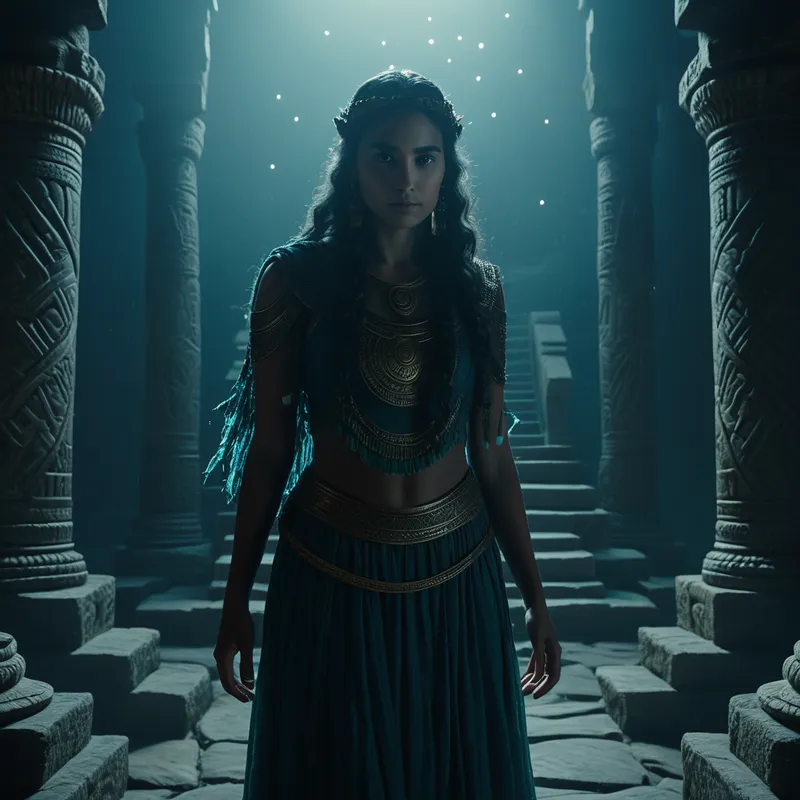
The myth of the Hero Twins is the central narrative of the Popol Vuh, a post-conquest text transcribed in the 16th [century](/myths/century “Myth from Biblical culture.”/) but preserving Pre-Columbian K’iche’ Maya cosmology. The ballgame itself, known as pitz or ollamaliztli across Mesoamerica, was far more than recreation. It was a profound ritual reenactment of cosmic struggle, often linked to warfare, divination, and fertility. The ballcourt (tlachtli) was a symbolic portal to the [underworld](/myths/underworld “Myth from Greek culture.”/), its I-shaped alley representing the three realms of cosmos (Heaven, Earth, Xibalba), with the movement of the solid rubber ball (olli) mirroring the perilous journey of the sun or of heroic souls.
The Twins’ story is deeply embedded in agricultural and astronomical cycles. Their defeat of the “false” sun and moon gods (Seven Macaw and his sons) before their descent, and their ultimate apotheosis as sun and moon, directly tie the myth to the solar year and lunar phases. Their trials in Xibalba reflect the perilous journey of the maize seed into [the earth](/myths/the-earth “Myth from Hindu culture.”/) (the underworld), its “death,” and its triumphant rebirth as the sustaining stalk. They are the archetypal maize gods, and their victory ensures the continuation of life, rain, and the ordered seasons against the threat of chaotic, sterile darkness.
Symbolic Architecture
The myth is built upon a lattice of profound dualities that resolve into a transcendent unity. Hunahpu and Xbalanque are not opposites but complementary halves: day and [night](/symbols/night “Symbol: Night often symbolizes the unconscious, mystery, and the unknown, representing the realm of dreams and intuition.”/), sun and [moon](/symbols/moon “Symbol: The Moon symbolizes intuition, emotional depth, and the cyclical nature of life, often reflecting the inner self and subconscious desires.”/), [action](/symbols/action “Symbol: Action in dreams represents the drive for agency, motivation, and the ability to take control of situations in waking life.”/) and [strategy](/symbols/strategy “Symbol: A plan of action designed to achieve a long-term or overall aim, often involving competition, resource management, and foresight.”/), the [blowgun](/symbols/blowgun “Symbol: A silent, precise hunting tool using breath to project projectiles, symbolizing focused intention, stealth, and indirect confrontation.”/)’s straight [path](/symbols/path “Symbol: The ‘path’ symbolizes a journey, choices, and the direction one’s life is taking, often representing individual growth and exploration.”/) and the [jaguar](/symbols/jaguar “Symbol: The jaguar symbolizes strength, power, and stealth, often associated with transformation and the spiritual journey.”/)’s coiled power. Their success depends on their inseparable partnership; alone, they would have perished like their fathers.
The ballgame is the alchemical vessel where opposites collide and are transmuted. The hard rubber ball, bouncing between life and death, is the unstable prima materia. The players’ limbs, striking it, are the forces of conflict necessary for transformation.
Their [journey](/symbols/journey “Symbol: A journey in dreams typically signifies adventure, growth, or a significant life transition.”/) is the ultimate [blueprint](/symbols/blueprint “Symbol: A blueprint represents the foundational plan or design for something, often symbolizing potential, structure, and the mapping of one’s inner self or future.”/) of [initiation](/symbols/initiation “Symbol: A symbolic beginning or transition into a new phase, status, or awareness, often involving tests, rituals, or profound personal change.”/). The descent into Xibalba is the nekyia, the night-sea [journey](/symbols/journey “Symbol: A journey in dreams typically signifies adventure, growth, or a significant life transition.”/) into the unconscious. The specialized houses are ordeals that purify and break down the initiate’s old self. The voluntary dismemberment is the symbolic [death](/symbols/death “Symbol: Symbolizes transformation, endings, and new beginnings; often associated with fear of the unknown.”/), the total surrender of ego. The [rebirth](/symbols/rebirth “Symbol: A profound transformation where old aspects of self or life die, making way for new beginnings, growth, and renewal.”/) from the [river](/symbols/river “Symbol: A river often symbolizes the flow of emotions, the passage of time, and life’s journey, reflecting transitions and movement in one’s life.”/), first as lowly fish, illustrates the new [life](/symbols/life “Symbol: The symbol of ‘Life’ represents a journey of growth, interconnectedness, and existential meaning, encompassing both the joys and challenges that define human experience.”/) emerging from the waters of the [collective unconscious](/symbols/collective-unconscious “Symbol: The Collective Unconscious refers to the part of the unconscious mind shared among beings of the same species, embodying universal experiences and archetypes.”/), humble and fluid before assuming its final glorious form.
The Twins’ greatest weapon is not strength, but the capacity for strategic defeat. By allowing themselves to be killed and ground to bone, they perform the ultimate sacrifice—not of an other, but of the self. In doing so, they rob death of its finality and absorb its power, turning the lords’ own principle against them.
The Dreamer’s Resonance
To dream of this myth is to encounter the psyche’s call to confront its own Xibalba—the repressed, shadowy realms of fear, shame, and unresolved grief (the “lords” who send summons). The Twins represent the dreaming ego’s potential for resourcefulness and resilience when faced with inner disintegration. A dream of a ballgame may signal a critical inner conflict where the outcome feels cosmically significant, a playing out of opposing life forces.
The figure of the Twin speaks to the dreamer’s experience of a hidden ally or an unrecognized aspect of [the self](/myths/the-self “Myth from Jungian culture.”/) that emerges in crisis. The ordeal houses translate into dreams of terrifying landscapes—bladed rooms, freezing voids, predatory animals—that are not mere nightmares but initiatory thresholds. To pass through them, as the Twins did, requires not fighting the fear directly, but outwitting it with symbolic intelligence: finding the warmth in cold, the whole in the broken. The myth assures the dreamer that the most horrifying defeat, the experience of being psychologically “dismembered,” may be the necessary precursor to a more authentic and integrated rebirth.
Alchemical Translation
In the alchemical opus, the myth maps perfectly onto the stages of transformation. The Twins’ initial state is the [nigredo](/myths/nigredo “Myth from Alchemical culture.”/), the blackening: the legacy of the slain fathers, [the shadow](/myths/the-shadow “Myth from Jungian culture.”/) of unresolved fate. Their descent is the dissolution ([solutio](/myths/solutio “Myth from Alchemical culture.”/)) into the chaotic waters of the underworld. The ballgame itself is the fierce [coniunctio](/myths/coniunctio “Myth from Alchemical culture.”/), [the sacred marriage](/myths/the-sacred-marriage “Myth from Various culture.”/) and battle of opposites (sun/moon, life/death) within the sealed vessel of the court.
The grinding of their bones is the mortificatio and putrefactio, the reduction of the psychic material to its bare, essential matter—the prima materia stripped of all illusion. The river that carries these bones is the ablutio, the washing.
Their resurrection as fish signifies the [albedo](/myths/albedo “Myth from Alchemical culture.”/), the whitening—the first emergence of the silver, lunar consciousness from the depths. Their final transformations, through the disguises and the dance of sacrifice, represent the citrinitas (yellowing) and ultimate [rubedo](/myths/rubedo “Myth from Alchemical culture.”/) (reddening), the creation of the philosophical gold: [the immortal](/myths/the-immortal “Myth from Taoist culture.”/), transcendent Self that has integrated and mastered the power of life and death. They ascend not as they descended; they are the completed [lapis philosophorum](/myths/lapis-philosophorum “Myth from Alchemical culture.”/), the sun and moon now eternally in harmonious orbit.
Associated Symbols
Explore related symbols from the CaleaDream lexicon:
- Hero — The archetypal figure who ventures into the unknown to confront a profound disorder, often sacrificing the personal self for the renewal of the collective whole.
- Sacrifice — The ritualized offering, often of something precious, to a higher principle or power, intended to enact transformation, restore balance, or forge a sacred connection.
- Rebirth — The emergence of a new, more conscious form of life from a state of dissolution, decay, or symbolic death, completing a cycle of renewal.
- Duality — The fundamental pairing of complementary or opposing forces whose tension and eventual reconciliation generate dynamic existence and meaning.
- Journey — A purposeful movement through symbolic landscapes, representing the process of psychological development, initiation, or the quest for wholeness.
- Death — Not merely an end, but a transformative threshold, a necessary phase of dissolution that makes way for reorganization and new life.
- Game — A structured, ritualized contest with symbolic stakes, representing the play of cosmic forces, fate, and the testing of skill and character within defined limits.
- Twin — An embodiment of duality, partnership, and [the mirror](/myths/the-mirror “Myth from Various culture.”/)-self; representing complementary aspects of a single psyche or the mysterious bond of shared destiny.
- Ball — A perfect, resilient sphere set in motion, symbolizing the cosmos, the sun, the skull of ancestors, or the volatile substance of fate bouncing between opposing forces.
- Ritual — A prescribed, symbolic action performed to align human activity with cosmic order, to mediate between realms, or to enact inner transformation through outward form.
- Trickster — A boundary-crossing, shape-shifting figure who uses cunning and subversion to overturn rigid order, expose hypocrisy, and enable renewal through chaos.
- Shadow — The hidden, rejected, or unconscious aspects of the self or the world, which must be confronted and integrated to achieve wholeness.