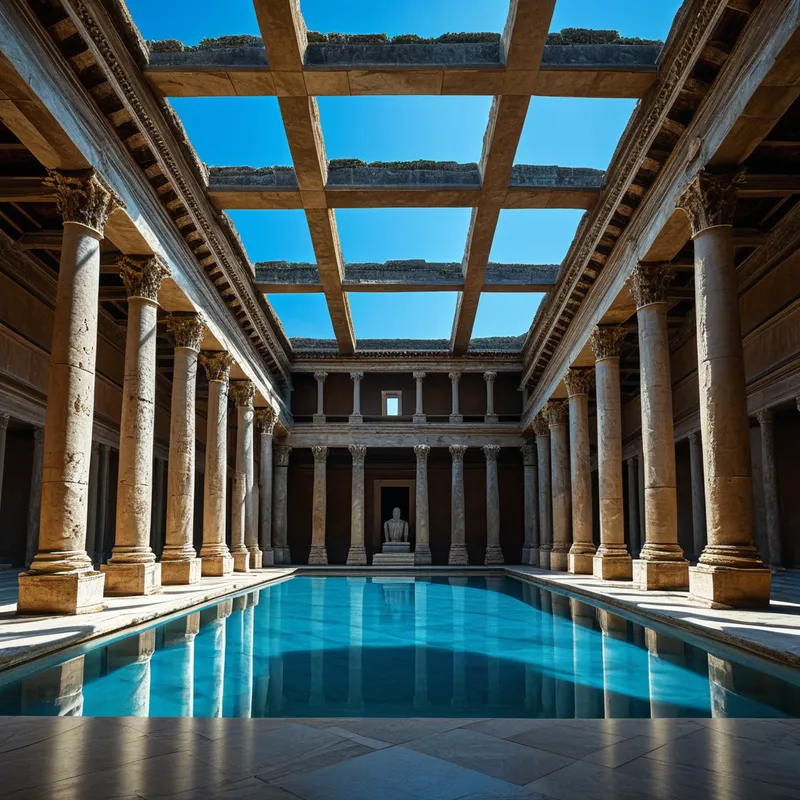
The Atrium of the Roman Domus Myth Meaning & Symbolism
The story of the sacred threshold, where the household's soul meets the world, guarded by ancestors and the divine breath of the hearth.
The Tale of The Atrium of the Roman Domus
Hear now the story not of a hero on a distant plain, but of the sacred space where the world was made and unmade each day. It is the tale of the Atrium.
Before the first cockcrow, when the world is hushed and grey, the great wooden door—the ianua—groans on its hinges. It is not the master who opens it, but the silent, watchful spirit of the threshold itself. The cold air of the via rushes in, a breath from the world of commerce, politics, and strangers. It swirls across the mosaic floor, tasting of dust and distant journeys. But it does not travel far.
For it meets the Heart.
At the center of the Atrium, open to the sky, lies the impluvium. It is a square of captured heaven, a pool of stillness. As dawn breaks, the first spear of light, Dies himself, strikes the water. The light shatters into a thousand liquid diamonds, throwing dancing reflections onto the surrounding walls. These walls are not empty. In niches, the faces of ancestors—the imagines maiorum—watch with painted eyes. They are silent judges, a chorus of memory.
Now comes the materfamilias. Her steps are soft on the stone. She carries a small clay lamp and a vial of wine. She approaches the lararium, a sacred niche where the little statues of the Lares stand guard. Her breath mingles with the scent of last night’s embers from the hearth. She pours the wine, a dark libation, whispering names—not of great gods on Olympus, but of this hearth, this storehouse, this line of blood and bone.
The conflict is eternal and quiet. It is the struggle between the raw, unformed chaos of the outside—the via, with its promises and perils—and the delicate, cultivated order within. The Atrium is the battleground. The rising sun is the ally, purifying the space. The rainwater in the impluvium is the prize, gathered from the sky-god Jupiter himself, now held in domestic trust.
The resolution comes not with a clash of swords, but with a sigh of settled peace. As the day brightens, clients begin to arrive, standing respectfully in the Atrium to greet the patron. They stand in the space sanctified by the ancestors and the morning rite. The outside has been invited in, but on the domus’s terms. It has been filtered through light, blessed by memory, and cooled by the sacred pool. The world enters, but it must first cross the threshold of the soul.

Cultural Origins & Context
This was no myth recited in grand temples, but a living ritual performed daily in thousands of homes across the Roman world. Its “storytellers” were every paterfamilias and materfamilias. The Atrium was the architectural and spiritual core of the familia. Its function was societal and profound: it was the stage for the salutatio, the display of ancestral prestige, and the center of domestic cult.
The mythologizing of this space was implicit in its very use. The impluvium was a direct contract with the divine—capturing the celestial water of Jupiter. The lararium housed the Lares, spirits of the land and lineage. The imagines made the past a visible participant in the present. Thus, the myth was passed down not in verse, but in stone, ritual, and daily practice. It taught every Roman their place in a continuum—between the gods above, the ancestors behind, and the social world at the door.
Symbolic Architecture
Psychologically, the Atrium is a master symbol of the conscious self—the “I” that stands at the intersection of multiple worlds.
The atrium is the psyche’s reception hall, where the outer world of persona meets the inner sanctum of the soul, mediated by the still pool of reflection.
The open roof (compluvium) represents openness to the transcendent, to light, inspiration, and the “higher” functions of consciousness. The impluvium is the reflective capacity of the ego, the ability to receive, contain, and clarify what comes from above. It is the tool of introspection. The surrounding walls, with their ancestral masks, symbolize the personal and collective unconscious—the stored memory, tradition, and genetic inheritance that shape identity. The ianua is the threshold of perception, the sensory gate through which reality enters.
The entire structure models a healthy ego-function: it is permeable but not passive. It filters, sanctifies, and integrates external pressures (clients, duties, society) through the stabilizing presence of internal values (ancestors, household gods, personal ritual).
The Dreamer’s Resonance
To dream of a Roman Atrium is to dream of one’s own psychological center in a state of negotiation or revelation.
If the dream-atrium is bright, clean, and the impluvium holds clear water, it suggests a conscious self that is successfully mediating between inner truth and outer demands. There is a sense of dignified self-possession. More commonly, the dream reveals disturbance. A cracked or empty impluvium speaks to a loss of reflective capacity, a drought of self-understanding. Ancestral busts turned to the wall or covered in dust indicate a disconnection from one’s history or a repressed inheritance causing silent pressure.
The somatic feeling is often one of being “on display” yet also “at home.” The dreamer may feel watched by the ancestors (the super-ego or internalized familial expectations) while trying to manage the crowd at the door (life’s responsibilities). Such a dream prompts a crucial question: What rites have been neglected at the center of my being? What needs to be acknowledged, honored, or cleansed at my personal hearth?
Alchemical Translation
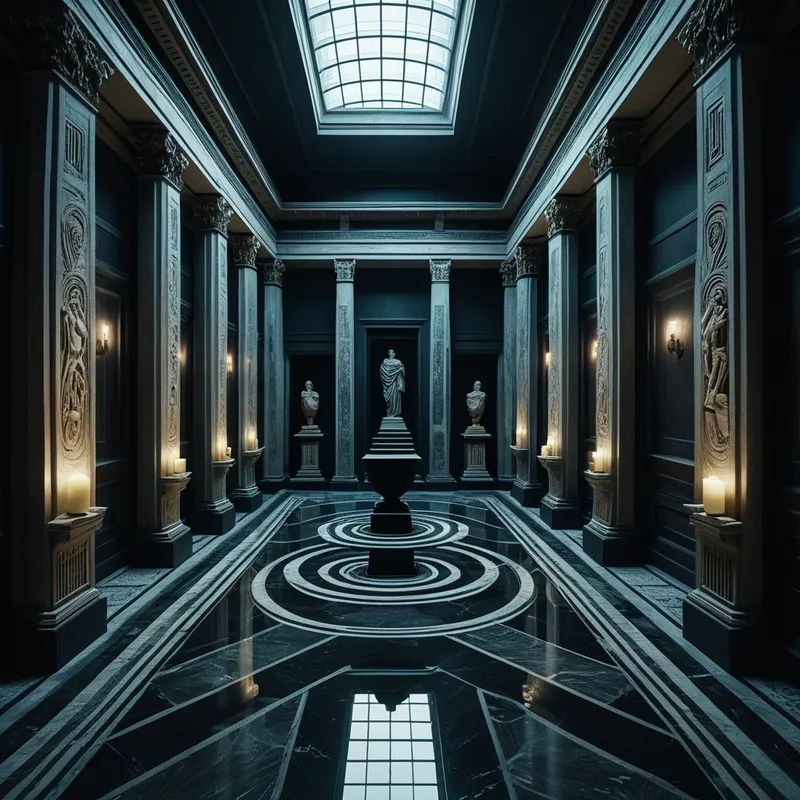
The alchemical process mirrored in the Atrium myth is that of coagulatio—the making solid, the creation of a sacred, bounded vessel for the spirit. Individuation is not about fleeing the world, but about building a competent, sacred center from which to engage it.
The work is not to escape the via, but to build an atrium so strong and true that the via must transform as it crosses the threshold.
The first operation is Apertura (Opening the Compluvium): Making oneself receptive to the light of awareness, to insight, and to the nourishing rain of the unconscious. This requires vulnerability—opening the roof of one’s defenses.
The second is Receptio (Filling the Impluvium): The conscious gathering and containing of what flows in. This is the discipline of reflection, of holding emotional and psychic content without immediate spillage or reaction. The water must be allowed to settle so it may become clear.
The third is Consecratio (Tending the Lararium): The daily, often humble, rituals of self-honoring. Honoring one’s personal “gods”—one’s core values, creative spirit, and bodily temple. It is the libation poured to the unique spark of one’s own life.
The final, ongoing process is Mediatio (Guarding the Ianua): Developing the discernment of the threshold. Learning what to admit into the sanctum of the self, what to transform through reflection, and what must respectfully remain outside. The integrated self, like the Atrium, becomes a transformative chamber where the lead of external pressure is transmuted into the gold of authentic, grounded being. The ancestors are not overthrown, but integrated; the world is not refused, but met with conscious sovereignty.
Associated Symbols
Explore related symbols from the CaleaDream lexicon: