The Athenian Ecclesia Myth Meaning & Symbolism
The myth of how the divine council of Athens was forged, where mortal voices were woven into the cosmic order by the goddess of wisdom.
The Tale of The Athenian Ecclesia
Listen, and hear the tale not of a single hero, but of a chorus. It begins in the smoky aftermath of the first kings, when the stones of the Acropolis still remembered the tread of giants and the air crackled with the unspoken potential of a people.
The city, cradled by the Attic hills, was a body with many limbs but no single mind. From the potter's quarter rose the clamor of trade, from the farmsteads the grumble of toil, from the warrior halls the clang of ambition. A cacophony of wants, a discord that threatened to unravel the very Dike that held the world together. The people gathered in the agora, yes, but their gathering was like storm waves crashing—loud, directionless, eroding the shore of their common life.
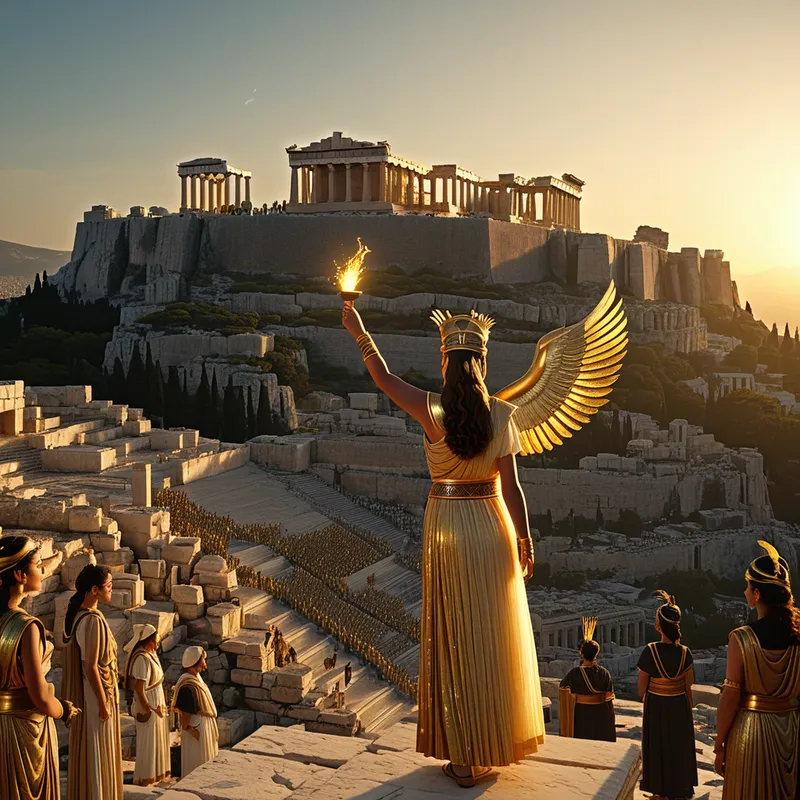
It was then that the owl-eyed daughter of Zeus descended. Athena did not come with thunder, but with a profound silence that settled over the crowd like a mantle. She stood upon the Bema, the speaker's stone, her grey eyes seeing not a mob, but the intricate tapestry of a polis waiting to be woven. In her hand, she held not a spear, but a single, unbroken thread spun from the same stuff as the Moirai's loom.
"Your voice is your sovereignty," she declared, her words measured and clear, cutting through the anxiety. "But a voice alone is wind. A chorus of voices, bound by purpose, is the foundation of a city that can touch the heavens."
She called forth not the strongest, nor the richest, but the first willing citizen. A farmer, his hands etched with earth, stepped forward, fear and awe warring in his heart. Athena took his rough hand and placed the end of the golden thread upon his palm. "Speak your need," she instructed. He spoke of water for his fields, his voice a tremulous thread that leapt from his lips and fused with the divine strand, glowing with a soft, steady light.
Then a craftswoman came, speaking of fair measures in the market. Her voice-thread joined the first, intertwining. A elder spoke of the wisdom of ancestors; a youth, of the hope for tomorrow. One by one, the people of Athens approached. With each utterance—be it grievance, proposal, or prayer—a unique thread of sound and intent was drawn from their very psyche and woven by Athena's guiding will into a growing, luminous cord.
The process was not easy. Some threads were knotted with anger, others frayed with fear. Arguments sparked like flint, threatening to snap the weave. Yet Athena, with the patience of a master weaver, did not suppress the discord. Instead, she showed them how to lay their conflicting threads side-by-side, to be held in tension within the greater pattern. The cord became a complex, living braid—a physical manifestation of the koinon.
When the last citizen had added their voice, Athena lifted the magnificent, pulsating braid high. It did not hang limp, but arched upward of its own accord, forming a perfect, resonant circle above the agora. Where the ends met, they fused with a sound like a great bronze shield being struck—a deep, clear note that vibrated in the bones of the earth and the soul of every listener. This was the birth-cry of the Ecclesia. The circle was both boundary and conduit, a sacred space where the mortal logos (speech/reason) was henceforth wedded to divine Themis (order). The people, once a cacophony, now sat within the embrace of their own collective voice, understood for the first time as a single, sovereign body.
Cultural Origins & Context
The myth of the Athenian Ecclesia is not found in a single epic like the Iliad, but is the foundational story woven into the very ritual and identity of classical Athenian democracy. It was a "charter myth," performed and recalled every time the herald's cry—"Who wishes to speak?"—rang out across the Pnyx. It was told by fathers to sons, by orators to the people, not as a distant legend but as a sacred precedent.
Its societal function was paramount: to sacralize the radical, fragile experiment of collective self-rule. In a world where power was traditionally seen as descending from the gods to kings (the basileus), this myth asserted that legitimate authority could ascend from the woven voices of the citizenry, under the aegis of Wisdom herself. It transformed the practical necessity of public debate into a holy rite, a re-enactment of Athena's original weaving. The myth served as both inspiration and warning: the divine gift of the Ecclesia was conditional upon the citizens' ability to weave their logos with responsibility, lest the golden braid unravel back into chaotic threads.
Symbolic Architecture
At its core, the myth symbolizes the terrifying and magnificent leap from the unconscious, undifferentiated collective (the mob) to the conscious, differentiated collective (the polity). The golden thread is the individual's authentic voice and lived experience—their daimon, or unique spirit.
The individual voice is a thread; the collective good is the loom. Neither has meaning without the other.
The agora represents the temenos, the sacred temenos or container, where chaotic psychic energy can be safely brought into form. Athena is the archetypal principle of conscious ordering—not a ruler who dictates, but the psychopomp who guides the process of self-organization. Her act of weaving is the application of nous (intellect) and metis (cunning wisdom) to raw human material.
The culminating circle, the Ecclesia, is the symbol of wholeness and sovereignty. It represents a psyche that has successfully integrated its myriad conflicting parts—the inner farmer, artisan, elder, and youth—into a self-governing council. The circle has no head, no single ruler; authority is distributed throughout its circumference, modeling the psychological state where the ego is not a tyrant, but the primus inter pares (first among equals) of the inner community.
The Dreamer's Resonance
To dream of the Athenian Ecclesia is to dream of one's own inner assembly coming to order. The dreamer may find themselves in a vast, empty council chamber, or standing mute before a crowd of their own internal figures. The somatic feeling is often one of pressure in the chest or throat—the voice struggling to be born.
This dream pattern emerges when the individual is at a life threshold requiring a profound personal decision or the integration of conflicting identities (e.g., parent vs. professional, tradition vs. innovation, self-care vs. duty). The ghostly, thread-emitting figures in the dream are the dreamer's own sub-personalities, each holding a piece of truth, waiting to be heard and woven into a coherent life-narrative. The dream signals a process of moving from inner cacophony—anxiety, indecision, self-contradiction—toward the difficult, sacred work of listening to one's full self and forging a personal "law" from the synthesis.
Alchemical Translation
The alchemical journey modeled here is the transmutation of the collective shadow into civic gold. The prima materia is the raw, often shadowy stuff of individual desire, fear, and ambition—the leaden threads of the unexamined life.
The goal of individuation is not to silence the inner debate, but to convene it with reverence, transforming conflict into the tensile strength of the self.
The athanor (vessel) is the sacred space of conscious attention—the "Athenian" capacity for self-reflection and reasoned discourse with oneself. Athena's role is performed by the emerging Self, which mediates between opposites. The conjunctio oppositorum (union of opposites) is achieved not by erasing difference, but by the intricate, patient work of "weaving"—holding tensions, finding the pattern that contains them.
The final aurum philosophicum (philosophical gold) is not perfection, but isonomia—inner democracy. It is the achieved state where all parts of the psyche have isegoria (equal right to speak) and are governed by self-authored, compassionate law. The individual becomes the sovereign of their own inner city, capable of action that is not impulsive nor tyrannical, but deliberate, cohesive, and aligned with their deepest wisdom. They no longer have an internal conflict; they are the Ecclesia in which it is perpetually, productively reconciled.
Associated Symbols
Explore related symbols from the CaleaDream lexicon: